


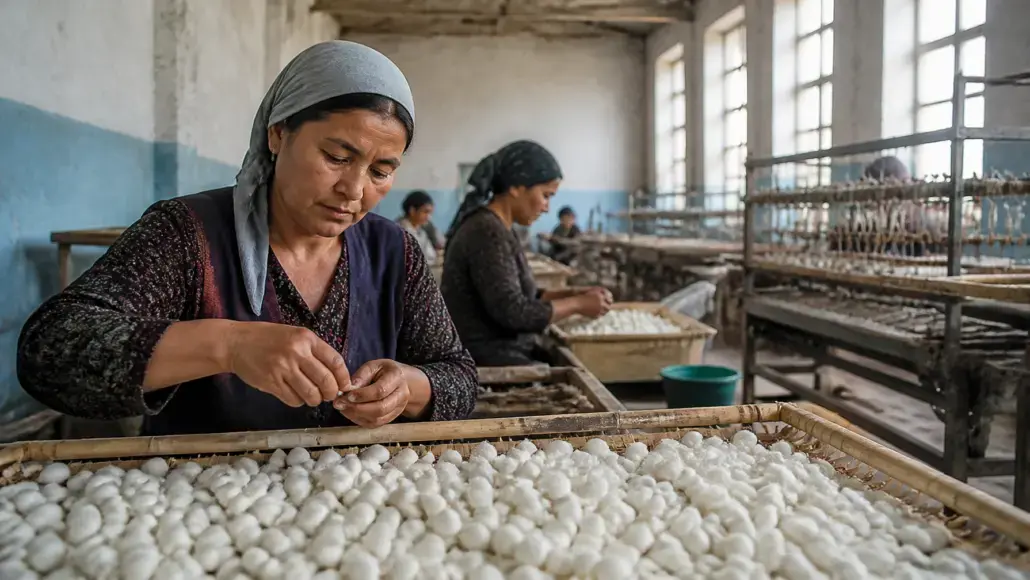
A new report by Uzbek Forum has exposed a deeply entrenched system of forced labor and state-imposed coercion within Uzbekistan’s silk sector — raising urgent questions about the country’s international trade standing and its ambitions to expand one of its most strategically important industries.
Uzbekistan is the world’s third-largest producer of silkworm cocoons, trailing only China and India. With silk exports reaching $87 million in 2025, primarily destined for Vietnam, South Korea, China, Türkiye, and India, the sector holds significant economic weight for the country. However, the findings of Uzbek Forum’s latest research suggest that much of this output is built on a foundation of exploitation.
Three Years of Research, 85 Interviews, Five Regions
The report, titled “It is Impossible to Refuse.” – State-Imposed Forced Labor and Exploitation in Uzbekistan’s Silk Sector, draws on three years of field research conducted across 21 districts in five regions of Uzbekistan and the Republic of Karakalpakstan. Uzbek Forum conducted 85 interviews with farmers, home-based producers, and representatives of silk-producing companies, while also reviewing official documents governing the sector and hundreds of social media posts from silkworm producers.
The depth and breadth of this research paints a troubling picture of how cocoon production quotas are enforced in practice.
What the Report Found
The report’s findings point to a layered system of coercion operating across the sector.
Local government officials have been found to force farmers into signing production contracts with silk processing enterprises, commonly known as clusters. Threats of land lease termination, harassment, and in some cases violence are used to ensure that state-mandated cocoon production quotas are fulfilled. These are not isolated incidents but appear to be part of a wider structural practice.
Contracts signed by farmers and home-based producers frequently omit pricing details entirely. In many cases, copies of these coercive contracts are withheld by officials, reportedly under the pretext of official registration — leaving producers with no documented proof of agreed terms.
Economic hardship runs deep across the supply chain. Producers who fulfill mandatory quotas often receive little to no payment, making the labor-intensive work of silkworm cultivation economically unviable by any reasonable measure.
The issue of land access is also central to this system of forced labor. Home-based producers are compelled to both cultivate cocoons and maintain mulberry trees as a condition for accessing agricultural and grazing land. Those who fail to comply face eviction or lease cancellation — a pressure mechanism that effectively removes any element of voluntary participation.
A Privatised Sector Still Under State Control
Despite the privatisation of Uzbekistan’s silk sector in 2017, the central government continues to set production quotas and approve purchase prices. This arrangement creates direct administrative incentives for regional officials to extract forced labor from cocoon producers, sustaining the same coercive dynamics that existed before privatisation.
Export Ambitions at Risk
The Uzbek government has identified silk production as a key strategic sector and intends to significantly expand it. Yet this ambition sits in direct tension with growing international regulatory pressure. An increasing number of countries — including the United States and members of the European Union — are introducing legislation designed to prohibit imports of goods made with forced labor. By continuing to rely on coercive cocoon production quotas, Uzbekistan risks undermining its own export potential at a time when global buyers are facing stronger compliance obligations than ever before.
A Call for Reform
Umida Niyazova, director and founder of Uzbek Forum, pointed to the country’s own recent history as evidence that reform is achievable. She noted that the Uzbek government had successfully followed through on its commitment to abolish state-imposed forced labor of cotton pickers in 2021, and called on authorities to now extend those same reforms to the silk sector — specifically by abolishing mandatory quotas and the administrative control mechanisms that guarantee private silk companies a steady supply of cheap silk cocoons at the expense of producers.
Uzbek Forum is urging the government of Uzbekistan to take three concrete steps: to end the use of forced labor and abolish the imposition of cocoon production quotas on farmers; to establish land tenure security for both farmers and home-based cocoon producers; and to require silk enterprises to create conditions that ensure decent work and fair pay for all those involved in production.
The findings of this report place Uzbekistan’s silk industry under significant scrutiny — and underscore that addressing Uzbekistan silk forced labor is not only a matter of human rights, but also an economic and trade imperative for the country’s future.

