


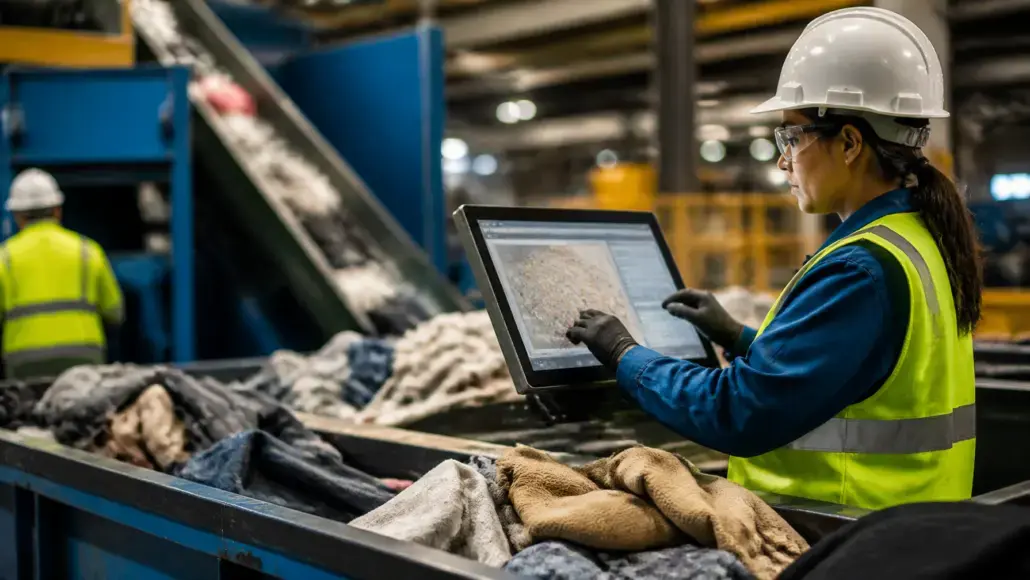
The Secondary Materials and Recycled Textiles Association (SMART) held its annual conference last month in Montréal, Québec, bringing together industry stakeholders focused on textile reuse, textile recycling, secondary materials, and the circular economy. The event featured a keynote address by Oliver Ardery, CEO of Applied Industrials — an artificial intelligence startup that builds workflow automation solutions for industrial, manufacturing, and distribution companies.
Ardery’s keynote, titled “SMART AI Adoption: Front- and Back-Office Automation,” offered practical implementation frameworks alongside a live demonstration of AI tools designed specifically for textile recyclers, processors, and exporters. Following the conference, Ardery sat down to discuss agentic AI’s potential within the industry and how it can help address some of the most pressing challenges facing recyclers and other stakeholders today.
The Real Bottleneck Is Not on the Sorting Floor
When asked about the primary technological and operational barriers preventing regional recyclers from adopting AI systems at scale, Ardery was quick to draw a critical distinction.
“My focus isn’t on physical AI — like robotic sorting arms or near-infrared optical scanners — but rather on agentic AI: autonomous software agents that automate front- and back-office workflows,” he explained.
That distinction, he noted, actually reveals the core problem. When operators hear the word “AI,” they tend to picture costly, multi-million-dollar hardware installations on the sorting floor, which creates what Ardery described as “sticker shock and analysis paralysis.” In reality, the most immediate operational bottlenecks for most regional recyclers are sitting inside their email inboxes, spreadsheets, and ERP systems — not on the warehouse floor.
For regional operators, fragmented data and poor workflow mapping remain the greatest barriers to adopting cognitive AI. Most recyclers run lean teams where institutional knowledge exists in people’s heads or is scattered across disconnected PDFs, bills of lading, and lab reports. Applied Industrials addresses this directly by beginning every deployment with an AI use policy and workflow mapping exercise, allowing companies to progress beyond basic chatbots toward genuine operational automation.
Standardizing Quality Control Through AI Workflow Automation
Textile composition varies significantly across brands and fast-fashion production batches, raising serious questions about how AI-driven identification models can help standardize quality control so that secondhand garments and recycled fibers can reach high-value secondary markets.
Ardery explained that while physical sorting — whether through optical sensors or third-party lab testing — is essential, it represents only half of the challenge. To access high-value markets such as chemical recyclers or premium fiber-to-fiber manufacturers, operators must be able to prove material composition and yield consistency on paper with complete accuracy.
This is precisely where cognitive AI and AI workflow automation demonstrate their value. In a workflow built for textile-to-textile recycling, AI agents automatically ingest incoming lab test reports, supplier quotes, and packing lists from multiple feedstock suppliers. The system cross-checks material specifications, flags missing safety or technical data sheets, and tracks weight and yield changes — for instance, catching a seven percent weight variance between what was ordered from a supplier and what arrived after shredding.
By automating that verification and documentation trail, operators can reliably certify their batches for high-value buyers without overwhelming quality teams with manual paperwork.
Return on Investment Without the Heavy Capital Expenditure
One of the most compelling aspects of Applied Industrials’ approach is its return-on-investment timeline compared to traditional physical automation. Heavy optical sorting lines and automated teardown equipment demand significant upfront capital expenditure and carry multi-year payback periods.
Applied Industrials, by contrast, builds cognitive and agentic AI workflows that integrate directly into an operator’s existing ERPs, email systems, and logistics platforms — requiring virtually zero hardware capital expenditure.
Because the focus is on high-volume, repetitive administrative bottlenecks — such as reconciling shipping invoices — operators typically see return on investment within weeks or months rather than years. In one deployment, an AI agent identified that two percent of a client’s shipping billing in 2025 was being incorrectly charged. Freeing skilled finance personnel from manual data review delivers near-immediate payback.
Bridging the Gap Between Digital Compliance and Physical Textile Recycling
Regulations such as the European Union’s Digital Product Passport and California’s SB 707 are creating significant pressure around textile traceability. Ardery described these frameworks as fundamentally “data-orchestration challenges.” Physical sorting capacity means little if operators cannot digitally prove chain of custody, origin, and material composition at every point in the supply chain.
AI agents serve as the connective tissue between physical bales and digital compliance records. Every time a batch of textiles moves — from initial collection to a domestic shredding processor, then onto an ocean carrier, and finally into an EU facility — it generates a trail of purchase orders, bills of lading, certificates of origin, and lab reports.
AI agents continuously read those unstructured documents from emails and portals, extract relevant weight, origin, and material attributes, and assemble a real-time, auditable digital ledger. The result is that regulatory compliance becomes an automatic byproduct of daily operations rather than a separate and resource-intensive burden — a critical development as textile traceability requirements continue to tighten globally.
Connecting Industrial Sorting to Consumer Resale Markets
Beyond fiber recycling, the secondhand clothing resale market depends heavily on accurate pricing and authentication. Ardery identified the greatest synergy between industrial-scale AI sorting and consumer-facing resale platforms as demand-driven sorting and market matching.
Traditionally, post-consumer sorters grade and bale clothing based on broad historical categories, while sales teams spend hours manually identifying buyers, checking import restrictions, and matching inventory to regional demand. As part of the SMART conference, Applied Industrials built AI-driven market intelligence tools for international used-clothing exporters that screen global trade flows and identify vetted wholesale importers down to the city level — whether in Chile, Uganda, or Central America.
By connecting industrial sorting output directly to real-time market demand and pricing intelligence, sorters can dynamically adjust what they allocate toward domestic resale versus specific export grades — bridging the gap between what comes off the sorting belt and what global buyers are actively paying a premium for.
The Next Five to Ten Years: Building the Global Textile Loop
Looking further ahead, Ardery described a fully optimized global textile loop as one that operates with end-to-end digital visibility, driven by the convergence of physical AI and agentic AI. Robotics, optical sorters, and industrial imaging sensors will manage the physical demands on the warehouse floor — sorting fibers and tracking inventory in real time — while agentic AI ensures that the data generated by those systems translates into actionable business decisions within legacy ERP platforms.
As industrial operators invest in more robotics and automated sensing technology, they face an integration challenge: converting raw machine and imaging data into decisions that live-system ERPs can act upon. Applied Industrials is positioning itself as the data orchestration layer between physical robotics and enterprise operations — already building workflows that ingest machine-level data such as X-ray inventory imaging.
Ardery was particular in pointing out that small and mid-market operators — who form the backbone of the SMART membership — do not need to wait a decade or spend millions on robotics to begin. Applied Industrials helps companies build the AI infrastructure around their existing front- and back-office operations now, automating procurement, export compliance, and sales outreach — protecting margins today while constructing the ERP data foundation needed to integrate robotics and navigate the circular economy of tomorrow.
AI in textile recycling, in this vision, is not a distant transformation but an operational reality that regional and mid-market players can begin building toward today — through incremental, software-driven automation that grows alongside their business.