


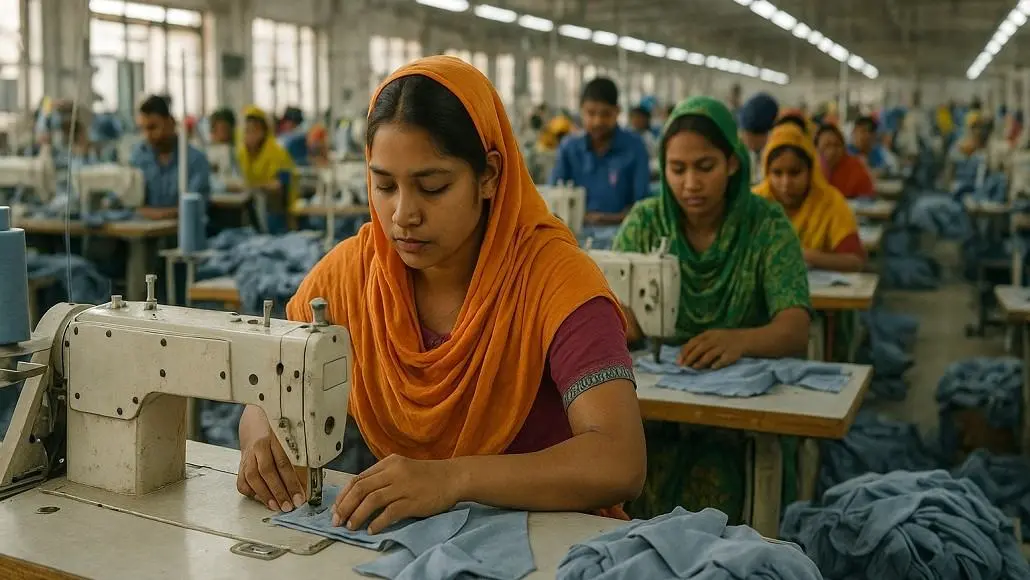
A nationwide wage survey spanning five major industries, including readymade garments, is set to begin data collection next month, according to official documents. The move comes as workers pressing for higher pay continue to stage protests across prominent garment-manufacturing hubs in the country.
Preliminary findings from the Bangladesh wage survey are expected to be available in February next year, confirmed Aziza Rahman, a deputy director at the Bangladesh Bureau of Statistics (BBS) who is coordinating the Wage Survey 2026.
Survey Scope and Methodology
Beyond readymade garments, the survey will also cover textile manufacturing, leather and related products, pharmaceutical manufacturing, and short-term accommodation, including hotels.
The BBS is conducting the wage survey in collaboration with the International Labour Organization (ILO). The exercise will examine pay levels, gender wage gaps, pay increments, and employment patterns across nearly 3,000 private establishments. It aims to estimate average wages across occupations and compare pay by establishment size and ownership type. The sample frame will be drawn from the Economic Census 2024.
The questionnaire will cover employment and salary structures, wage payment practices, working hours, allowances, and employee benefits. It will also gather information on individual establishments, including their ownership and registration status, research and development activities, and training facilities.
The Bangladesh wage survey will follow the Bangladesh Standard Classification of Occupations 2020 and the Bangladesh Standard Industrial Classification 2020 to ensure findings are comparable with international standards.
Additionally, the survey will examine the educational qualifications required for different occupations, wage increments, and employment patterns, including the proportions of permanent and temporary workers broken down by gender.
Context: Wage Setting Under Scrutiny
The survey is being launched against a backdrop of growing concern among labour experts and economists who have characterised minimum wage setting for the readymade garments sector — the country’s principal export earner — as a bargaining game between workers and employers, with each side starting from opposing figures. These experts have been urging wage boards to base their proposals on credible data and evidence rather than relying on negotiated positions.
A significant factor driving this push is that the BBS does not currently hold up-to-date wage data for key sectors, making evidence-based policy decisions difficult.
Filling Labour Market Data Gaps
The Bangladesh wage survey forms part of a broader collaborative effort between the BBS and the ILO to address existing gaps in labour market information. A related initiative under the same effort, the Labour Demand Survey 2025, is focused on providing information on labour demand, skills requirements, and wage structures. The final report and microdata from that survey are awaiting approval and are expected to be released this year, according to the BBS official.
Expert Views on the Survey
Economist Zahid Hussain welcomed the initiative, noting that if carried out properly, it could provide a clearer picture of wage conditions across key industries and would be useful for the country. He did, however, caution that industry owners might overstate wages when providing data, and recommended that surveyors include consistency checks within the questionnaire to guard against this. He also suggested running an industry demand survey alongside the wage survey so researchers can better understand the factors that determine wages.
“If they collect data on industry characteristics, such as demand and cost conditions in textiles, we can analyse what wages depend on. They will have plant-wise data, so we can look at inter-industry and inter-factory differences in wages. A lot of information can be drawn from this,” Hussain said. He added that the ultimate usefulness of the findings will depend on the quality of information collected from establishments.
Calls for Broader Application of Findings
Sayema Haque Bidisha, a professor of economics at the University of Dhaka, said the Bangladesh wage survey could fill existing data gaps and deliver reliable evidence on wage conditions in industries beyond readymade garments. She stressed the importance of proper sampling and standard survey methods to ensure the credibility of findings.
She recommended that the results be used alongside the Household Income and Expenditure Survey to build a fuller picture of household living costs and wage needs. Bidisha also called for gradually bringing more sectors under the minimum wage framework, taking into account the specific needs of individual industries and providing incentives to help businesses manage higher wage costs.
She further suggested revising minimum wages every year in line with inflation, arguing that such an approach would help workers maintain their purchasing power while allowing employers to adjust to wage increases gradually rather than absorbing large, infrequent increases.

