


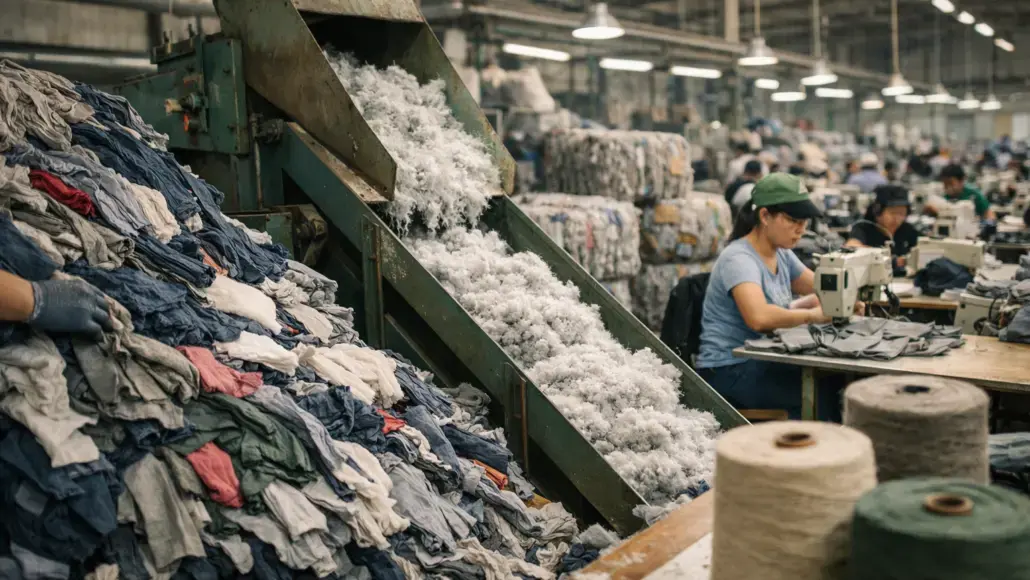
A newly published study is drawing attention to the growing potential of the U.S.-Dominican Republic-Central America Free Trade Agreement (CAFTA-DR) region as a viable hub for textile-to-textile recycling, as the global apparel industry faces mounting pressure to address an annual textile waste problem exceeding 90 million tonnes.
The study, titled Strengthening Textile to Textile Recycling Capacity in the U.S.-Dominican Republic-Central America Free Trade Agreement (CAFTA-DR) Region, was authored by Emilie Delaye and Dr. Sheng Lu. It examines the region’s readiness to support and scale textile-to-textile (T2T) recycling operations amid escalating global sustainability demands.
CAFTA-DR Nations Offer a Competitive Foundation
According to the study, the six CAFTA-DR member nations — Costa Rica, the Dominican Republic, El Salvador, Guatemala, Honduras, and Nicaragua — already possess a strong base from which to expand T2T recycling capacity. The region benefits from established apparel manufacturing infrastructure, long-standing trade relationships with the United States, and a growing industry push toward nearshoring. These combined factors place the bloc in a competitive position to serve US apparel brands that are seeking both sustainable sourcing options and geographically closer supply chains.
Chelsea Murtha, Senior Director of Sustainability at the American Apparel and Footwear Association (AAFA), noted that as companies continue to look for practical sustainability solutions and new nearshoring opportunities, there is a clear opportunity to support American apparel businesses in advancing both goals within one region. She further acknowledged that the study examines how trade policy can serve as a tool to expand textile-to-textile recycling capacity, and credited the University of Delaware for identifying where the region is already succeeding in T2T recycling, where expansion opportunities exist, and what is needed to help US businesses take advantage of them.
Challenges Requiring Urgent Attention
Despite the region’s promise, the study identifies several critical challenges that must be addressed for the CAFTA-DR region to fully deliver on its circular economy potential. Among the key concerns are whether current rules of origin adequately accommodate products made with recycled content, how customs authorities will classify recycled materials, and the pressing need to strengthen regional coordination across both recycling and manufacturing supply chains.
These barriers, if left unaddressed, could slow the region’s ability to scale T2T recycling and limit its role in supporting a viable circular economy for the apparel sector.
Three Central Recommendations to Drive T2T Recycling Growth
The study presents three core recommendations aimed at promoting the development, scalability, and long-term success of textile-to-textile recycling across the CAFTA-DR trade bloc.
Leveraging Trade Policy for Market Incentives
The first recommendation calls for the use of trade policy as a driver of change — specifically through the creation of stronger market-based incentives and the consideration of tariff reductions for products containing recycled content. This approach is intended to make recycled-content goods more commercially attractive and competitively priced within the CAFTA-DR trade framework.
Reforming Rules of Origin and Customs Procedures
The second recommendation urges the establishment of clearer and more flexible rules of origin, alongside updated customs procedures that better accommodate recycled materials. The study points out that existing trade regulations were not designed with textile-to-textile recycling in mind, and that current frameworks may inadvertently create obstacles for manufacturers working with recycled inputs.
Building Regional Partnerships and Investment Mechanisms
The third recommendation focuses on fostering regional partnerships and developing innovative investment mechanisms to boost T2T recycling capacity and support the commercialisation of these processes across the CAFTA-DR region. Collaboration among stakeholders across borders is highlighted as essential to achieving the scale needed to make a meaningful environmental and economic impact.
Study Methodology and Industry Significance
The study draws on a combination of industry data and in-depth interviews conducted with a broad cross-section of stakeholders, including US apparel brands, recyclers, manufacturers, and regional experts. The American Apparel and Footwear Association emphasized that this research provides essential groundwork for both policymakers and industry leaders as they evaluate next steps for trade integration and environmental responsibility.
With textile waste continuing to be a defining challenge for the global fashion and apparel industry, the CAFTA-DR T2T recycling study offers a timely and evidence-based framework for action — one that ties trade policy, circular economy goals, and nearshoring strategy into a cohesive regional opportunity.