


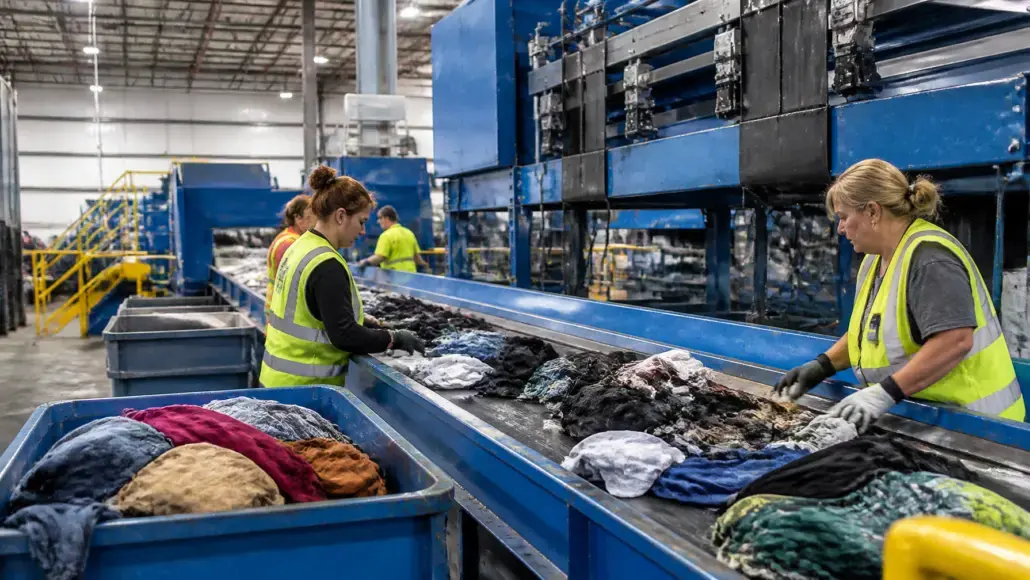
A collaborative initiative led by the NSF Textile Innovation Engine in North Carolina is set to significantly expand textile sorting capacity in the region, bringing together Goodwill Industries of Northwest North Carolina and UpCycle Fiber as primary installation partners, with Material Return and The Industrial Commons contributing to the broader operational system.
The new automated sorting equipment will be installed at both Goodwill Industries of Northwest North Carolina and UpCycle Fiber facilities, with operations expected to begin in early 2027. At full capacity, the systems are capable of sorting up to 16 million kilograms of material each year — an increase of approximately 4,400 pounds per hour over current handling levels.
How the Technology Works
The systems will deploy near-infrared spectroscopy combined with automated sorting technology to identify and classify textiles across as many as 20 distinct attributes, including fibre composition and colour. The data generated through this process is intended to direct materials that cannot be resold toward their highest-value next use — whether that is textile recycling, feedstock production, or other material pathways.
Goodwill’s Role: Resale First, Responsible Recycling Second
Goodwill Industries of Northwest North Carolina currently manages more than 14 million kilograms of textile material annually. The organisation has consistently prioritised resale as the preferred route for donated textiles, and that approach will not change. Rather, the new textile sorting capacity will be applied to items that fall outside the resale stream.
Goodwill Industries of Northwest North Carolina President and CEO Barbara Maida-Stolle stated: “Our first goal is always to find the highest and best use for donated products, and for textiles that means keeping them in use through resale for as long as possible. This new equipment gives us the ability to sort the remaining textiles by content to direct those textiles toward responsible recycling and new material pathways.”
UpCycle Fiber: Engineering New Applications for Recovered Material
UpCycle Fiber will use its facilities to break down recovered textiles into fibre suitable for nonwoven materials and yarn development. The company employs mechanical recycling and nonwoven manufacturing techniques to enable greater integration of recovered materials into new products.
Support from the NSF Textile Innovation Engine, combined with investment in advanced sorting systems, is expected to help establish distinct fibre streams for both spinning and nonwoven applications — addressing a core challenge in fiber recovery at scale.
UpCycle Fiber Co-Founder and Chief Operating Officer David Culp explained: “The challenge is not simply collecting textile waste or finding ways to process it. The real challenge is creating reliable offtake for the recovered fibre. Trying to force this fibre into existing markets and compete with established materials is not a long-term strategy for success. We need to engineer new products and applications that can consume this feedstock at scale and create real value from it. That is what we are building at UpCycle Fiber.”
Material Return and The Industrial Commons: Closing the Loop
Material Return, backed by The Industrial Commons, further strengthens this initiative through its specialisation in fiber recovery and circular yarn spinning — particularly with natural fibres through mechanical recycling. The company processes both post-consumer and post-industrial sorted textiles, converting them into tailored recycled yarns.
Together, the combined efforts of all partners create an integrated pathway linking collection, sorting, processing, and manufacturing — delivering a circular textile solution that no single organisation could achieve independently. The interconnected model is designed to maximise material value, prioritising reuse and resale while enabling specialised textile recycling when items can no longer be resold.
A Connected Regional System Built on Complementary Expertise
Funding for the initiative includes support from the National Science Foundation through the Textile Innovation Engine, alongside contributions from public, private, and organisational partners.
Anne Wiper, Chief Executive of the NSF Textile Innovation Engine, described the collaboration as one designed to connect collection, resale, sorting, processing, and manufacturing capabilities across the region. “Goodwill Industries of Northwest North Carolina brings deep expertise in collection and resale, UpCycle Fiber brings innovation and expertise in nonwovens, and Material Return brings expertise in mechanical recycling and customised circular yarn production. By connecting those strengths and leveraging advanced technologies, we can keep more material in use and create textile to textile solutions,” Wiper said.
The combined model reflects a growing recognition within the circular textile space that lasting progress in textile recycling depends not on isolated efforts, but on integrated systems that align collection, automated sorting, processing, and end-use manufacturing into a single, coordinated value chain.