


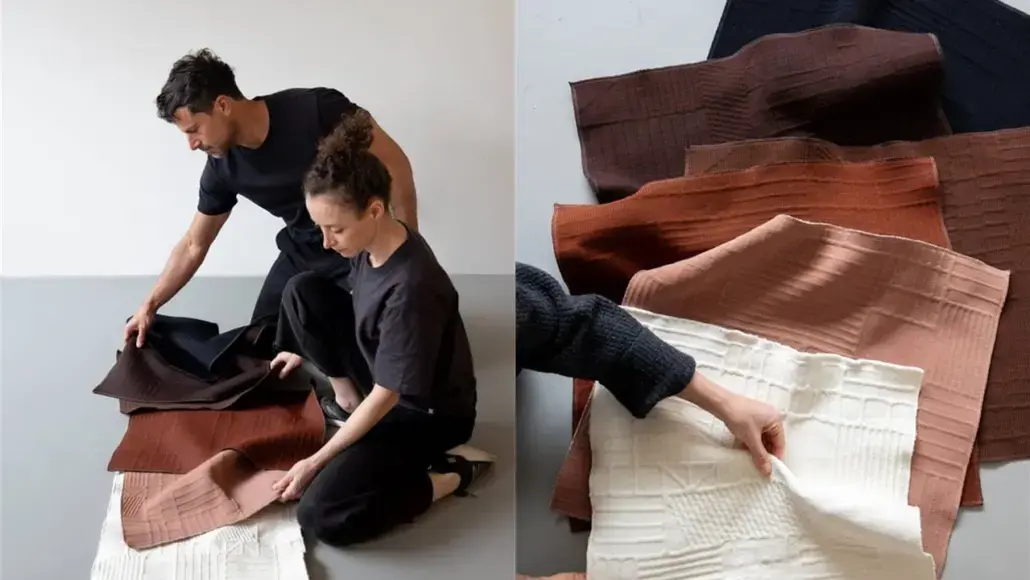
Amsterdam-based textile company Byborre is showcasing how digital design and advanced circular knitting technology can be brought together to produce complex three-dimensional fabrics — ones where pattern, colour and surface texture are engineered directly into the knitted construction itself, rather than applied after the fact.
Three recent collaborations with European design studios — Rome-based Pastina, London’s Raw Edges, and Amsterdam’s Martens & Martens — offer a window into what this approach can produce. Each project translates a distinct creative source, whether landscape geometry, surface topography, or graphic composition, into highly individual knitted constructions made available through Byborre’s digital platform, the Textile Room.
The Textile Room: A Digital Gateway to Complex Knitted Fabrics
The Textile Room, launched in April 2025, builds on Byborre’s earlier Create software, which was originally developed to make advanced knitting machinery more accessible to designers without specialist textile manufacturing knowledge. At launch, the platform offered 20 configurable knitted textiles, enabling users to experiment with colour combinations, tonal variations and pattern repeats through a digital interface.
Designers can select and modify existing structures, or collaborate directly with Byborre’s specialists to develop entirely new fabrics.
The three new collections demonstrate how the Textile Room can accommodate fundamentally different creative approaches while drawing on a shared base of digital circular knitting technology.
A Foundation in Circular Knitting Innovation
Byborre’s approach to 3D knitted fabrics has its roots in a long-standing collaboration with German circular knitting machinery manufacturer Mayer & Cie. The relationship began when founder Borre Akkersdijk experimented with one of the company’s OVJA 1.6 E machines at the Textile Museum in Tilburg. Those experiments led to the development of double-face knitted constructions that became central to Byborre’s identity.
The company later invested in a more advanced OVJA 1.6 EE 3/2WT machine and worked alongside Mayer & Cie to push the boundaries of both the knitting hardware and its associated software. The partnership has extended well beyond fashion — one notable outcome being interactive knitted upholstery developed for BMW’s i Interaction Ease concept vehicle.
What the Collaborations Collectively Illustrate
Although modest in scale, the three collections together highlight the creative range that becomes available when digital design tools are combined with advanced circular knitting technology. For Byborre, the broader commercial proposition lies in making complex knitted constructions more accessible to designers working outside conventional textile manufacturing.
The Textile Room enables designers to experiment with fabric structures and visual effects ahead of physical sampling and production, while Byborre’s technical expertise translates those designs into machine-knittable constructions. The platform does carry inherent constraints — the complexity of some textiles, the development costs involved, and the economics of small production runs all require careful balancing against commercial realities. Nonetheless, the three latest collections show clearly how digital tools can meaningfully extend the creative possibilities of established textile manufacturing processes.