


The global textile recycling landscape is undergoing a quiet but consequential shift. With the European Union set to enforce waste-handling rules from 2028, a critical question is emerging across the industry — who stands to benefit most from the incoming regulatory framework, and where will the recycled-fibre supply actually come from?
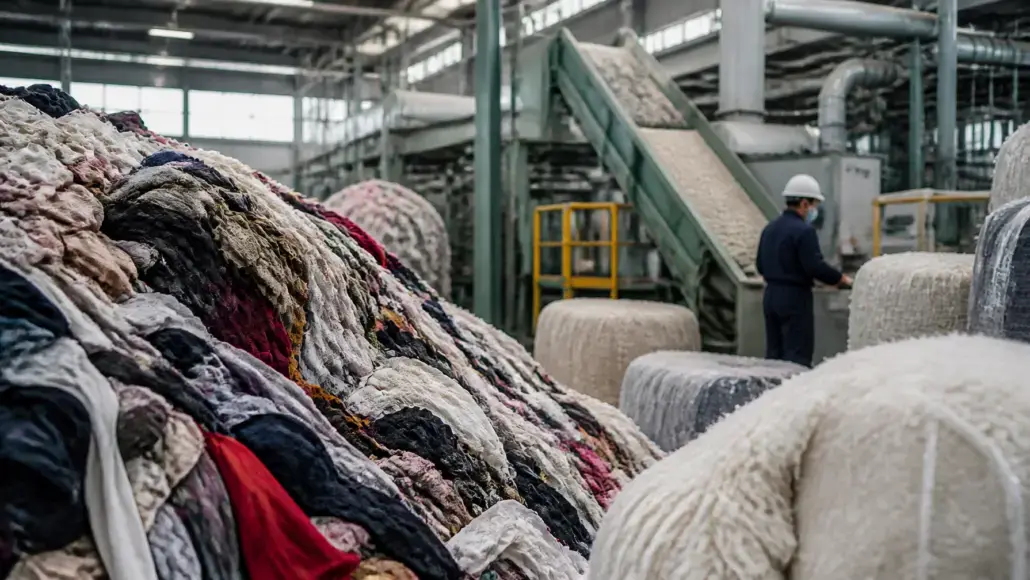
A recent development has brought this question into sharper focus. US-based recycler Circ and China’s Huafon have announced a joint textile-to-textile recycling plant located in China, designed to process blended polyester-cotton waste on a significant scale each day. The facility is built to recover PTA (purified terephthalic acid), MEG (monoethylene glycol), and cellulose pulp from polycotton blended waste — materials that are notoriously difficult to separate and recycle at commercial scale. The announcement signals a clear move of recycling capacity closer to Asia’s established polyester and garment production hubs.
What the Circ–Huafon Plant Signals for the Industry
The Circ–Huafon recycling plant carries different implications depending on where a business sits in the textile and apparel value chain. For Asian fibre and yarn producers, the facility represents an opportunity to integrate textile recycling as a new revenue stream alongside existing manufacturing operations. By moving early to secure polyester-cotton waste — commonly known as polycotton waste — these producers could position themselves as competitive suppliers of recycled materials to the EU market.
For brands and retailers sourcing products intended for the European market, the picture involves both opportunity and obligation. Recycled-fibre supply is expected to increase in the coming years, with a significant portion of that supply originating from Asia. At the same time, producer-responsibility fees tied to EU recycling rules are set to come into effect, adding a compliance dimension to sourcing decisions. Industry participants are advised to secure long-term supply arrangements across multiple suppliers and regions, while carefully comparing the total compliance costs of sourcing from Asia versus sourcing within the EU.
EU Recycling Rules Create Pressure, Not Purchase Mandates
It is important to note that while the EU’s regulatory framework will introduce waste-handling costs from 2028, the rules do not compel brands or retailers to purchase recycled fibre specifically. The distinction matters. The regulations create a financial incentive structure through producer-responsibility fees, but sourcing decisions will ultimately be driven by cost, availability, and compliance strategy rather than a direct mandate to buy recycled content.
This regulatory nuance makes the competitive dynamics all the more complex. EU-based textile recyclers, already operating in a higher-cost environment, now face the prospect of increasing competition from Asian producers who benefit from proximity to raw polycotton waste streams, lower operational costs, and integration with large-scale polyester manufacturing infrastructure.
Challenges for EU-Based Recyclers
For recyclers operating within Europe, the entry of Asian capacity into the textile recycling market raises the stakes considerably. Securing committed buyers and confirmed funding before committing to new plant construction is becoming increasingly important. Industry analysis suggests that projects backed by confirmed customer orders prior to construction are more likely to reach commercial viability — a signal that the textile recycling sector is maturing past the pilot phase and into a phase where commercial certainty is a prerequisite for investment.
EU textile recycling operations will need to differentiate on factors such as supply-chain transparency, proximity to European waste streams, and regulatory alignment — areas where geography and policy familiarity may offer a natural advantage over distant competitors.
The Broader Picture for the Asian Textile Supply Chain
The Circ–Huafon announcement reflects a broader trend: as EU recycling rules approach, global supply chains are repositioning to meet anticipated demand for recycled fibre. The Asian textile supply chain, with its scale, existing infrastructure, and cost competitiveness, is well placed to absorb and process a large portion of polycotton waste headed for recycled-fibre production.
The plant’s focus on recovering PTA, MEG, and cellulose pulp from polycotton blended waste is particularly notable given that blended fabrics — which combine polyester and cotton in a single garment — represent one of the most significant unresolved challenges in textile recycling globally. Successfully processing these materials at commercial scale would mark a meaningful step forward for the recycled-fibre supply chain.
The coming years will likely determine whether EU textile recycling capacity can remain competitive or whether Asia consolidates its position as the primary source of recycled fibre for the global market — including for European brands subject to the incoming EU regulations.