


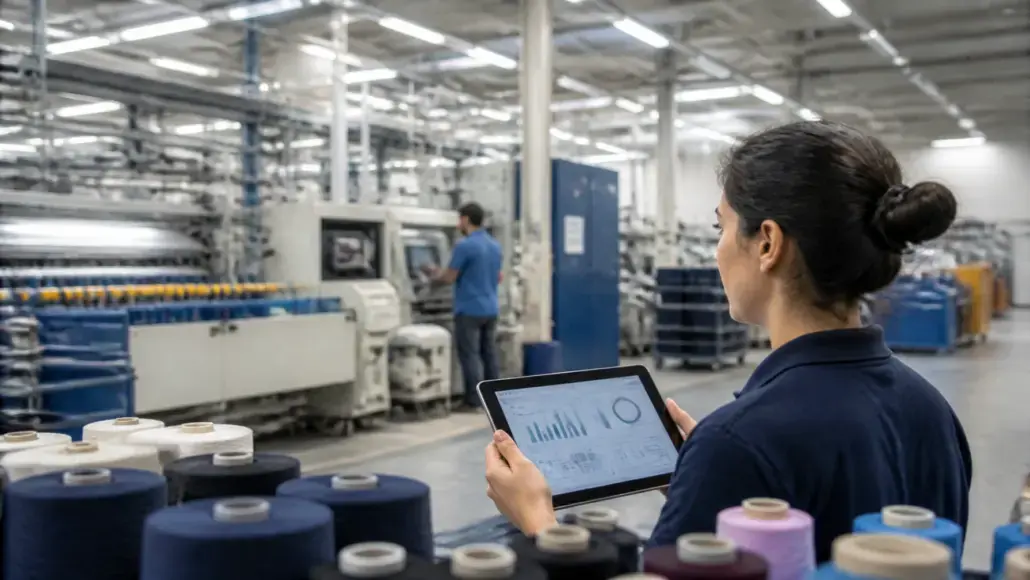
The International Textile Manufacturers Federation (ITMF) and RWTH Aachen University’s Institut für Textiltechnik (ITA) have jointly published a white paper titled AI in the Textile Value Chain: A Strategic Guide to Artificial Intelligence for the Global Textile Industry. Released in October 2026, the paper draws from an ITMF and ITA webinar series on AI in the textile value chain and concludes that the industry’s advancement will hinge on “coordinated, industry-wide capability-building.”
Textile Manufacturing Is Digitally Fragmented, Not Under-Digitalised
One of the central findings of the ITMF ITA white paper is that textile manufacturing should not be characterised as under-digitalised. Instead, the report describes it as “digitally fragmented,” pointing out that decades of digitalisation have led to data being spread across disconnected systems. A notable concern raised is that companies regularly overestimate the volume of usable, structured data they actually have available to support AI projects.
RWTH Aachen University’s ITA director, Professor Thomas Gries, addressed this directly: “Companies need a dedicated task force to embed data integration into their day-to-day and strategic technical and business processes. Partnering with external experts on a transparent assessment — a data or automation waste walk — and on effective implementation is not only decisive to future success, but essential to survive!”
This emphasis on data integration textiles underlines a recurring theme throughout the white paper — that meaningful textile AI adoption cannot happen without first getting foundational data infrastructure in order.
Key Drivers Pushing the Industry Toward AI
The paper identifies several forces accelerating the push toward textile manufacturing AI. These include demographic change, shortages of skilled workers, market volatility, and growing customer and regulatory demands around quality, traceability, and sustainability. Together, these pressures are compelling companies across the value chain to explore AI-driven solutions more seriously.
AI Applications Already Delivering Results
Several AI applications are already producing measurable outcomes within the sector, according to the report. Computer-vision systems for fabric and yarn inspection, predictive maintenance, energy optimisation, and demand forecasting are among the use cases cited as delivering tangible results.
The paper also highlights a broader directional shift — from AI systems that assist human decision-making to systems increasingly capable of coordinating or executing defined tasks under human supervision. Agentic AI, for instance, is beginning to manage multi-stage processes such as sourcing, while causal AI can directly adjust production settings. The paper places the likely timeframe for end-to-end AI workflows at two to three years.
The Risk of Compounding Existing Data Problems
While the opportunity is clear, the white paper does not shy away from the risks. Research participants warned that AI can compound, rather than resolve, underlying problems when data is incomplete or of poor quality. This reinforces the call for businesses to establish dedicated teams focused on data integration into both technical and commercial processes before pursuing wider AI deployment.
Trust and accountability were also flagged as critical conditions for adoption. Industry participants pointed to control of sensitive information, cyber security, transparency about system limitations, and retained human responsibility as prerequisites for deploying AI in production and supply-chain contexts.
Practical Recommendations for Industry Players
ITMF Director Olivier Zieschank offered a measured perspective on what AI in the textile industry can and cannot do: “AI is not a shortcut around the structural challenges our industry faces, but it can help companies manage complexity and make the most of scarce expertise. Understanding where AI genuinely helps is a learning process. That is why exchange through associations like ITMF matters so much.”
In line with this view, the paper recommends that companies begin with contained, well-defined use cases rather than attempting broad implementation programmes from the outset. It also proposes shared data standards and data spaces that allow originators to retain ownership of their data. Additionally, sector-specific tools — including a controlled “Textile GPT” — are suggested as particularly valuable resources for smaller and medium-sized businesses navigating textile AI adoption.
The ITMF ITA white paper represents a detailed, industry-grounded assessment of where AI in the textile industry currently stands, what is realistically achievable, and what structural groundwork must be laid for sustainable, responsible integration across the global textile value chain.