



























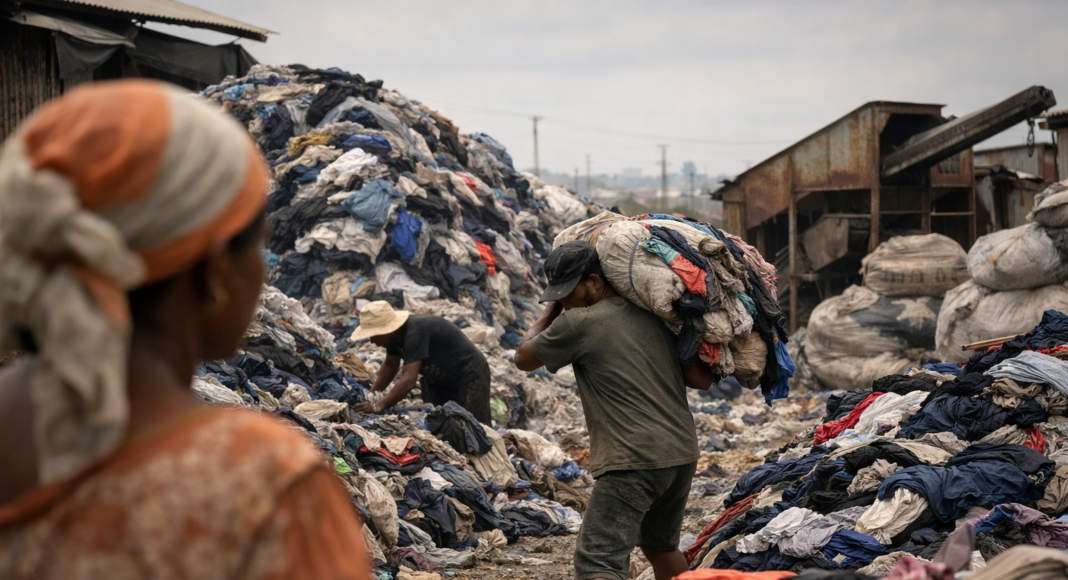
The dominant conversation surrounding sustainability often places the burden on consumers, urging them to buy fewer items, choose better quality, and donate more. However, as it is currently defined, this approach alone is not providing effective textile waste crisis solutions. Even an environmentally conscious consumer base cannot create systemic change without the necessary infrastructure to close the production loop. These systems are largely missing in the Global South, where discarded clothing accumulates in areas such as the Atacama Desert in Chile, the Kantamanto Market in Ghana, and Panipat in India. These locations serve as visible examples of the sector’s waste footprint.
While the market has introduced various fast fashion alternatives—such as organic cotton, recycled polyester, capsule wardrobes, and secondhand marketplaces—only 1% of used garments are recycled back into new clothing globally. The industry remains heavily reliant on virgin inputs, with nearly two-thirds of materials derived from oil-based polymers. To overcome this, the sector must confront the ongoing textile waste crisis by evaluating every step of the value chain.
Creating a Supportive Infrastructure
The apparel sector is approaching a phase where it could transition toward a circular economy. Realizing this requires a mix of policy, inclusion, and innovation, alongside trade systems and extended producer responsibility. Rethinking what happens to garments involves evaluating both the initial materials chosen and the end-of-use processing.
Formalizing the Informal Workforce
Informal workers operating repair and upcycling facilities often work from home without established health and safety protocols. This lack of regulation leads to poor working conditions and information asymmetries. To address this, Chile is implementing an extended producer responsibility system combined with a National System for the Certification of Labor Competencies, known as Chile Valora.
This platform allows individuals who gained skills through practical experience to validate their knowledge and join an official catalogue of experts. This provides state accreditation, identifying them as trusted suppliers. Under the country’s extended producer responsibility rules, collection and recycling companies are required to use grassroots recyclers listed in this registry. For such mechanisms to function equitably, the financial cost of training must not be placed on the workers themselves.
Innovations in Material Sourcing
Developing new inputs is another crucial component among practical textile waste crisis solutions. Bio-based materials present a viable option for reducing environmental impact, provided they are developed under the correct parameters. These materials must originate from regenerative sources and secondary stream feedstocks while being designed for durability, value retention, and reuse. They also need to be free of substances harmful to people and the planet.
Entrepreneurs are developing tangible fast fashion alternatives using these methods. A startup called Spora Biotech creates textiles using fungi by discovering, cultivating, and preserving wild fungal strains from diverse ecosystems. Its initial product, Sporatex, is a mushroom-based leather that is currently used internationally.
Another company, Desserto, is a Mexican startup producing vegan leather from nopal, a succulent in the cactus family. Native to the Americas, this plant acts as a natural carbon sink. Desserto uses locally abundant minerals and rainwater to maintain its crops, selectively harvesting mature leaves every six to eight months. By integrating bio-based materials and establishing a circular economy, the sector can better address the ongoing textile waste crisis.

