


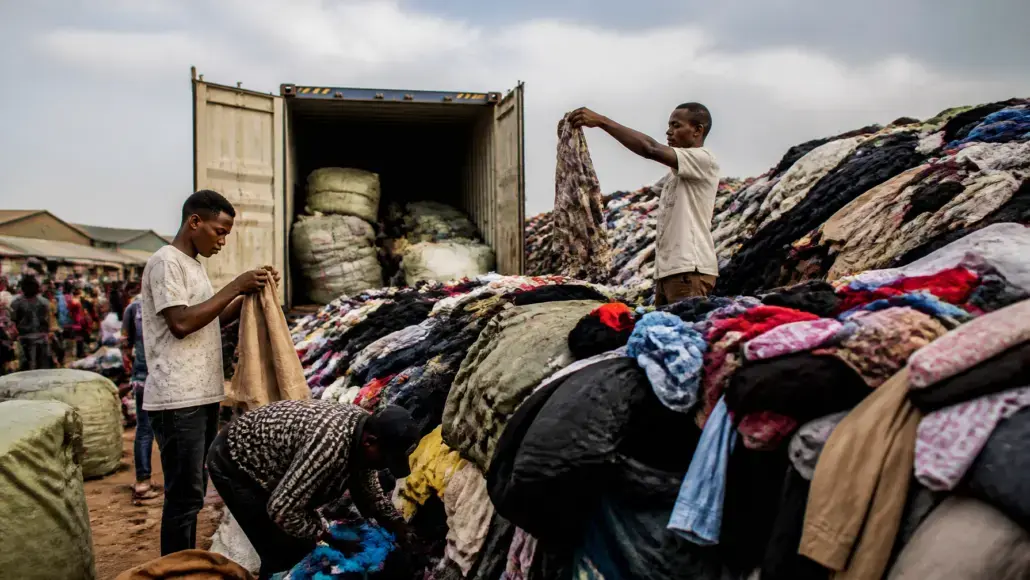
Nearly a decade after East African nations announced ambitious plans to curb and eventually eliminate imports of used clothing — locally known as mitumba — those efforts have largely come to nothing. Economic realities, fierce consumer demand, US trade pressure, and underdeveloped local manufacturing have all played their part in unravelling a policy that was once seen as a pathway to building stronger domestic textile industries.
The Push to Protect Local Textile Industries
The East African Community (EAC) — comprising Kenya, Uganda, Tanzania, Rwanda, Burundi, and South Sudan — formally announced plans to impose steep tariffs and phase out second-hand clothes imports with the goal of shielding and growing home-grown fashion and textile businesses. The bloc’s primary argument was straightforward: cheap imported garments arriving from Europe, the United States, and China were directly undercutting domestic producers and stunting the growth of a potentially powerful regional industry.
What followed, however, was not a clean policy rollout. Instead, the proposed restrictions ran headlong into a wall of international trade obligations and economic dependencies that proved far harder to overcome than initially anticipated.
The US Trade Ultimatum That Changed Everything
The most decisive blow to the mitumba ban came from Washington. The United States warned EAC member states that proceeding with restrictions on second-hand clothes imports would constitute a violation of existing trade agreements and, more critically, would put their access to the African Growth and Opportunity Act (AGOA) at risk. AGOA is a trade arrangement that grants African nations the ability to export goods to the US market duty-free — a privilege of considerable economic importance to the region.
Faced with that ultimatum, every EAC member state except Rwanda withdrew their support for the ban. Rwanda chose to hold its ground, pressing ahead with higher import taxes on used clothing. The consequences were swift: Rwanda was hit with a 30 percent tariff on its clothing exports to the United States, a costly price for its defiance.
Why Second-Hand Clothes Remain So Popular
Beyond the politics of trade, there is a simple and powerful reason why mitumba continues to thrive across the region: people want it. Imports of second-hand clothes into Kenya alone rose by 76 percent between 2013 and 2022, making Kenya the largest importer of used clothing on the African continent.
Shoppers consistently point to two factors — affordability and quality. At Tanzania’s Ilala market, one shopper summed up a view shared by many: “Most of the clothes have good quality… they last long.” Another customer noted that second-hand clothes appeal to him because “they look unique,” a sentiment reflecting the individuality that mass-market, locally produced garments often struggle to offer.
These are not trivial preferences. For millions of people in the region, the choice between mitumba and locally made clothing is also a financial one, and second-hand clothes routinely win on both price and perceived durability.
Millions of Livelihoods Are Tied to the Trade
The mitumba trade is not merely a shopping habit — it is an economic ecosystem. Research commissioned by the Mitumba Consortium Association of Kenya estimates that as many as 4.9 million people across East Africa depend on the second-hand clothes trade for their livelihoods. That figure encompasses a wide chain of participants: importers, market traders, tailors, transporters, and food vendors who operate within and around the sprawling open-air markets that characterise cities like Nairobi, Kampala, and Dar es Salaam.
Gikomba in Nairobi stands as one of the most visible examples — a vast, busy marketplace dedicated almost entirely to worn clothing, drawing buyers and sellers from across the country and beyond.
The Limits of the Local Textile Industry
Critics of the mitumba trade argue that its dominance actively suppresses industrial growth. Dr Andrew Brooks, an academic at King’s College London, made the point directly: “Retail is the most limited form of job creation you can have in an economic sector, versus production, marketing and distribution.”
The concern is valid, but so is the counter-argument: East Africa’s textile industry is simply not yet capable of filling the gap that a mitumba ban would create. Ugandan designer Joel Okalany acknowledged as much, stating that the region lacks modern manufacturing capacity and is not ready to phase out second-hand clothes entirely.
Even Rwanda — the one country that took the toughest stance against mitumba — later recognised the shortcomings of its own domestic textile production and was forced to delay plans for a complete ban. The gap between policy ambition and industrial reality proved too wide to bridge on the original timeline.
A New and Growing Threat: Cheap New Imports
Complicating matters further is the rapid rise of cheap new clothing from countries such as China and Turkey. Both local textile manufacturers and mitumba traders have flagged this influx as a greater threat to their respective businesses than any competition between them. The arrival of inexpensive fast-fashion goods at scale presents a challenge that neither side of the domestic debate had fully accounted for in earlier years.
The Environmental Dimension
Environmental concerns have also shaped the conversation around second-hand clothes imports. Activists argue that a significant portion of imported used clothing ends up discarded in African landfills, particularly items that are too damaged or worn to be resold or reused. This has fuelled criticism of the global trade in used garments, with parts of Africa bearing the environmental cost of consumption patterns elsewhere in the world.
Mitumba traders, however, push back firmly on this framing. Their position is that reusing clothing — giving garments a second life rather than discarding them — actively reduces environmental waste on a global scale. It is a debate without easy resolution, and one that continues to run alongside the economic and political arguments.
Where Things Stand Now
The prevailing view among experts is that second-hand clothes and local textile production may need to coexist for the foreseeable future. The logic is pragmatic rather than idealistic: until East African countries develop manufacturing industries strong enough to reliably meet consumer demand at comparable price points, a hard ban on mitumba would create a gap that neither local producers nor policymakers are currently equipped to fill.
The story of the mitumba ban is, in many ways, a case study in the gap between trade policy aspirations and on-the-ground realities. The textile industry across the region remains a work in progress — and so, for now, does the debate over second-hand clothes.