























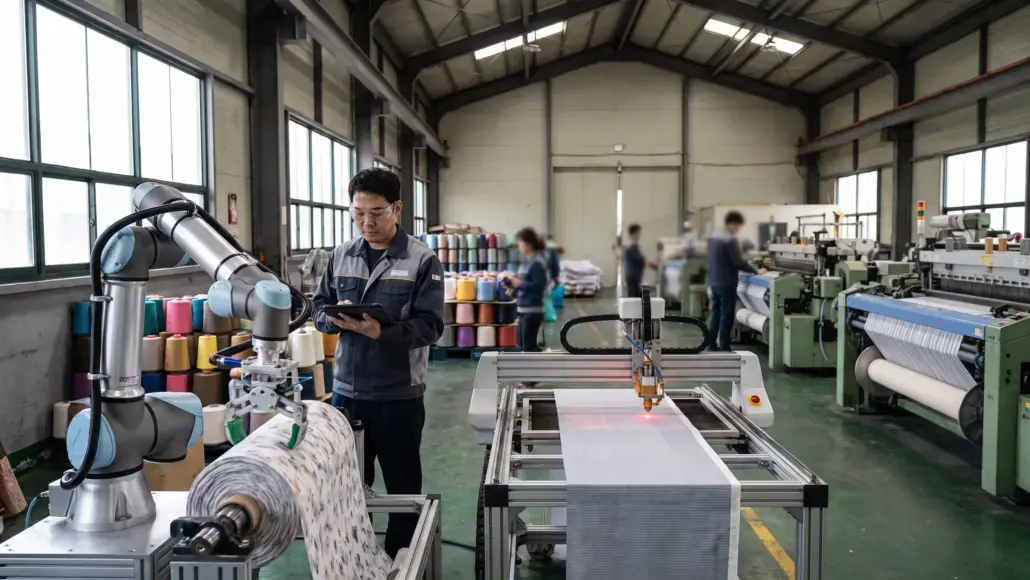
The use of artificial intelligence in South Korea’s textile sector is rapidly moving beyond design studios and sales forecasting. Companies across the industry are now making serious moves to bring AI and robotics directly onto the factory floor — covering everything from fabric handling to pattern production. The central question driving this shift is whether Korea’s textile and apparel manufacturers, many of whom relocated production overseas due to climbing labor costs and worsening worker shortages, can reclaim their manufacturing edge through automation.
Hansae Partners with Robotics Firm to Explore AI on Production Lines
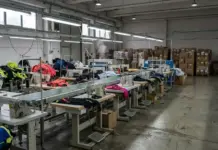
Apparel manufacturer Hansae has signed a contract with Realworld, a robotic gripper technology firm, and is currently reviewing practical applications of AI and robotics within its apparel production lines. Realworld specializes in robotic-hand AI technology capable of gripping and moving objects with the same precision as a human hand. Industry sources indicate that interest in automating apparel production gained noticeable momentum after Hansae Vice Chairman Kim Ik-hwan personally examined the technology.
Hansae’s engagement with AI in textile manufacturing is not new. After establishing a dedicated AI team in 2023, the company began applying artificial intelligence to design development and product manufacturing processes. More recently, Hansae has been running a proof-of-concept project alongside system software developer CA Planet, focused on technology that automatically adjusts a single pattern to fit multiple sizes.
“We are expanding the application of AI technology to various areas, including production, development and quality control,” a Hansae official stated.
Domestic Manufacturers Lead the Push for AI-Driven Automation
The adoption of manufacturing AI is especially pronounced among companies maintaining production bases within South Korea — a direct response to decades of skill-dependent manual processes that are increasingly difficult to sustain.
Bokwang INT, which produces specialized garments for the military and firefighting sectors, is applying AI to gauge fabric thickness and tension in real time, enabling automatic adjustment of sewing conditions and instant detection of minute surface defects. The objective is to standardize sewing and quality inspection processes that have traditionally varied depending on individual worker skill levels.
Korean Friends is developing technology that converts generative AI-created designs directly into the work orders required for actual garment production — reducing the need for staff to manually redraw design images into production blueprints, thereby cutting both time and manpower in product development.
Meanwhile, Georim Trend, F&I Korea, and Good Trust are collaborating with AI data company SIJE to collect and analyze real-time sewing workloads and equipment data, with the goal of identifying and eliminating bottlenecks that emerge during production. These efforts collectively reflect a growing industry-wide commitment to K-fashion production becoming less reliant on manual labor.
Government Backs the AI Transition with a ₩310 Billion Investment Plan
The South Korean government is actively supporting the integration of AI in textile manufacturing. The Ministry of Trade, Industry and Energy has surveyed corporate demand to advance an “advanced future textile development project,” which plans to invest a total of 310 billion won (approximately $224 million USD) between 2028 and 2034. The project is designed to boost productivity by incorporating AI across the entire textile manufacturing chain — spanning yarn and spinning through to dyeing, processing, and sewing. More than 200 companies responded to the demand survey, exceeding initial expectations.
U.S. Fashion-Tech Also Eyes Full Garment Automation
In the United States, where production facilities were offshored decades ago, there is a parallel push toward fully automating garment production. American fashion-tech company CreateMe is developing a production system that tracks fabric position in real time and automatically assembles complete garments. The company holds over 95 related patents and has recently launched a project to build a domestic garment production ecosystem in partnership with AI agriculture firm Avalo and fabric manufacturer Laguna Fabrics.
A Sense of Crisis Drives South Korea’s Automation Urgency
Behind the Korean textile industry’s intensifying focus on textile automation lies a deeper sense of urgency about a weakening domestic production base. South Korea’s textile sector was a pillar of national exports during the 1960s and 1970s, but production facilities migrated rapidly to China, Vietnam, and other lower-cost destinations as labor and manufacturing expenses rose. This trend, compounded by the aging of Korea’s domestic workforce, has made it increasingly difficult to find skilled workers for labor-intensive tasks such as sewing.
“If only design and planning remain in Korea while the production base disappears, there are bound to be limits to the growth of K-fashion,” an industry official said. “If we can automate even labor-intensive processes such as cutting and sewing with AI and robots, it will help make up for the labor shortage and maintain the domestic manufacturing base.”
The convergence of robotic gripper technology, AI-driven quality control, government funding, and cross-sector collaboration signals that South Korea’s textile industry is making a calculated and coordinated effort to use AI manufacturing not just as a productivity tool, but as a means of preserving the country’s industrial identity in apparel.

