


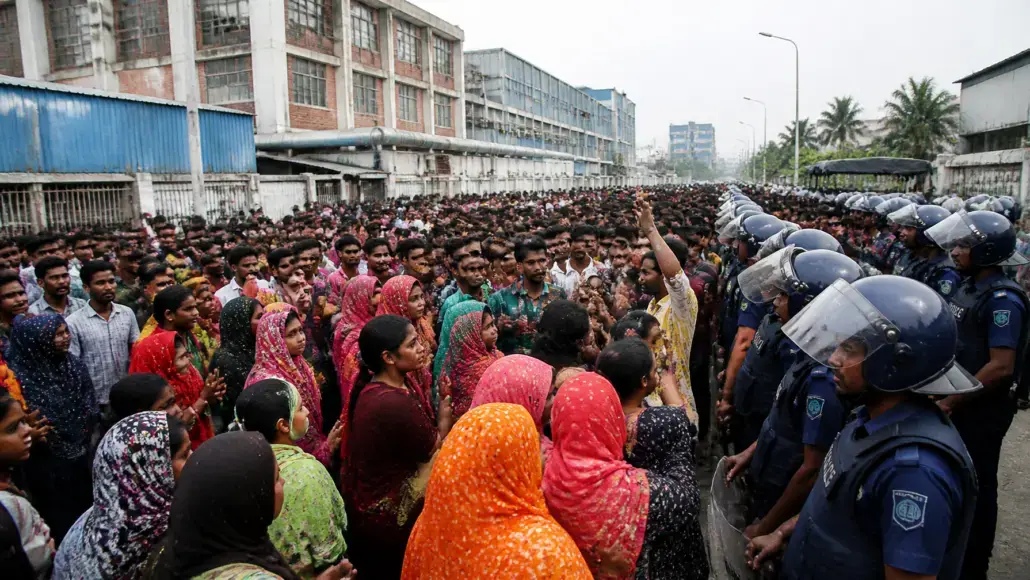
The labor crisis gripping Bangladesh’s textile sector has intensified, with fresh worker strikes spreading to additional factories in Gazipur over the weekend, forcing at least 13 plants into indefinite closure. As the Bangladesh garment strike shows no immediate sign of easing, employers have hardened their stance by threatening to withhold wages from participating workers under existing labor law provisions.
The industrial police confirmed the indefinite closure of 13 factories in Gazipur, one of the country’s main garment manufacturing centres, with a further 16 factories shutting down during morning unrest the following day, according to Police Superintendent Mohammad Amjad Hossain.
Nearly 150 Sites Shut Across Key Textile Hubs
Across the country’s major garment manufacturing corridors — Savar, Ashulia, and Gazipur — nearly 150 sites came to a standstill this weekend, as workers walked off production floors demanding a substantial revision to their monthly pay. The Bangladesh garment strike has drawn attention not only domestically but also from international buyers who source billions of dollars’ worth of clothing from the country each year.
The garment industry is a cornerstone of Bangladesh’s economy, generating nearly $40 billion in exports annually and accounting for approximately 10% of the country’s total GDP. Bangladesh ranks as the world’s second-largest exporter of ready-to-wear clothing after China, and concerns are mounting that sustained unrest could have a knock-on effect for international buyers if production disruptions continue for a substantial period.
On Sunday morning, striking workers massed on the Dhaka-Tangail highway in Gazipur to block traffic. The blockade lasted approximately one hour before police intervened to restore movement.
Workers Demand 30,000 Taka Minimum Wage
At the heart of the Bangladesh garment industry crisis is a wage dispute. Workers are demanding a minimum monthly wage of 30,000 taka — roughly £182 — arguing that the current minimum of 12,500 taka per month is insufficient to manage the growing cost of living. Employees say the existing wage structure leaves them unable to meet basic expenses, and the demand reflects years of built-up economic pressure.
The industry employs approximately four million workers and produces clothing for globally recognized brands including H&M, Primark, and Zara. Critics argue that the competitive pricing these brands benefit from comes at a direct cost to the workers on the factory floor.
Joly Talukder, Vice President of the Garment Workers Trade Union Centre, speaking to BBC’s Newshour, said that “workers have carried the costs for years” while factory owners and global retailers profit from their labor. “They are asking for a wage they can survive on. How can any person of conscience stand against such a basic human demand?” she said.
Manufacturers Call for Factory Protection as “No Work No Pay” Rule Invoked
Industry associations have taken a firm stance amid the ongoing textile industry unrest. The Bangladesh Garment Manufacturers and Exporters Association (BGMEA) and the Bangladesh Knitwear Manufacturers and Exporters Association (BKMEA) have called for stronger protection for factories facing disruption.
BGMEA President Mahmud Hasan Khan stated that both associations have questioned the justification of continuing to participate in wage board negotiations without any assurance that factories will be protected. “Garment factories that have been unable to continue production due to the ongoing unrest will remain indefinitely closed from tomorrow under Bangladesh’s labour law,” he said.
The “No Work No Pay” provision under Bangladesh’s labor laws allows factory owners to suspend operations and withhold wages when production is disrupted by worker actions — a measure that employers are now actively invoking in response to the Bangladesh garment strike.
Government Wage Board Set to Submit Recommendations by End of November
On November 1, the government established a minimum wage board tasked with recommending a revised pay structure for garment workers. The board, chaired by a senior district judge, confirmed at its first meeting that it aims to finalize its recommendations by the end of November.
The outcome of those deliberations will be closely watched as the garment factory closure count continues to rise and the pressure mounts on all sides of the dispute. With Bangladesh’s export economy and the livelihoods of four million workers hanging in the balance, the minimum wage Bangladesh debate remains one of the most consequential labor issues the country faces at this time.