


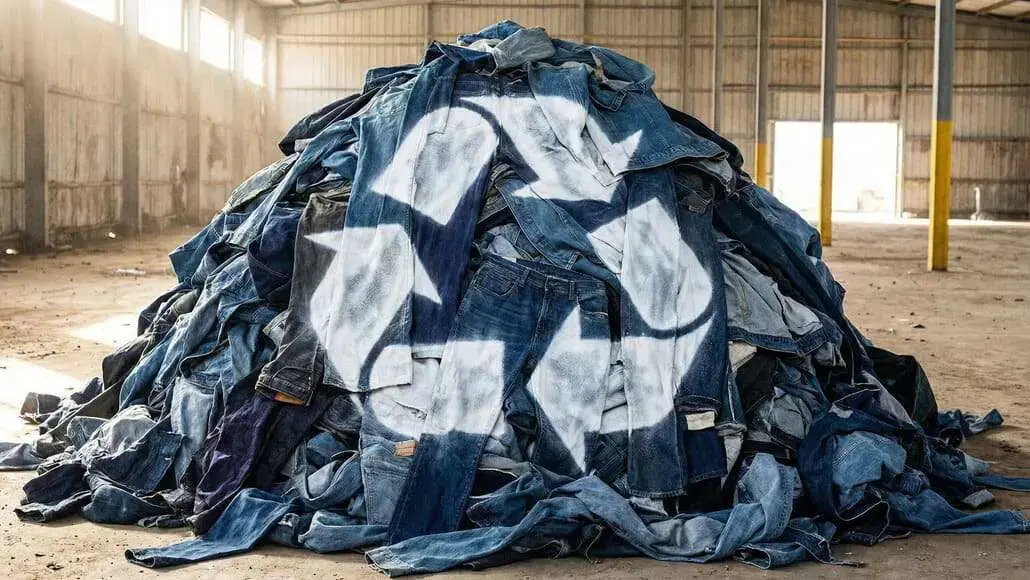
Brussels — Italy has emerged as the leading country in the European Union in both the volume of textile waste generated and the quantity of materials sent for treatment and recycling. According to data published by Eurostat, the European Union’s official statistical office, Italy generated 441,736 tonnes of textile waste in 2024, of which 280,680 tonnes were processed — placing it firmly at the top among all 27 EU Member States.
This picture reflects both the scale of Italy’s textile sector and the considerable challenge of managing the waste produced by industry and consumer activity alike. It also puts a spotlight on the broader state of EU textile waste recycling across the bloc.
Where the Other Major Producers Stand
After Italy, the largest textile waste producers in the EU include France, which generated 339,965 tonnes and treated 258,129 tonnes, and Germany, with 212,107 tonnes generated and 207,156 tonnes treated. Together, these three countries account for a substantial portion of the EU’s overall textile waste output.
Across the European Union as a whole, 2.3 million tonnes of textile waste were generated in 2024. More than half of this originated from household waste, underscoring the significant role that domestic consumption plays in contributing to the total volume. Of this, 1.4 million tonnes were treated, representing 63 per cent of all textile waste generated during the year.
How the EU Is Managing Its Textile Waste
When it comes to treatment methods, the data from Eurostat shows that 91 per cent of the EU’s textile waste was directed toward recovery operations. Within that figure, recycling accounted for 78 per cent of the total treated volume, while 13 per cent was sent for incineration with energy recovery. The remaining share was either disposed of in landfill, which accounted for 8 per cent, or incinerated without energy recovery, making up just 1 per cent.
These numbers point to a strong overall preference for circular economy approaches across the bloc, though the picture varies considerably when individual countries are examined.
Recycling Performance: Leaders and Laggards
In terms of the share of recycled textiles as a proportion of the total volume of textile waste processed, Italy and France jointly lead the EU at 98 per cent. They are followed by Lithuania at 87 per cent and Slovenia at 83 per cent — all reflecting strong national commitment to circular economy practices in the textile sector.
At the opposite end of the spectrum, Latvia recorded no recycling of textile waste at all. Estonia stood at just 5 per cent, while Romania reached 23 per cent — though for Romania, this figure refers to data from 2022.
New EU Rules Target Destruction of Unsold Textiles
Beyond the waste management data, the broader regulatory environment is also evolving. On 9 February, the European Commission adopted new rules under the Ecodesign for Sustainable Products Regulation (ESPR), specifically aimed at preventing the destruction of unsold clothing, accessories, and footwear.
The Commission, in its own words, stated: “Every year in Europe, an estimated 4–9 per cent of unsold textiles are destroyed before ever being worn. This waste generates around 5.6 million tons of CO2 emissions — almost equal to Sweden’s total net emissions in 2021.”
The introduction of these Ecodesign regulation provisions represents a direct policy response to the environmental impact of unsold goods being discarded within the fashion and textile supply chain, reinforcing the EU’s commitment to advancing a circular economy for textiles across all Member States.