






























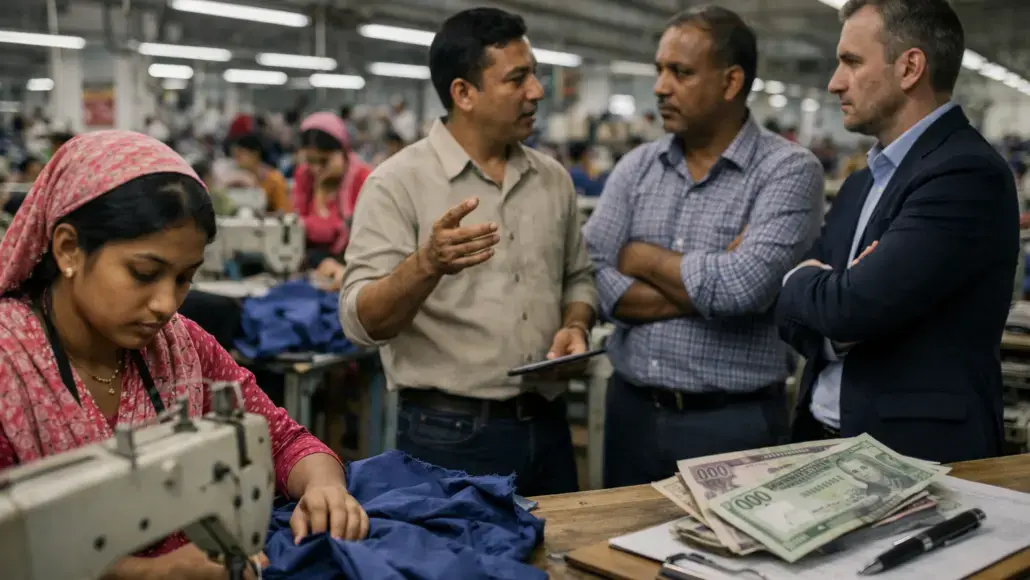
Bangladesh’s ready-made garment (RMG) sector has long been a cornerstone of the country’s economy, contributing the lion’s share of its export earnings. Yet, the question of fair wages for garment workers remains one of the most persistent and sensitive challenges the industry continues to grapple with. The wage issue in the RMG sector has sparked considerable debate among factory owners, workers’ representatives, policymakers, and international buyers — and now, an alternative proposition has emerged that seeks to reframe the entire conversation.
The Background of the RMG Wage Debate
The Bangladesh garment industry employs millions of workers, the majority of whom are women from rural areas. Wages in this sector have historically been a point of contention. Workers argue that their compensation does not keep pace with the rising cost of living, while factory owners cite global competitive pressures and thin profit margins as limiting factors in wage enhancement.
Periodic wage revisions under the Minimum Wages Board have provided incremental increases, but critics contend that these adjustments rarely reflect the true economic needs of the workforce. The textile wage reform discussions have repeatedly reached an impasse, with neither side finding a durable and mutually acceptable solution. The RMG sector wages debate, therefore, remains an open and pressing issue.
A Structured Look at the Current Wage Framework
Under the existing structure, garment workers are categorized into different grades, with each grade carrying its own minimum pay scale. The total compensation package includes the basic salary, house rent allowance, medical allowance, and transport allowance, among other components. However, many workers argue that despite these allowances, their take-home pay still falls short of meeting basic household expenses.
The minimum wage for RMG workers was last revised in 2023, following significant labor unrest and pressure from international brands. The new minimum wage was set, but dissatisfaction persisted in various quarters — a clear signal that the wage issue in the RMG sector requires a more comprehensive and sustainable resolution than periodic point-in-time revisions.
The Alternative Proposition
The alternative proposition outlined in the discussion centers on rethinking how wages in the Bangladesh RMG industry are structured and determined. Rather than relying solely on government-mandated minimum wages that are revised infrequently and often under crisis conditions, the proposition calls for a more dynamic and formula-based wage-setting mechanism.
The suggested approach would link wage adjustments to measurable economic indicators such as inflation rates, productivity levels, and the cost of living index. This would make garment workers pay revisions more predictable, transparent, and aligned with real economic conditions — reducing the cycle of unrest that tends to precede every formal wage revision.
Proponents of this approach argue that a structured formula would benefit both workers and factory owners. Workers would have greater income security and predictability, while factory owners could plan their cost structures more effectively, reducing uncertainty in operations and pricing negotiations with buyers.
The Role of Productivity in Wage Determination
A significant element of the alternative proposition involves tying a portion of the wage increment to worker productivity. This concept, while not entirely new, has seen limited practical application in the Bangladesh RMG sector. The idea is that as factories invest in training, better technology, and improved working conditions — all of which enhance output per worker — a portion of the gains from that increased productivity should be shared with the workers themselves.
This productivity-linked component of garment workers pay would serve as an incentive for both management and workers to collaborate toward higher efficiency. It also addresses a common concern raised by factory owners — that wage increases must be sustainable and tied to real business performance rather than being imposed uniformly regardless of factory-level economics.
Cost of Living as a Benchmark
Central to the alternative proposition is the use of a credible and regularly updated cost of living index as a benchmark for wage adequacy. Currently, the standard of living for workers — particularly in urban industrial zones like Dhaka and Chattogram — has risen considerably due to higher food prices, increased rent, and elevated transportation costs.
Aligning the RMG sector wages with a cost of living benchmark would ensure that the purchasing power of garment workers does not erode between formal wage revision cycles. This would be a meaningful shift in how textile wage reform is approached — moving from a reactive model to a more proactive and worker-protective framework.
Perspectives from the Industry
The wage issue in the RMG sector attracts attention from multiple stakeholders, including manufacturers, labor organizations, international apparel brands, and development agencies. Each group has a distinct set of interests, and the alternative proposition attempts to find a middle ground that addresses the core concerns of each.
Manufacturers, particularly smaller factories operating on tighter margins, are concerned about the financial feasibility of any significant wage increase. They argue that unless brands agree to pay higher prices for garments — reflecting the true cost of ethical production — factories will struggle to sustainably raise worker compensation. This is a long-standing structural tension within global garment supply chains and is not unique to Bangladesh RMG.
Labor organizations, on the other hand, emphasize that garment workers pay must reflect not just the minimum cost of survival but a living wage that allows workers to live with dignity, support their families, and save for the future. The distinction between a minimum wage and a living wage is at the heart of much of the debate around textile wage reform.
The Buyer Responsibility Dimension
One of the more compelling aspects of the alternative proposition is its acknowledgment of the role that international buyers play in determining how much factories can realistically afford to pay their workers. Brands that source from Bangladesh RMG factories have significant leverage, and the proposition calls for greater transparency and shared responsibility in the wage-setting process.
If buyers commit to paying fair prices that factor in the cost of living wages, the entire supply chain benefits — from improved worker welfare to better product quality, lower turnover, and more stable production environments. This collaborative approach to garment workers pay reform is seen as essential for any long-term solution to the RMG wage issue.
Challenges in Implementation
While the alternative proposition presents a more structured and rational approach to Bangladesh RMG wage determination, challenges in implementation remain considerable. Establishing a credible and universally accepted cost of living index, defining productivity metrics that are fair and measurable across factories of varying sizes and categories, and ensuring compliance without adding to the administrative burden of smaller factories are all non-trivial obstacles.
Moreover, any new framework for RMG sector wages would require broad consensus among the government, the Bangladesh Garment Manufacturers and Exporters Association, workers’ unions, and international stakeholders. Reaching such consensus has historically been difficult, though not impossible, particularly when external pressure from global brands and consumers creates a shared urgency for textile wage reform.
Looking at the Path Forward
The alternative proposition on the wage issue in the RMG sector does not claim to offer a perfect solution. Rather, it introduces a framework for more rational, transparent, and fair-minded determination of garment workers pay — one that moves beyond the politics of periodic wage announcements and toward a system that responds more fluidly to economic realities.
For Bangladesh RMG, which competes on a global stage with countries like Vietnam, Cambodia, and India, maintaining competitiveness while improving worker welfare is a delicate but necessary balance. The alternative proposition, if taken forward through proper consultation and policy development, could represent a meaningful contribution to the ongoing dialogue on textile wage reform in Bangladesh and the broader global garment industry.
As the RMG sector wages discussion continues to evolve, all stakeholders — from factory floors to boardrooms, from Dhaka ministries to international brand headquarters — will need to engage seriously with the economic and human realities that underpin it. The wage issue in the RMG sector is not simply a labor relations matter; it is fundamentally tied to the sustainability and reputation of one of the world’s most important manufacturing industries.

