


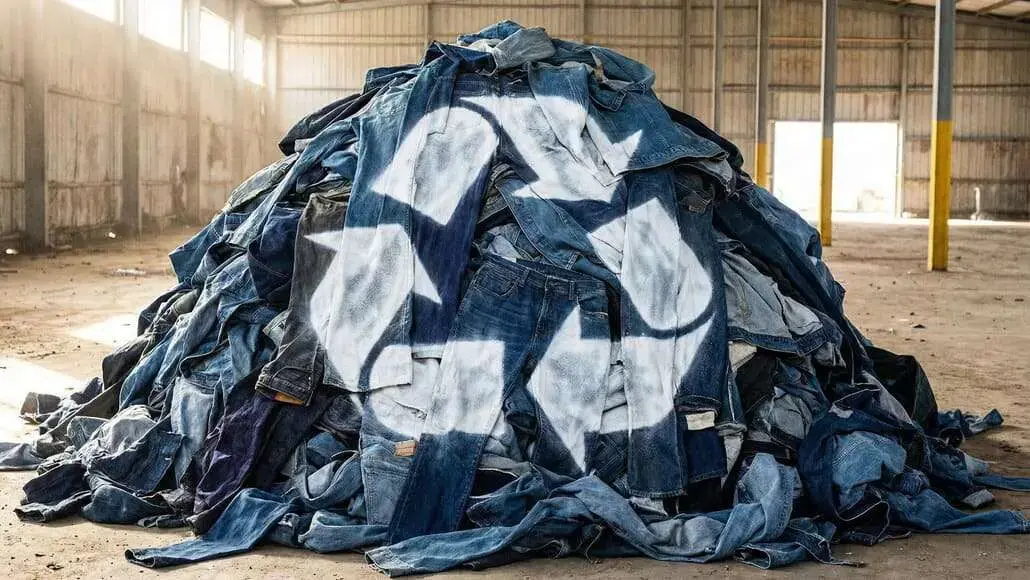
The Denim Deal has expanded its international membership to 70 organisations, reinforcing industry collaboration aimed at increasing the use of post-consumer recycled cotton in denim fabrics and jeans. The initiative is working towards a target of producing one billion jeans containing at least 20% post-consumer recycled cotton by 2030.
Led by a European industry partnership, the Denim Deal seeks to establish common standards and encourage circular practices throughout the denim value chain. Its growing network brings together manufacturers, technology developers, research organisations and supply chain specialists working to make recycled cotton a more widely adopted material in denim production.
Among the latest additions is ANSI-PGT-jeans, a manufacturer with operations in Belgium and Tunisia, alongside Turkey-based Baytech, which specialises in producing HandMadeStone (HMS), an alternative to conventional pumice stone used in denim finishing.
The expanded membership also includes companies developing technologies to improve the environmental performance of textile manufacturing. Paris-based EveryDye has introduced a dyeing process that uses cellulose as a carrier for colour derived from mineral or natural resources, offering an alternative approach to conventional textile dyeing methods.
Austria-headquartered Agatex develops auxiliary products designed to improve the quality and processability of recycled fibres. The company is also planning to extend its operations into Thailand, potentially broadening its reach within the Asian textile manufacturing market.
Another new participant is the International Trade and Research Centre (ITRC), an Africa-based organisation working with cotton growers and companies across the textile supply chain. Its expertise includes sorting, grading and the recovery and reuse of post-consumer apparel waste, areas that are increasingly important for improving textile recycling and material recovery.
The addition of these organisations brings together capabilities spanning fibre processing, dyeing, garment manufacturing, finishing technologies and textile waste management. This broader participation is intended to support the development of more connected circular systems and increase the practical adoption of recycled cotton across the denim industry.
According to the Denim Deal, the expansion reflects a growing willingness among industry stakeholders to work towards shared standards and collective sustainability objectives.
Nicolas Prophte, Founder and Executive Director of the Denim Deal, said, “No single company can close the loop on denim. Seventy working to the same standard can.”
With its membership now reaching 70 organisations, the initiative continues to build an international network around its 2030 ambition, seeking to accelerate the transition towards more circular denim manufacturing and greater utilisation of post-consumer textile resources.