


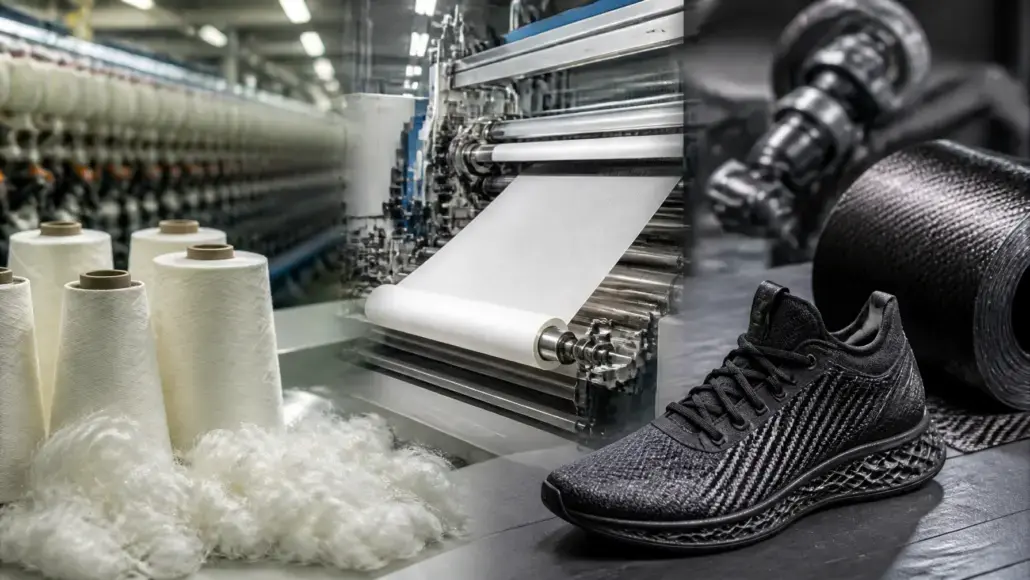
The textile and materials industry witnessed several notable developments this week, spanning sustainable fibre manufacturing, high-speed textile machinery, innovative material research and performance-focused applications in apparel and footwear. From the resumption of cellulosic fibre production in Finland to advances in spacer fabric manufacturing and carbon fibre footwear technology, these developments highlight the industry’s continued focus on material innovation, production efficiency and functional performance.
Spinnova Restarts Cellulosic Fibre Production in Finland
Finnish materials technology company Spinnova has successfully completed its first batches of fibre at the Eteläportti demonstration facility in Jyväskylä, Finland, marking an important step towards resuming commercial production. The company confirmed that the newly manufactured fibre is ready for delivery to customers for further processing.
Spinnova took full ownership of the Eteläportti facility in October 2025 and began preparations for test production in April. Following a series of production trials, the facility has achieved output volumes and fibre quality comparable to those recorded during its previous operating phase.
The company’s patented mechanical manufacturing technology converts wood pulp and waste-based raw materials into textile fibres without dissolving the original feedstock. Potential inputs include discarded textiles, leather waste and agricultural residues, offering an alternative approach to conventional fibre production.
Commenting on the progress, Ari-Matti Tuovinen, Operations Director at Spinnova, stated: “The test runs have progressed according to plan at the Eteläportti factory. During the autumn, we have completed several test runs and validated the developed process improvements, with good results. As part of the test runs, we have produced fiber for commercial use, which is now ready for delivery for further processing. During the remainder of the year, we will prepare to move into larger scale production phase.”
The development represents a significant milestone for Spinnova as it prepares to advance from demonstration-stage operations towards larger-scale manufacturing.
Karl Mayer Unveils Faster Machinery for Spacer Fabric Manufacturing
Textile machinery manufacturer Karl Mayer has introduced its latest seven-bar double-needle bar raschel machine, the RD 7/2-6 MAX, at its Changzhou facility in China during ITMA Asia 2026. The company claims that the new equipment can operate more than 30% faster than comparable machinery currently available in the market.
Designed for manufacturing spacer fabrics used in footwear, sportswear, mattresses and technical textile applications, the machine operates at speeds of up to 1,400 revolutions per minute. Its improved performance comes from several engineering changes, including the first application of carbon fibre-reinforced plastic technology in a double-needle bar raschel machine. Karl Mayer has also redesigned the machine frame and drive system, repositioned its levers and modified the latch needles to support higher operating speeds.
Kay Hilbert, Head of Design Fabrics and Specials at Karl Mayer, noted: “The potential applications for spacer fabrics — especially in high-volume markets — are so diverse that the issue of production efficiency is becoming increasingly important.”
Alongside the RD 7/2-6 MAX, the company is presenting its Big Beam concept for tricot machines at the Shanghai exhibition. The configuration features two warp beams, each measuring 156 inches in width, helping reduce preparation time and eliminate fabric inconsistencies that can occur when smaller beams are joined.
Other equipment on display includes the HKS 2-SE and HKS 3-S EL tricot machines, both featuring working widths of 312 inches. Karl Mayer is also showcasing machinery at its Changzhou facility designed to convert staple fibres, including cotton and wool, into warp-knitted fabrics.
China continues to represent Karl Mayer’s largest market, according to CEO Lutz Wolf. By November 23, the company had recorded nearly 300 visitor reports at the Shanghai exhibition and approximately 250 at its accompanying product showcase in Changzhou.
Indian Research Examines Pine Needle Cellulose for Microfibre Removal
Research into alternative materials for textile wastewater treatment is exploring the potential of cellulose extracted from discarded pine needles to capture plastic microfibres released during domestic laundry.
The research initiative involves Anya Goyal, a student at Crimson Global Academy based in Navi Mumbai, and Chandresh Kumari of Shoolini University. Their work focuses on extracting nanoscale cellulose from discarded pine needles, a natural source of the structural material found in plant cell walls.
The researchers used electron microscopy and particle-size analysis to examine the extracted material. However, they have not yet disclosed results demonstrating whether the cellulose can effectively capture synthetic microfibres from laundry wastewater.
The research highlights an emerging area of interest in textile-related environmental innovation, particularly the use of plant-based waste materials to address pollution associated with synthetic clothing.
Goyal is scheduled to present the findings at the Materials Research Society Fall Meeting and Exhibit in Boston on December 2.
Woolly Expands Merino Wool Applications Across Activewear and Everyday Apparel
Seattle-based Woolly Clothing Co. is placing merino wool at the centre of its Fall/Winter 2026 collection, extending the material’s use across underwear, activewear and everyday clothing. According to the company, wool accounts for between 95% and 100% of the primary fabric compositions used in the collection.
The brand uses a 17.5-micron merino knit weighing 175 grams per square metre for everyday garments, while its leggings feature a heavier 360-gram-per-square-metre construction intended to provide additional coverage and support.
Women’s bralettes and underwear incorporate a blend of 95% merino wool and 5% elastane, while several men’s underwear styles use 100% merino wool. The company’s MerinoAire boxer briefs also feature panels made entirely from merino mesh.
Beyond its core fabric offerings, Woolly incorporates wool-blend jacquard waistbands and ceramic buttons into selected garments, extending the use of natural materials across different product components.
James Kelly, co-founder of Woolly, said: “For more than a decade, we’ve been proving that merino doesn’t have to be a luxury.”
The company states that its wool carries Woolmark and Responsible Wool Standard certifications. The Fall/Winter 2026 collection is available through the brand’s website and Amazon, reflecting continued efforts to position merino wool as an option for everyday and performance-oriented clothing.
Carbitex and So iLL Introduce Carbon Fibre Technology in Climbing Footwear
Carbon fibre technology is entering another specialised footwear segment through a collaboration between materials technology company Carbitex and climbing footwear brand So iLL.
The partnership has resulted in the integration of Carbitex’s flexible MonoFlex carbon fibre plate into So iLL’s Lever climbing shoe. The technology forms part of the shoe’s midsole and is engineered to provide directional flexibility, bending in one direction while maintaining stiffness in the other.
This construction is intended to deliver support and stability when climbers use small footholds, while allowing the footwear to adapt to climbing surfaces through controlled flexibility.
Development of the Lever shoe began in May 2022, with So iLL bringing Carbitex into the project in June 2024. The product is now available, while the companies are considering further applications of carbon fibre technology across climbing and outdoor footwear in 2027.
Junus Khan, President and Founder of Carbitex, stated: “Climbers demand a combination of precision, support and natural foot movement, and that’s exactly what MonoFlex was designed to deliver. We’re excited to debut this technology with So iLL, a small family-owned business that has spent over a decade advancing climbing footwear with a distinct vision for the future of the sport.”
The collaboration demonstrates how advanced composite materials are finding applications beyond traditional industrial uses, particularly in footwear designed for specialised performance requirements.
OrthoLite Expands Footwear Materials Portfolio with New ATPU Insoles
Footwear materials supplier OrthoLite, part of Coats Group’s footwear division, is expanding its technology portfolio with the introduction of the Lift collection, a new range of insoles based on supercritically foamed aliphatic thermoplastic polyurethane (ATPU).
The launch marks an expansion beyond the company’s established open-cell polyurethane technology, introducing alternative foam constructions designed for different footwear performance requirements.
The Lift range includes two formulations. Lift ATPU uses a closed-cell foam structure with water-resistant properties and a reported resilience level of at least 65%. The second formulation, Lift DLT, combines a foamed ATPU base with a customisable open-cell polyurethane top layer.
The company plans to showcase the new collection at The Running Event in San Antonio, scheduled to take place from December 1 to 3.
The introduction reflects ongoing material development within the footwear supply chain, where manufacturers are exploring new foam technologies and material combinations to address requirements related to cushioning, resilience, water resistance and product performance.