


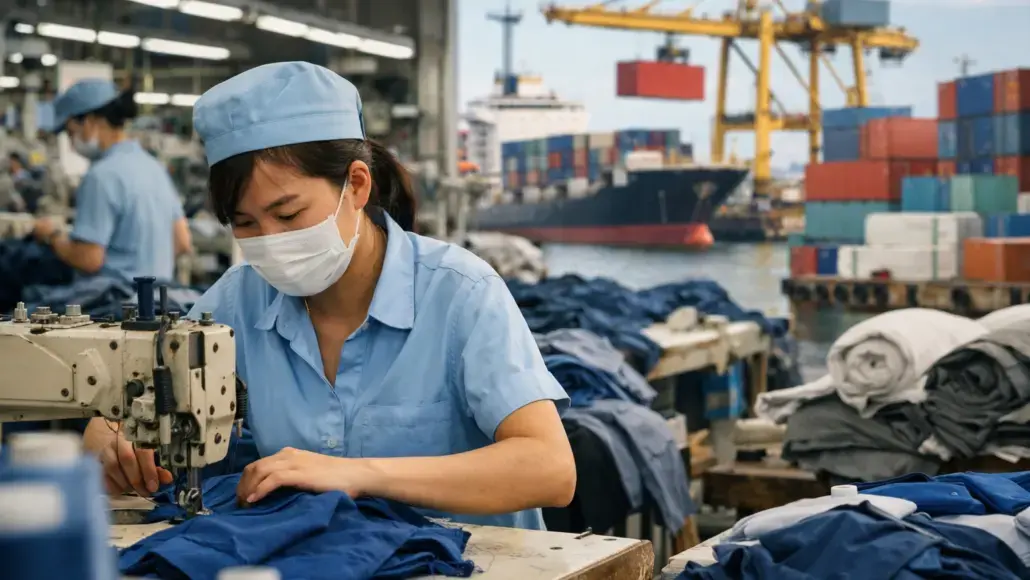
Vietnam’s garment exports have recorded a 3.9% increase in the first months of 2025, reflecting continued demand from global buyers. However, the country’s heavy reliance on imported fabrics — predominantly from China — continues to cast a shadow over the long-term sustainability of its textile supply chain, raising questions about the depth of Vietnam’s domestic manufacturing capabilities.
Export Growth Signals Steady Demand
Vietnam’s apparel industry posted garment exports worth approximately USD 3.86 billion in January and February 2025 combined, marking a 3.9% year-on-year rise. The United States remained the largest destination for Vietnamese garment exports, absorbing a significant share of the outbound shipments. Japan and South Korea followed as key markets, reinforcing Vietnam’s position as one of Asia’s leading garment manufacturing hubs.
The Vietnam Textile and Apparel Association (VITAS) has been actively working to sustain this upward momentum, as the country competes with regional peers for global orders. The garment manufacturing sector remains one of Vietnam’s most critical industries, employing millions of workers and contributing substantially to the national export revenue.
Fabric Imports Reveal the Core Challenge
Despite the encouraging export numbers, Vietnam’s textile supply chain continues to reflect a structural imbalance. The country imported around USD 2.73 billion worth of textiles and fabric materials during the same January–February 2025 period, a rise compared to the corresponding period last year. China accounted for the dominant share of these fabric imports, supplying the raw materials that Vietnamese factories transform into finished garments destined for Western markets.
This dependency on fabric imports from China exposes a well-known vulnerability within the textile supply chain — Vietnam’s domestic fabric and yarn production has not scaled at a pace that matches the country’s export ambitions. While Vietnam excels in garment manufacturing, the upstream segments of the supply chain, particularly fabric weaving and dyeing, remain underdeveloped.
The Raw Material Gap
The gap between garment exports and domestic fabric production means that a substantial portion of the value added in Vietnam’s apparel industry actually originates outside the country. For Vietnam garment exports to maintain competitiveness under trade agreements that include yarn-forward or fabric-forward rules of origin — such as the Comprehensive and Progressive Agreement for Trans-Pacific Partnership (CPTPP) — the country needs greater domestic fabric sourcing capability.
Currently, Vietnam imports not just fabric from China but also yarns and other textile intermediates from South Korea and Taiwan. This multi-layered import dependency underlines how much of the textile supply chain Vietnam still needs to build domestically if it is to fully capitalize on its free trade agreement network.
Industry and Trade Context
Vietnam’s garment manufacturing sector has benefited considerably from the ongoing diversification of global supply chains, with international buyers increasingly looking beyond China for production. This shift has brought more orders to Vietnamese factories, contributing to the growth seen in Vietnam garment exports. However, the irony is that as Vietnam receives more business from buyers seeking to reduce exposure to China, its own production process continues to depend on Chinese fabric and materials to fulfill those very orders.
The situation reflects a broader challenge for the Vietnam apparel industry — building a more self-sufficient and vertically integrated textile supply chain is capital-intensive and time-consuming, and progress has been slower than what trade partners and policy frameworks may require.
Investment in Upstream Capacity Needed
Experts within the industry have consistently pointed to the need for greater investment in fabric mills, dyeing facilities, and finishing units within Vietnam to close the supply chain gap. The Vietnam apparel industry has attracted considerable foreign direct investment in garment assembly, but investment in the upstream textile segment — which is more environmentally complex due to dyeing and treatment processes — has been comparatively limited.
Developing this upstream capacity is not just about meeting rules-of-origin requirements for preferential tariffs. It is also about increasing the value retained within the country from each unit of Vietnam garment exports, thereby strengthening the economic contribution of the sector to the national economy.
Looking at the Numbers
The data from the first two months of 2025 paints a clear picture. Vietnam garment exports are growing, but the textile supply chain feeding those exports remains heavily import-dependent. The ratio of fabric imports to garment export value continues to highlight how much of the production input is sourced from abroad, particularly from China.
For the Vietnam apparel industry to build genuine resilience — and to maximize the gains from its trade agreements — closing this supply chain gap remains an urgent priority. The 3.9% export growth is a positive indicator of demand and competitiveness, but it also makes the underlying structural imbalance more visible, not less.