

























China has raised the bar for textile wastewater testing by introducing a biological survival requirement under its new discharge standard. The regulation, known as GB 4287-2026, now mandates that certain dyeing and finishing operations demonstrate that fish embryos can survive exposure to their treated wastewater — a biological check that sits alongside existing chemical limits.
The standard came into effect on September 1 for new, rebuilt, and expanded facilities. Existing facilities are required to comply from January 1, 2028, though provincial governments may approve an earlier rollout. Published jointly by China’s Ministry of Ecology and Environment and the State Administration for Market Regulation, GB 4287-2026 replaces four standards from 2012 that previously covered dyeing and finishing, silk reeling, wool, and hemp operations.
What the Fish Embryo Test Requires
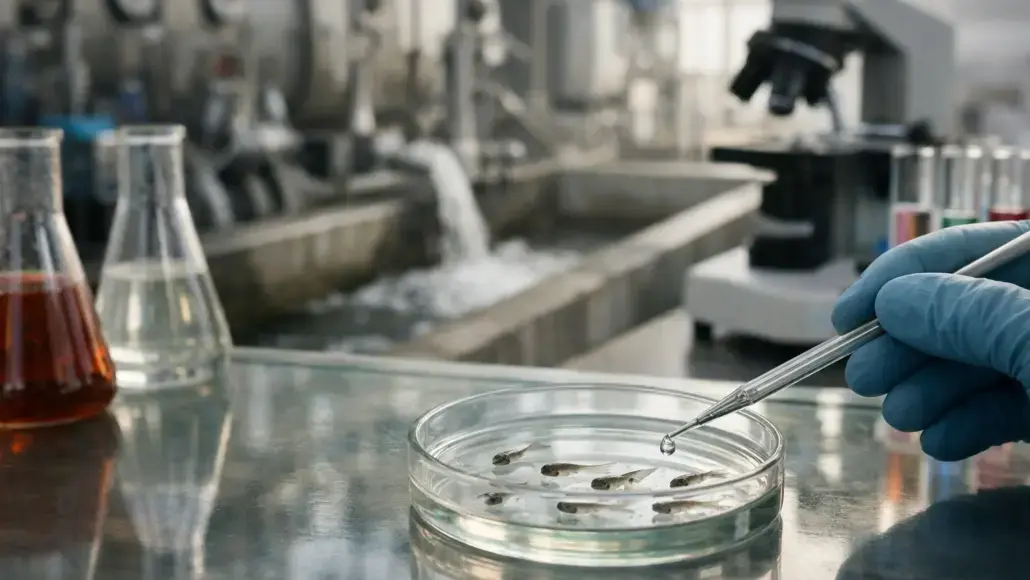
The test protocol uses newly fertilized zebrafish eggs exposed for 48 hours to a wastewater sample diluted to one-sixth of the test solution. At least 90 percent of the embryos must survive at approximately 79 degrees Fahrenheit for the facility to meet the standard. Facilities subject to the strictest discharge-permit management must conduct this fish embryo toxicity test at least every six months, while other covered dischargers are required to test at least annually.
The significance of this measure lies in what it can detect that conventional testing cannot. Traditional tests track individual chemical parameters — such as ammonia levels or the concentration of a named metal — while textile wastewater testing using a biological organism assesses the combined acute effect of the entire treated effluent mixture. China’s Ministry of Ecology and Environment acknowledged that earlier textile standards lacked this kind of overall toxicity control for dyeing and finishing wastewater.
Scope and Applicability of GB 4287-2026
The fish embryo limit applies to treated wastewater released directly into rivers, lakes, or other water bodies by dyeing and finishing operations — excluding purely physical finishing processes — as well as dedicated textile-industry wastewater treatment plants. Where a mill sends its wastewater to a shared textile treatment facility, the toxicity check is carried out at that facility’s final discharge point rather than at the mill’s own outlet. Mixed-industry treatment plants are not listed under the fish embryo limit.
Separately, the standard prohibits new dyeing and finishing operations — again excluding purely physical finishing — from sending wastewater to municipal treatment plants.
Bluesign’s Position and Proposed Expansion
For textile chemical management specialist Bluesign, the Chinese regulation aligns with its own longstanding approach to effluent management. The organization has required fish egg toxicity testing for over a decade from chemical suppliers that discharge treated wastewater directly into water bodies.
Sumit Sarker, a sustainable textile expert at Bluesign Academy, explained the rationale for pairing chemical input controls with biological output testing: “The Bluesign Criteria address chemical inputs and wastewater treatment, but these controls alone cannot show the combined biological effect of the final effluent. Whole-effluent toxicity testing adds a final biological check that the treated wastewater does not cause unacceptable acute toxicity.”
Bluesign is now proposing to extend annual biological testing requirements across a broader segment of its supplier network. Its draft revisions would apply to directly discharging yarn and textile manufacturers, as well as consumer-product manufacturers with wet processing operations, including denim. For textile manufacturers, the proposed requirement would apply to sites discharging more than 5 cubic meters of wastewater daily.
Test Hierarchy Under Bluesign’s Proposed Criteria
Under the draft, fish egg toxicity is designated as the preferred test method, followed by water fleas — known as daphnia — then algae, and then bacteria. A site may only use the next test in that sequence when testing at the higher level is not reasonably available through an accredited laboratory. The proposed fish egg limit uses the same dilution factor of six as China’s GB 4287-2026 standard.
Bluesign is accepting public comments on its revised criteria through October 30. The organization plans to publish the final documents in the fourth quarter of the year, followed by a general one-year transition period.
What a Failed Test Indicates
A failed dyeing and finishing effluent test confirms that the treated wastewater has an acute toxic effect under the test conditions, but it does not identify the cause on its own. Bluesign notes that potential sources of failure include production chemicals that survive the treatment process, substances formed during production or treatment, and problems within the treatment system itself. Further investigation is required to isolate the root cause.
Guidance for Brands Sourcing from China
For brands that source from facilities in China, Bluesign recommends a structured approach to managing textile wastewater testing compliance. This includes establishing where a supplier’s wastewater is discharged, confirming whether an accredited laboratory has conducted testing, and understanding how the facility would investigate and correct a failed result. Its guidance also calls for reviewing chemical inputs and evaluating ongoing treatment performance.
Bluesign’s position on the matter is clear: “A single passing result is a snapshot. Ongoing monitoring is a system.” The organization’s emphasis on continuous oversight reflects the underlying message of the new Chinese standard — that passing a test once is not equivalent to consistently safe effluent discharge.
With GB 4287-2026 now in force and Bluesign’s own criteria under revision, textile wastewater testing is moving firmly toward biological measurement as a standard component of environmental compliance across the global textile supply chain.