































When policymakers sit down to discuss defense readiness, the conversation almost always moves toward semiconductors, rare earth magnets, and advanced optics. These materials dominate legislation and media coverage alike. What continues to be left off the list is engineered technical textiles — the category of materials that equips, protects, and in critical moments saves the lives of American warfighters every single day.
This is not a simple oversight. The word “textile” immediately calls to mind fabric bolts and sewing machines, not computer-controlled looms, aerospace certification standards, or advanced polymer laboratories. But engineered military textiles are sophisticated systems designed to tolerances measured in fractions of an ounce per yard, built from high-performance synthetic materials, and qualified under strict specifications that take years to develop. Two imperatives make this matter urgently: availability and innovation. Lose either, and military readiness pays a steep price.
What Technical Military Textiles Actually Are
The scope of this category extends well beyond what most people would expect. Parachute panel fabrics, seam reinforcements, harnesses, and risers. Soft ballistic panels and armor carriers. Cargo restraints for airdrop operations. Thermal protection systems for aerospace reentry vehicles. Structural composite preforms for aircraft components. These are not off-the-shelf products; they are precision-engineered systems, and the knowledge required to produce them correctly is neither obvious nor easy to acquire.
Engineering begins at the fiber level. Where military webbing once relied on cotton or silk, today’s applications demand high-performance synthetics — nylon, Kevlar®, Nomex®, Vectran®, Zylon®, Spectra®, Dyneema® — and next-generation materials like Kevlar® EXO. Each carries a distinct mechanical profile covering tensile strength, elongation, abrasion resistance, heat tolerance, and chemical stability. Matching the right fiber to a given application demands deep material science expertise.
Why Weaving Architecture Is as Critical as the Fiber
Selecting the right fiber is only half the engineering challenge. How that fiber is woven determines whether its properties translate into real-world performance — and this is precisely where the complexity of military textiles becomes most apparent.
The most fundamental weave structures — plain, twill, and satin — each carry distinct trade-offs. Plain weaves deliver the greatest strength per interlacement and are widely used in high-load flat webbing for cargo systems and harnesses. Twill weaves introduce greater flexibility and more efficient tensile strength transfer, making them well-suited for load-bearing equipment that must balance strength with weight and endure repeated stress cycles. Tubular weaves, which produce a seamless hollow structure, are preferred in parachute applications because they are more pliable, better at holding knots, and more resistant to abrasion than flat equivalents.
Getting these trade-offs right for a specific application is not a matter of catalog selection. It demands intimate knowledge of how yarn type, weave density, and loom tension interact under load. Jacquard loom technology adds another layer of complexity through software-controlled fiber placement within intricate weave structures, providing shear strength and interlaminar shear resistance. The way yarns are interlaced within a structure ultimately dictates the final performance characteristics of the finished fabric.
The 3D Weaving Frontier
At the most technically demanding frontier of military and aerospace textile engineering sits 3D weaving. Where conventional looms work across two dimensions — length and width — 3D looms interlock yarns through the thickness of the material as well, creating a fully integrated single structure with no discrete layers. The performance implications are substantial.
Layered two-dimensional composites used in structural aerospace and armor applications are vulnerable to delamination — the separation of layers under impact or cyclic stress — which can lead to catastrophic component failure. Three-dimensional woven composites eliminate this failure mode entirely because the structure is fully interconnected throughout its thickness. For aircraft components, armor inserts, and aerospace reentry systems, this represents a fundamental improvement in structural reliability.
Beyond reliability, 3D woven composite structures can reduce component weight by up to 30 percent compared to equivalent metal parts. In military aviation, that weight reduction translates to an estimated one million dollars in reduced fuel costs per pound saved over an aircraft’s operational lifetime. Additionally, 3D weaving produces components close to their final shape directly on the loom, eliminating the time-consuming hand-layup and machining steps required for traditional two-dimensional laminated composites — resulting in faster production, lower costs, and reduced manufacturing variability for military procurement programs.
Developing 3D weaving capability requires purpose-built loom technology, specialized design engineering, and years of iterative qualification work. It is not a process that can be stood up quickly. Bally Ribbon Mills began developing these capabilities under a U.S. Air Force Research Laboratory contract in 1991 and has been advancing them continuously since.
The Supply Chain Risk That Rarely Makes Headlines
The majority of U.S. commercial textile manufacturing has been lost to offshore competition. In the past two years alone, 40 textile mills and supply chain producers have shuttered their operations. Over three decades, manufacturers who once produced in the United States relocated first to Mexico and then moved fully to Asia. For what domestic textile fabrication and cut-and-sew manufacturing remains, U.S. textile producers face competitive imports priced at more than half below domestic production costs. For commodity products, that competitive battle has, for now, been largely conceded.
Technical military textiles are an entirely different category, and the stakes of losing domestic capacity in this segment are severe. The knowledge embedded in certified parachute webbing or Berry Amendment-compliant Kevlar® harness components — covering fiber selection, loom programming, weave architecture, testing protocols, and certification records — represents decades of accumulated development. It cannot be reconstructed in months. In a conflict scenario or supply chain crisis requiring a rapid production surge, there is no viable substitute for established domestic capability.
World War II delivered this lesson at the worst possible moment. When Japan severed America’s silk supply in December 1941, silk was the primary material in military parachutes. The successful pivot to nylon that followed depended entirely on domestic manufacturers who already possessed the infrastructure, loom technology, and military relationships to execute that transition rapidly. The Berry Amendment — codified at 10 U.S.C. § 4862 — exists to ensure that lesson does not have to be relearned.
The amendment requires the Department of Defense to procure textiles that are domestically manufactured on a fiber-forward basis: yarn must itself be U.S.-sourced and U.S.-produced. A complete chain-of-custody documentation trail — including affidavits, sourcing records, and lot traceability — must flow from raw material through finished component. “Made in America” is not sufficient, nor is domestic weaving using imported yarn. Compliance is demanding and extensively documented by design, and that documentation infrastructure is itself a strategic national asset.
Every production lot supplied for military use is accompanied by test reports covering tensile strength, thickness, weight per yard, elongation, abrasion resistance, and color fastness, alongside yarn affidavits certifying domestic fiber origin. For aerospace-certified products, the quality management system generating those records must itself be certified — in the case of Bally Ribbon Mills, to both ISO 9001:2015 and AS9100D. When a tier-one defense contractor submits a finished system for military qualification, the documentation package from their textile supplier becomes part of the certification dossier. Incomplete records stall the entire approval process.
Kevlar® EXO and the New Era of Fiber Innovation
Availability without innovation produces stagnation. Military advantage depends not only on domestic access to current materials, but on continuous development of the next generation. On the fiber side, DuPont’s Kevlar® EXO represents the most significant advancement in para-aramid technology in decades — and its performance data is concrete.
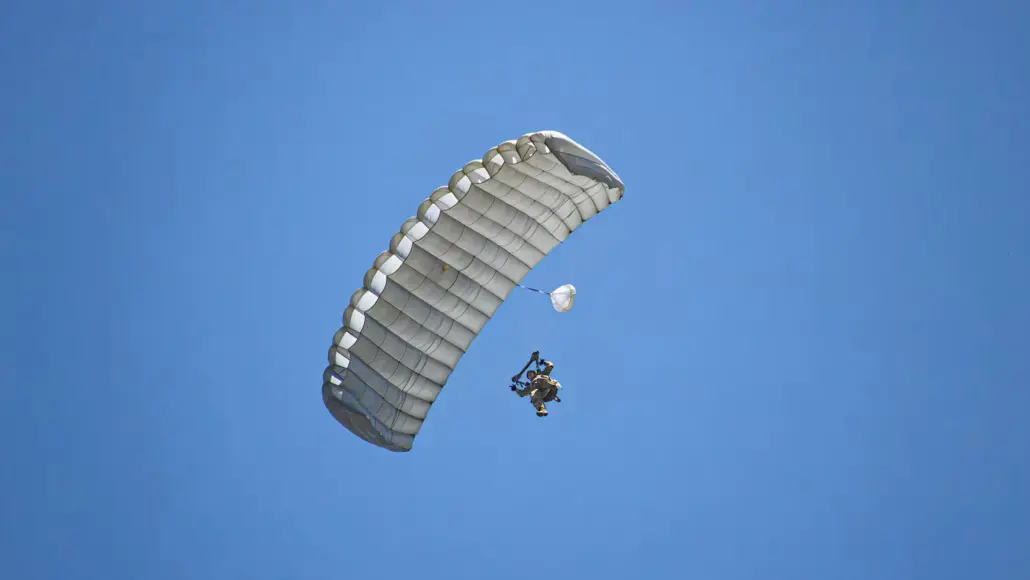
Bally Ribbon Mills’ current 1¾-inch Kevlar® 29 riser webbing, certified to PIA-T-87130, achieves an average tensile strength of 23,000 lbs. at 2.41 oz/yd. The Kevlar® EXO version reaches 29,500 lbs. at just 1.77 oz/yd — representing a 28 percent strength increase at 27 percent less weight. For military parachute systems, these numbers carry direct operational consequences.
A lighter parachute system allows the same aircraft to carry more personnel, equipment, or cargo on a given mission, or carry an equivalent load farther on less fuel. Reduced webbing weight also decreases the packed volume of the parachute assembly, allowing more compact storage on aircraft and easier handling by operators in the field. Weight savings in individual components compound across an entire fleet, with fuel consumption reductions on every mission resulting in savings measured in millions of dollars over an aircraft’s operational life.
Achieving these results required a multi-year development process conducted in collaboration with DuPont and parachute system manufacturers, involving bench-top analysis, repeated loom trials, rigorous testing against PIA-T-87130 specifications, and qualification through a co-investment model that brought fiber developer, textile manufacturer, and end-user together around a shared technical objective. Kevlar® EXO is already proven in military body armor applications, where its lighter weight extends operational effectiveness by reducing the fatigue burden of heavy protection systems. Its potential across additional military soft-goods applications — load-bearing harnesses, armor carriers, and vehicle restraint systems — is actively being explored.
What Defense Procurement Must Recognize About Technical Textile Supply
Technical textile supply is a long-lead capability. The expertise that makes a supplier valuable to the defense industrial base — material science depth, advanced weaving technology, certified quality systems, active fiber development partnerships, and qualified mil-spec product portfolios — takes decades to build and cannot be quickly replicated once lost.
When that expertise atrophies because contracts shift to lower-cost alternatives, the capacity does not simply move elsewhere. It disappears. The domestic supply chain resilience framework now rightly applied to semiconductors and rare earth materials applies with equal force to military textiles. Maintaining domestic technical textile manufacturers — by supporting R&D partnerships, mil-spec certification work, and the full innovation pipeline from fiber developer through weaver to system integrator — represents a national security decision as consequential as any other defense procurement policy.
Military textiles protect warfighters, protect air assets, carry critical loads, absorb impact, and form the structural backbone of aerospace systems. They are engineered to tolerances that take years to master and certified to standards that take years to earn. They are, in every meaningful sense, part of the arsenal — and the arsenal must be prepared before it is needed.

