


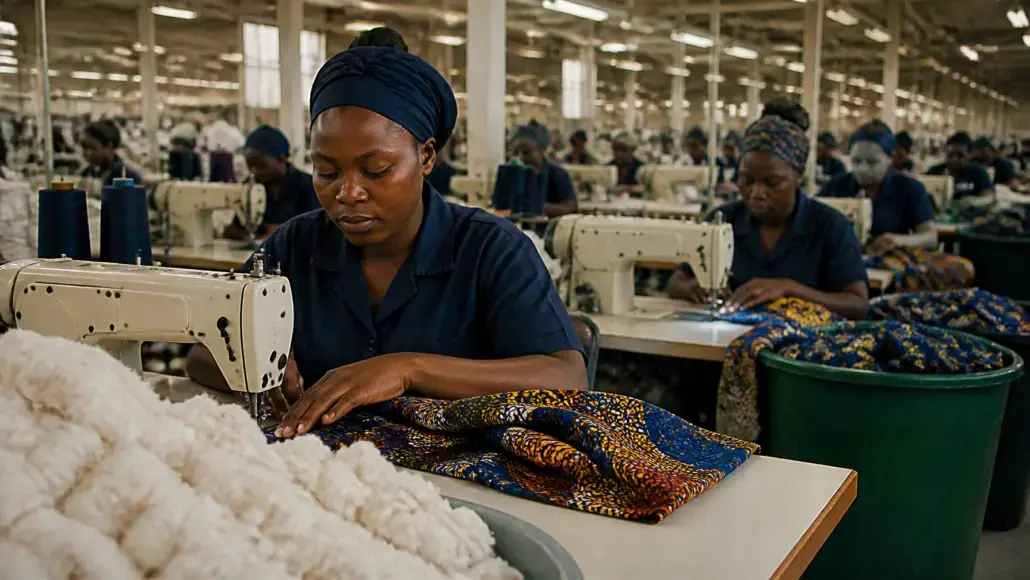
The Africa Made It initiative has outlined that the continent could generate approximately $34 billion in annual GDP contributions by scaling up local capacities. By transforming raw materials into finished apparel, African cotton processing can directly stimulate garment production and create nearly two million permanent industrial jobs. This strategy was detailed on Tuesday in Lagos during the official launch of the “Power, Protect, Purchase” campaign, a movement focused on advancing industrialization across the fashion value chain.
Addressing the Annual Trade Deficit
Data from the initiative indicates that Africa currently exports up to 98 percent of its raw cotton. Consequently, the continent retains only about two percent of the value generated from this commodity, leading to an estimated $35 billion annual trade deficit. Expanding domestic manufacturing capacity for cotton spinning, weaving, and overall garment production is projected to add roughly $33 billion in additional household income each year. This expansion would concurrently strengthen industrial jobs throughout the region.
The Power, Protect, Purchase Framework
The campaign is structured around three core priorities designed to bolster domestic manufacturing. These include securing reliable and competitive energy sources for industrial mills, shielding emerging domestic producers from unfair foreign competition, and encouraging consumers to purchase locally manufactured items. Representatives from Africa Made It noted that this approach empowers economies to retain greater value from their natural resources, rather than exporting raw materials and importing finished goods.
Bridging the Structural Gap
To effectively transition the continent’s industry, the initiative identified a $1.8 billion capital requirement for critical structural infrastructure. This investment aims to address the missing middle within the fashion value chain, ensuring that African cotton processing becomes a sustainable and highly integrated reality.
Empowering Rural Economies and Women
Beyond macroeconomic improvements, the campaign emphasized the direct impact on rural communities and women. Increased local production and purchasing can improve capital circulation in rural areas. Furthermore, the expansion of formal employment opportunities is expected to significantly benefit women, who currently represent between 70 and 90 percent of factory workers within the sector across the continent.
Securing Economic Returns on Culture
Marie Wilke, editor-in-chief of Africa Made It magazine, observed that the continent’s growing influence in global fashion, music, and media has not yet yielded proportional economic returns due to limitations in domestic manufacturing. Wilke explained that closer integration between cotton farming and local processing allows countries to maintain intellectual property, commercial margins, and essential industrial jobs.
“African culture, design, and storytelling influence global fashion, music, and media like never before. Yet, without domestic manufacturing infrastructure, Africa’s creative authority yields very little economic return,” Wilke stated. She affirmed that linking raw material yields to internal processing networks retains maximum economic value on the continent.

