






























Online retail’s most visible battleground is the front end: faster sites, cleaner apps, sharper marketing. Yet the real competitive edge increasingly sits out of view, in the systems that decide whether an order arrives tomorrow, next week, or not at all. In practice, fulfilment infrastructure the storage, picking, packing, shipping and returns engine behind every checkout has become the operating system of e-commerce. As customers demand speed, accuracy and convenience as standard, retailers are rebuilding this backbone to keep pace.
Warehouses are becoming machines, not just buildings
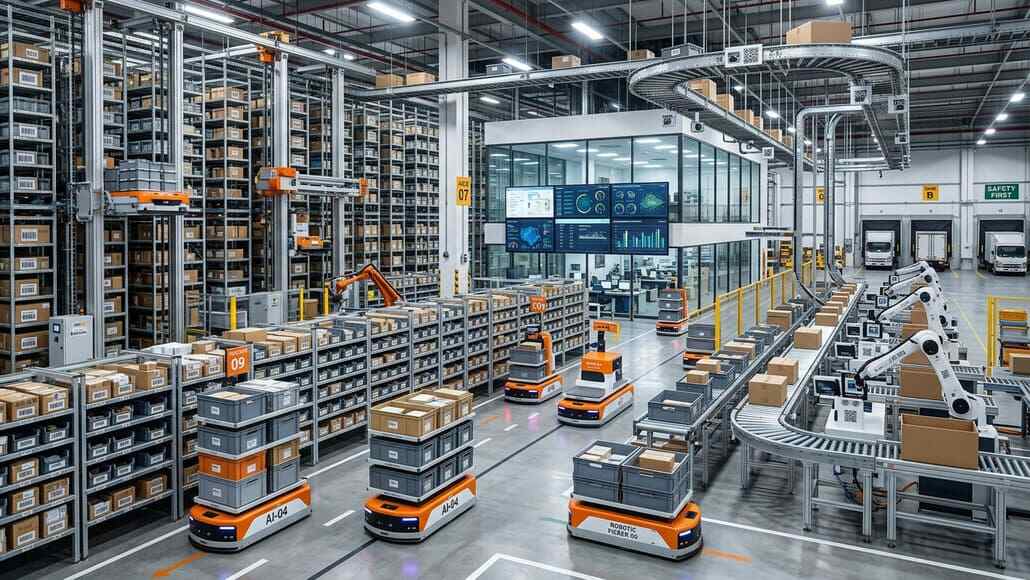
The modern fulfilment centre looks less like a sea of shelves and more like a choreographed production line. Where traditional warehouses depended on staff walking long aisles to find items, today’s facilities increasingly deploy robotics, automated storage and retrieval systems and AI-based orchestration to compress time and distance. Robots can bring inventory to the picker rather than the other way around, raising throughput and improving accuracy. That reduction in mis-picks matters when operations are processing tens of thousands of parcels a day and a small error rate becomes a costly flood of customer service cases.
Automation also stabilises performance during demand spikes. When a promotion hits or seasonal volumes surge, automated workflows can scale more predictably than purely manual operations, while also lowering the risk of mistakes that erode margin through reships and refunds.
From one mega hub to many smaller nodes
The second structural shift is geography. To meet the promise of next-day and same-day shipping, retailers are moving away from reliance on a single central warehouse and toward distributed networks of fulfilment sites placed closer to where customers live. With inventory positioned in the right places, shipping distances shrink, delivery times tighten and carrier costs can fall.
For many retailers, this distributed model is too complex to run without specialist support. Inventory has to be balanced across locations, demand has to be forecast at a regional level and replenishment decisions have to happen continuously. As a result, many businesses lean on fulfilment partners to manage the complexity and keep the network responsive.
Micro fulfilment rises as speed expectations harden
The push for faster delivery has also created space for micro fulfilment small, highly automated facilities located in dense urban areas or even integrated into existing stores. These sites are built for rapid processing of local orders, reducing the last-mile distance and helping retailers meet tight delivery windows.
Grocery has been a major catalyst here, where speed and freshness are non-negotiable. But micro fulfilment is increasingly relevant across categories where consumers expect near-immediate availability, particularly in major cities.
Software now dictates flow, not just labour
Hardware gets attention, but the real nervous system of fulfilment infrastructure is software. Advanced warehouse management systems provide real-time visibility into inventory, optimise where products are stored and coordinate the choreography of picking, packing and dispatch. With machine learning layered on top, these tools can anticipate demand shifts, flag stock risks and suggest rebalancing moves before service levels drop.
That intelligence reduces two expensive failures at once: stockouts, which cost sales and damage trust, and excess inventory, which ties up capital and increases markdown pressure. When demand changes quickly, visibility and responsiveness are the difference between a smooth operation and a costly scramble.
AI and predictive analytics reshape planning
Predictive models are increasingly being used to decide what stock should sit where, and when. By analysing historic sales, seasonality and behavioural patterns, retailers can pre-position inventory across regions so orders travel fewer miles and process faster. The same forecasting logic can be applied to workforce planning and transport routing, cutting overtime costs and improving utilisation.
This is also where many retailers gain the confidence to promise faster delivery: not by working harder, but by planning earlier and moving stock before customers click “buy”.
Last mile delivery is still the hardest mile
Even the best warehouse cannot fix a broken last-mile network. The final journey from a local depot to the customer’s door remains the most expensive and operationally messy step in e-commerce logistics. To reduce friction, retailers are combining fulfilment operations with alternative delivery models, including local courier partnerships, parcel lockers and crowdsourced networks. Longer term, autonomous vehicles and drones remain on the horizon, but even without them, the goal is the same: increase density, cut failed deliveries and reduce per-drop cost.
Sustainability becomes operational, not optional
As e-commerce grows, so does the environmental burden of packaging, transport and energy-intensive facilities. Many retailers are now investing in lower-impact operations: energy-efficient warehouses, route optimisation, recyclable packaging and renewable power sources such as solar. Some are electrifying delivery fleets where feasible, reducing emissions in urban zones.
The shift is partly reputational, partly regulatory and partly economic. More efficient routes and better packaging choices often reduce cost as well as carbon.
Returns management is a profit lever
Returns are a defining reality of online apparel and footwear retail, and they can quickly erode profitability. Modern systems are therefore being designed to process returns faster, sort items accurately and route them to the most value-preserving outcome restock, refurbish, secondary channels or liquidation. Automated sorting and tracking tools help compress cycle time, which is critical because resale value often drops as a season moves on.
Data is also becoming a prevention tool. By analysing return reasons and patterns, retailers can improve sizing guidance, imagery and product descriptions, reducing avoidable returns before they happen.
Stores rejoin the network through ship from store and BOPIS
Physical stores are being repurposed as fulfilment assets. Ship-from-store turns local inventory into a delivery advantage, enabling faster fulfilment and better stock utilisation. BOPIS buy online, pick up in store offers convenience for customers and lowers last-mile delivery cost for retailers, while also creating opportunities for incremental in-store purchases.
The pandemic locked in the new playbook
COVID-19 accelerated many of these moves. As online demand surged, retailers invested rapidly in automation, logistics software and new fulfilment locations. Those capabilities did not disappear when stores reopened; they became the baseline. Consumers learned to expect speed and reliability, and retailers learned that logistics excellence is a core competitive advantage.
Where fulfilment goes next
Fulfilment will keep evolving as robotics improves, AI becomes more predictive and data becomes more real time. The retailers that win will be those that treat fulfilment not as a cost centre, but as a strategic platform that shapes customer experience, margins and brand trust.
In the end, the front-end of online retail may be what shoppers see, but fulfilment infrastructure is what they feel every time an order arrives on time, intact and exactly as expected.