































PSI 2026

Smart Jacket With AI Prevents Overheating, Adds Safety

Note* - All images used are for editorial and illustrative purposes only and may not originate from the original news provider or associated company.

Subscribe

- Never miss a story with notifications

- Gain full access to our premium content

- Browse free from up to 5 devices at once

Media Packs

Expand Your Reach With Our Customized Solutions Empowering Your Campaigns To Maximize Your Reach & Drive Real Results!
– Access The Media Pack Now!
– Book a Conference Call
Leave Message for us to Get Back

Related stories

Sorting Technologies Revolutionizing Pre-Consumer and Post-Consumer Textile Recycling

Advanced sorting technologies—near-infrared spectroscopy, Raman spectroscopy, RFID tagging, digital identification systems, and AI-powered computer vision—are revolutionizing textile material classification and enabling automated processing at previously impossible scale and accuracy. These technologies simultaneously address the sorting bottleneck that has constrained recycling scaling, achieve accuracy exceeding 95-98%, process materials at industrial speeds, and provide cost reduction of 25-35% through labor elimination and processing optimization, fundamentally transforming textile recycling economics and feasibility.

The Role of AI and Automation in Advancing Textile Recycling Systems

Artificial intelligence and automation technologies are revolutionizing textile recycling by dramatically improving sorting accuracy, material separation efficiency, and overall system throughput. Machine learning algorithms, computer vision systems, near-infrared spectroscopy, and robotic automation are transforming labor-intensive manual processes into intelligent automated systems capable of identifying and processing hundreds of items per hour with accuracy exceeding 95%, enabling scalable textile recycling infrastructure that was previously economically unviable.

How Digital Fashion Trends are Reshaping Brand Identity

Digital fashion—virtual garments, metaverse clothing, AI-styled avatars, and NFT-based digital collectibles—represents unprecedented frontier in fashion expression and brand positioning. As consumers increasingly inhabit virtual spaces through gaming, social platforms, and metaverse environments, brands develop digital-native strategies reshaping traditional fashion business models while creating opportunities for virtual-only design expression unbounded by physical materiality constraints.

A group of researchers recently unveiled a “smart” jacket equipped with advanced environmental sensors, heat-generating yarns, color-changing thermochromic yarns, and artificial intelligence (AI) for temperature control. This innovative jacket aims to prevent overheating while keeping the wearer warm. Their findings were published in the American Chemical Society (ACS) journal ACS Applied Materials & Interfaces.

Traditional electronic textiles, such as heating pads and electric blankets, help keep users warm but can pose risks like hyperthermia or burns with prolonged use. Older adults, especially those in nursing homes, are particularly vulnerable to heat-related injuries due to reduced heat sensitivity and limited temperature monitoring.

To address these issues, researchers led by Jeanne Tan developed a safer e-textile by combining AI technology with thermochromic yarn. The jacket, designed for intelligent heating, features silver-coated yarn that provides warmth with greater flexibility and less bulk compared to carbon fiber. The AI-based system was trained using data from 50 individuals of varying ages, genders, and body types, ensuring it could predict and maintain comfortable temperatures across different environmental conditions.

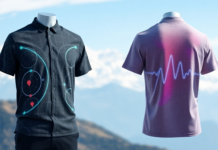
The jacket incorporates two types of color-changing yarns for real-time temperature monitoring. In well-lit environments, the yarn transitions from purple to pink when the heating temperature exceeds 30°C. In darker settings, polymeric optical fiber yarn glows blue, yellow, or red to indicate heating temperatures of 30°C, 40°C, and 50°C, respectively.

During demonstrations, the jacket’s thermochromic and optical yarns accurately displayed heating temperatures, while its AI component maintained consistent warmth even under changing environmental conditions.

The researchers believe this technology could extend beyond clothing to applications like heated car seats, furniture, and even spacesuits. The study was funded by the Laboratory for Artificial Intelligence in Design under InnoHK Research Clusters in Hong Kong.

Latest stories

Related stories

Sorting Technologies Revolutionizing Pre-Consumer and Post-Consumer Textile Recycling

Advanced sorting technologies—near-infrared spectroscopy, Raman spectroscopy, RFID tagging, digital identification systems, and AI-powered computer vision—are revolutionizing textile material classification and enabling automated processing at previously impossible scale and accuracy. These technologies simultaneously address the sorting bottleneck that has constrained recycling scaling, achieve accuracy exceeding 95-98%, process materials at industrial speeds, and provide cost reduction of 25-35% through labor elimination and processing optimization, fundamentally transforming textile recycling economics and feasibility.

The Role of AI and Automation in Advancing Textile Recycling Systems

Artificial intelligence and automation technologies are revolutionizing textile recycling by dramatically improving sorting accuracy, material separation efficiency, and overall system throughput. Machine learning algorithms, computer vision systems, near-infrared spectroscopy, and robotic automation are transforming labor-intensive manual processes into intelligent automated systems capable of identifying and processing hundreds of items per hour with accuracy exceeding 95%, enabling scalable textile recycling infrastructure that was previously economically unviable.

How Digital Fashion Trends are Reshaping Brand Identity

Digital fashion—virtual garments, metaverse clothing, AI-styled avatars, and NFT-based digital collectibles—represents unprecedented frontier in fashion expression and brand positioning. As consumers increasingly inhabit virtual spaces through gaming, social platforms, and metaverse environments, brands develop digital-native strategies reshaping traditional fashion business models while creating opportunities for virtual-only design expression unbounded by physical materiality constraints.

Subscribe

- Never miss a story with notifications

- Gain full access to our premium content

- Browse free from up to 5 devices at once

Media Packs

Expand Your Reach With Our Customized Solutions Empowering Your Campaigns To Maximize Your Reach & Drive Real Results!

– Access The Media Pack Now!
– Book a Conference Call
Leave Message for us to Get Back

Translate »