





























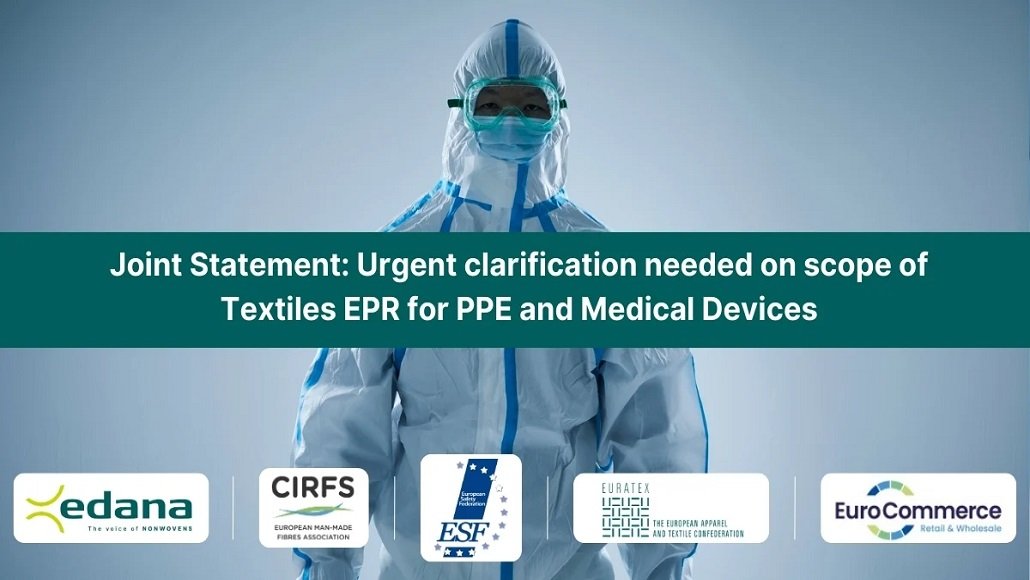

EDANA, the voice of the nonwovens sector, alongside the European Man-Made Fibres Association (CIRFS), the European Safety Federation (ESF), the European Apparel and Textile Confederation (EURATEX), and EuroCommerce (Retail & Wholesale), has issued a joint statement expressing serious worries regarding the implementation of the textile EPR directive (EU) 2025/1892, a revision of the Waste Framework Directive.
As member states begin to enforce extended producer responsibility (EPR) for textiles, the lack of distinction within the textile EPR directive is causing significant confusion, according to EDANA.
Currently, the specified combined nomenclature (CN) codes do not differentiate standard clothing from essential personal protective equipment (PPE) or medical devices.
The joint statement highlights that PPE and medical devices are specifically designed to protect users from hazardous conditions, including chemical, biological, and radiological threats. Due to their nature, these garments often become contaminated and are classified as hazardous waste, necessitating incineration (often with energy recovery) rather than recycling for safety reasons.
Integrating these products into standard textile EPR schemes poses substantial risks, including cross-contamination, regulatory conflicts, and limited circularity potential.
Mixing hazardous PPE waste with regular textiles jeopardizes both human health and environmental safety. The disposal of contaminated PPE is already regulated under Articles 13, 17, 18, and 19 of the existing Waste Framework Directive.
PPE accounts for less than 1% of textile waste, with 80-90% considered hazardous. The environmental advantages of recycling the remaining non-hazardous fraction are minimal compared to the extensive transport required to collect sufficient volumes.
The statement further urges for guidance on safety footwear. Like other personal protective equipment, these items encounter contamination issues that restrict recyclability. Manufacturers find it challenging to guarantee warranties or compliance for reused safety footwear, and the fee structure for heavier items, such as steel-toed boots, remains unclear.
Although the directive indicates that products posing safety or hygiene risks should be excluded from the EPR, this is being overlooked in national implementations by countries such as Spain and the Netherlands.
In light of these concerns, the signatories have called upon the European Commission to provide clear guidance to member states, affirming that products compliant with the PPE Regulation (2016/425) and the Medical Devices Regulation (2017/745) are outside the scope of the textile EPR directive.