


















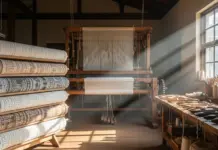










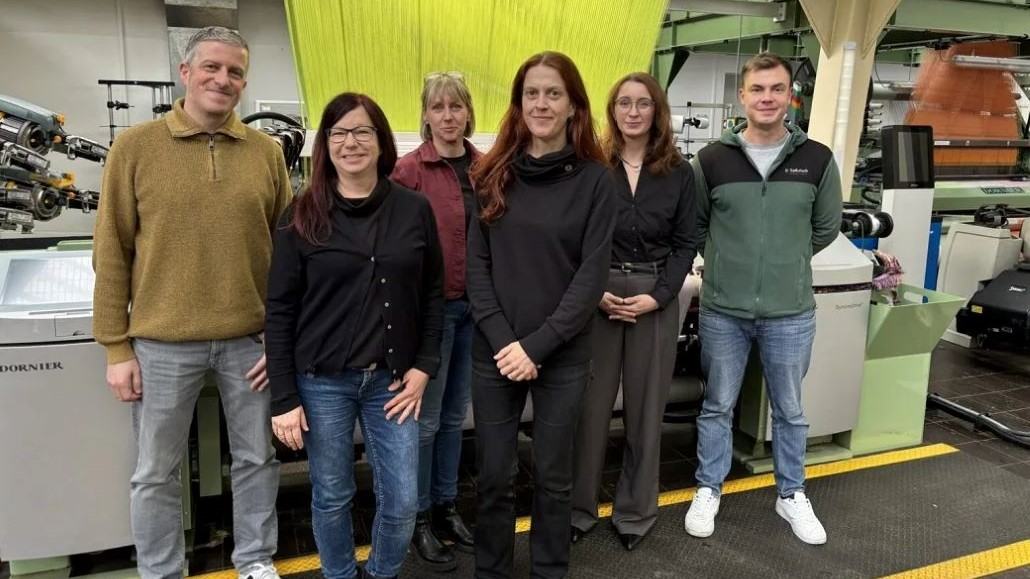
Hof University of Applied Sciences has launched a two-year R&D effort aimed at creating next-generation interior building materials that deliver both thermal insulation and improved room acoustics while relying on renewable, locally available resources rather than petrochemical-based insulation systems. Known as the WAVE research project, the initiative unites the university with partners in Upper Franconia to develop textile panel solutions that make functional use of regional wool.
The programme’s full title “Thermal Insulation and Acoustic Optimisation through the Use of Residual Materials as Fillers in Near-Net-Shape 3D Woven Structures for Textile Panels” signals its technical direction: fully textile, near-net-shape 3D structures that can be filled with residual-material-based fillers. The work began at the start of the year and is supported through Germany’s Central Innovation Programme for SMEs (ZIM).
“With WAVE, we are addressing a highly relevant topic that meaningfully combines ecological requirements, material innovation, and regional value creation,” explained professor Dr.-Ing. Frank Ficker, project lead and Head of the Institute of Materials Science (ifm) at Hof University of Applied Sciences.
The project is responding to growing demand for building products that are environmentally compatible without sacrificing performance. Many conventional insulation and acoustic materials depend on fossil-derived inputs, use multi-material composites that are difficult to separate, and often fall short on recyclability or biodegradability. The WAVE consortium aims to demonstrate an alternative: a textile-based panel system engineered to deliver insulation and sound optimisation while supporting circular end-of-life pathways.
“We see a clear market demand, but also enormous untapped potential in regionally available raw materials such as wool,” emphasised Isabell Korn, research associate at the ifm and project manager. “Our approach is to make this resource functionally usable in a targeted way and to transfer it into a market-ready textile system.”
A key technical premise is that engineered textile structures can integrate multiple requirements function, stability and design flexibility within one material system, rather than relying on glued layers or difficult-to-recycle composites.
“Textile structures enable us to combine functionality, stability, and design within a single material system,” explained Corinna Anzer, deputy project lead and head of weaving, braiding, and yarn development at the Institute of Materials Science (ifm). “This opens up new pathways for sustainable insulation and acoustic solutions in interior construction.”
Development will begin with lab-based design and testing at the ifm, where researchers will evaluate textile structures and filler concepts. From there, the work will move toward industrial-scale implementation at Möbelstoffweberei Reich e.K., with continuous knowledge transfer built into the process. The target at the end of the WAVE research project is a market-ready prototype demonstrating verified thermal and acoustic performance and meeting current expectations for modern interior construction.
“For us, the close integration of research and practice is a key success factor,” said Claudia Schödel-Reich of Möbelstoffweberei Reich e.K. “Early involvement in the development process ensures that a good idea can ultimately become an industrially viable product.”
The partners say the resulting textile insulation panels could offer a lower-impact alternative for offices, educational facilities and cultural buildings, supporting improved acoustics and thermal comfort while aligning with environmentally responsible construction choices.
“Particularly in interior construction, there is growing demand for flexible, sustainable, and aesthetically appealing solutions,” added Korn. “Textile panel systems can offer genuine added value here.”
The initiative also reflects a regional innovation pipeline. The concept emerged from discussions at TextilTreff Oberfranken, a networking event organised by Bayern Innovativ GmbH and the Association of the Bavarian Textile and Apparel Industry (VTB), where representatives from Möbelstoffweberei Reich, the ifm and Felix Meier of neowistra developed the joint proposal that was later approved under ZIM.

