

























PSI 2026

BRÜCKNER: New Expertise in Energy & Environmental Tech

Note* - All images used are for editorial and illustrative purposes only and may not originate from the original news provider or associated company.

Subscribe

- Never miss a story with notifications

- Gain full access to our premium content

- Browse free from up to 5 devices at once

Media Packs

Expand Your Reach With Our Customized Solutions Empowering Your Campaigns To Maximize Your Reach & Drive Real Results!
– Access The Media Pack Now!
– Book a Conference Call
Leave Message for us to Get Back

Related stories

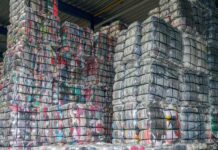
The Future of Fiber-to-Fiber Textile Recycling and Material Regeneration

Fiber-to-fiber recycling represents the ultimate achievement in textile waste management, enabling post-consumer and pre-consumer textile waste to be transformed into virgin-quality materials capable of indefinite recycling cycles. Advanced regeneration technologies now enable high-purity recovery of recycled cotton, polyester, wool, and blended materials for next-generation apparel, effectively closing material loops and enabling true circular textile systems where material value persists across multiple product lifecycles without quality degradation.

Textile Recycling in the Nonwoven Industry: A Growing Opportunity

Nonwoven textiles—engineered fabrics composed of fibers bonded together without weaving or knitting—represent distinct recycling challenge and opportunity. Used extensively in medical, hygiene, automotive, and industrial applications, nonwovens comprise approximately 30-35% of global textile production yet remain largely unrecycled. Emerging technologies enabling nonwoven separation, fiber recovery, and regeneration are unlocking substantial market opportunity as industries face regulatory pressure and resource constraints, positioning nonwoven recycling as high-growth segment within broader textile recycling market.

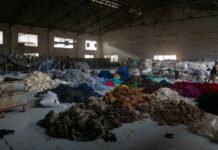
Sorting Technologies Revolutionizing Pre-Consumer and Post-Consumer Textile Recycling

Advanced sorting technologies—near-infrared spectroscopy, Raman spectroscopy, RFID tagging, digital identification systems, and AI-powered computer vision—are revolutionizing textile material classification and enabling automated processing at previously impossible scale and accuracy. These technologies simultaneously address the sorting bottleneck that has constrained recycling scaling, achieve accuracy exceeding 95-98%, process materials at industrial speeds, and provide cost reduction of 25-35% through labor elimination and processing optimization, fundamentally transforming textile recycling economics and feasibility.

For over 75 years, the German mechanical engineering company BRÜCKNER has been developing, producing and selling lines for textile finishing worldwide. The core competence of the family-owned company includes coating, drying, heat-setting and much more. Environmental protection and energy efficiency have always played a central role. Reducing emissions and the consumption of resources, as well as the use of different heating media, has always been the focus of BRÜCKNER’s research and development work. This will be an even stronger focus in the future. In order to be even better prepared for this and to be able to provide customers with comprehensive advice, BRÜCKNER has bundled its personnel capacities in a new “Environmental and Energy Technology” department headed by Mr. Andreas Troscheit. This area includes all heat-recovery and exhaust air purification systems. Mr. Troscheit has already been responsible for the Technology Center in Leonberg and for the entire technical application advice for three years. In environmental and energy technology, Mr. Troscheit is now supported by Mr. Tobias Keitel and Mr. David Knies. Mr. Keitel focuses on the distribution and design of these systems, while Mr. Knies specializes in software and control. This also includes the ExperTex simulation tool. This intelligent software, which is available for all new machines, enables customers to increase their production output and reduce energy consumption. Depending on the year of manufacture, this tool can also be retrofitted to older lines.

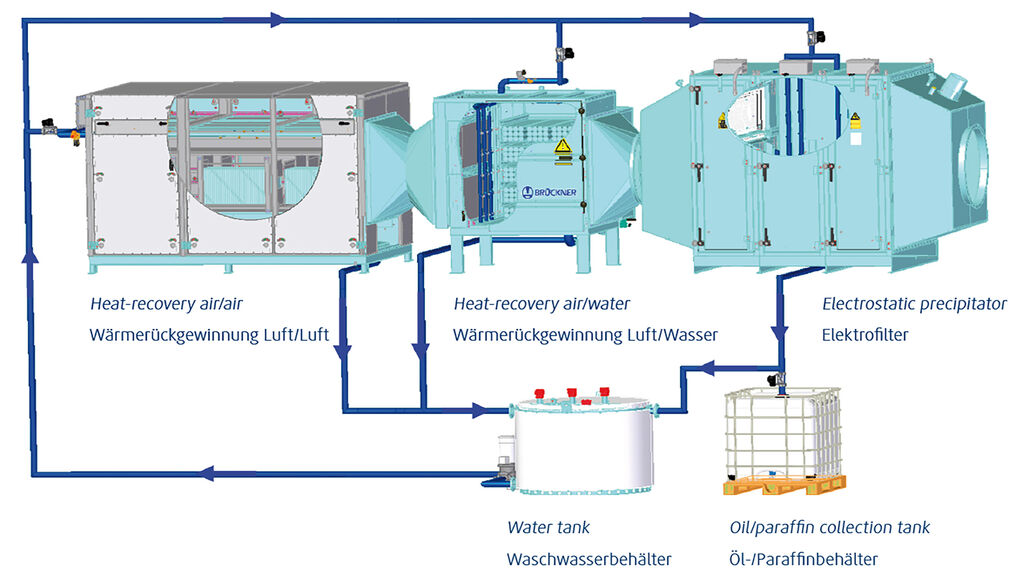
BRÜCKNER’s product portfolio in the field of environmental and energy technology is very extensive. The various units for heat-recovery and exhaust air purification are available individually or as a fully integrated system. Thanks to their modular design, these systems can be individually adapted to any customer requirement. Depending on the process, individual units can be flexibly switched on or off. Newly developed automatic cleaning systems ensure additional energy savings, a significant reduction in maintenance and personnel costs, a longer service life for the filter modules and consistently good filter separation performance. The cleaning programs can be freely configured and the cleaning intervals can be individually controlled so that there is no need to interrupt ongoing production.

BRÜCKNER is the only supplier on the market who can offer all heat-recovery and exhaust air cleaning components from a single source. The newly established energy and environmental technology team combines all the advantages for you as a customer: state-of-the-art technology, expertise and years of experience. You can benefit from this and make your textile finishing sustainable and future-oriented.

Latest stories

Related stories

The Future of Fiber-to-Fiber Textile Recycling and Material Regeneration

Fiber-to-fiber recycling represents the ultimate achievement in textile waste management, enabling post-consumer and pre-consumer textile waste to be transformed into virgin-quality materials capable of indefinite recycling cycles. Advanced regeneration technologies now enable high-purity recovery of recycled cotton, polyester, wool, and blended materials for next-generation apparel, effectively closing material loops and enabling true circular textile systems where material value persists across multiple product lifecycles without quality degradation.

Textile Recycling in the Nonwoven Industry: A Growing Opportunity

Nonwoven textiles—engineered fabrics composed of fibers bonded together without weaving or knitting—represent distinct recycling challenge and opportunity. Used extensively in medical, hygiene, automotive, and industrial applications, nonwovens comprise approximately 30-35% of global textile production yet remain largely unrecycled. Emerging technologies enabling nonwoven separation, fiber recovery, and regeneration are unlocking substantial market opportunity as industries face regulatory pressure and resource constraints, positioning nonwoven recycling as high-growth segment within broader textile recycling market.

Sorting Technologies Revolutionizing Pre-Consumer and Post-Consumer Textile Recycling

Advanced sorting technologies—near-infrared spectroscopy, Raman spectroscopy, RFID tagging, digital identification systems, and AI-powered computer vision—are revolutionizing textile material classification and enabling automated processing at previously impossible scale and accuracy. These technologies simultaneously address the sorting bottleneck that has constrained recycling scaling, achieve accuracy exceeding 95-98%, process materials at industrial speeds, and provide cost reduction of 25-35% through labor elimination and processing optimization, fundamentally transforming textile recycling economics and feasibility.

Subscribe

- Never miss a story with notifications

- Gain full access to our premium content

- Browse free from up to 5 devices at once

Media Packs

Expand Your Reach With Our Customized Solutions Empowering Your Campaigns To Maximize Your Reach & Drive Real Results!

– Access The Media Pack Now!
– Book a Conference Call
Leave Message for us to Get Back

Translate »