
























PSI 2026

Trützschler India Relocates To Ultra-Modern Manufacturing Plant in Sanand

Note* - All images used are for editorial and illustrative purposes only and may not originate from the original news provider or associated company.

Subscribe

- Never miss a story with notifications

- Gain full access to our premium content

- Browse free from up to 5 devices at once

Media Packs

Expand Your Reach With Our Customized Solutions Empowering Your Campaigns To Maximize Your Reach & Drive Real Results!
– Access The Media Pack Now!
– Book a Conference Call
Leave Message for us to Get Back

Related stories

Advancements in Natural Fiber Textile Recycling for Cotton and Wool

Natural fiber textile recycling has advanced significantly through cutting-edge chemical dissolution, fiber regeneration, and advanced separation technologies enabling high-purity recovery of cotton and wool fibers matching virgin specifications. Processes like Renewcell’s Circulose® and Evrnu’s NuCycl technology now enable indefinite cycling of cotton fibers while wool recycling technologies preserve fiber properties across multiple reuse cycles, creating genuine circular pathways for natural textiles and addressing the environmental advantages of fiber recovery from conventional resource-intensive virgin cultivation.

The Role of AI and Automation in Advancing Textile Recycling Systems

Artificial intelligence and automation technologies are revolutionizing textile recycling by dramatically improving sorting accuracy, material separation efficiency, and overall system throughput. Machine learning algorithms, computer vision systems, near-infrared spectroscopy, and robotic automation are transforming labor-intensive manual processes into intelligent automated systems capable of identifying and processing hundreds of items per hour with accuracy exceeding 95%, enabling scalable textile recycling infrastructure that was previously economically unviable.

How Brands are Redesigning Products to Support Textile Recycling and Circularity

Fashion brands are fundamentally redesigning product architecture to support textile recycling and circular business models through design-for-recycling principles including mono-material construction, detachable trims, and simplified component design. These design transformations address downstream processing requirements, reduce end-of-life complexity, and enable brands to achieve circular positioning while simultaneously improving manufacturing efficiency and creating differentiated market positioning in sustainability-conscious segments.

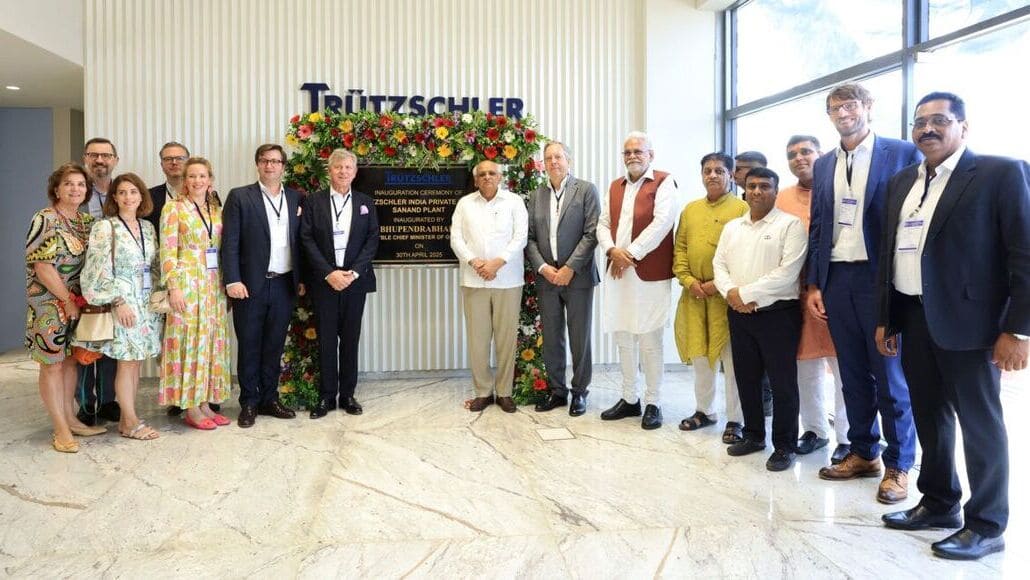
Trützschler India proudly celebrated the grand opening of its state-of-the-art manufacturing plant in Sanand, near Ahmedabad, Gujarat. This strategic relocation from the previous Ahmedabad site to the new facility is set to enhance operational efficiency, sustainability, and innovation.

The Trützschler and Schürenkrämer families and the Trützschler Group management team, alongside Trützschler India CEO Joseph Thomson, warmly welcomed a distinguished group of guests, including Shri Bhupendra Bhai Patel, Chief Minister of Gujarat, Achim Fabig, Consulate General of Germany in India and Shri Parshottam Ji Rupala, Member of Parliament. In addition, many of Trützschler’s valued customers, long-time partners and dedicated colleagues joined the celebration for a day of inspiring speeches, networking and a lively cultural program.

The new Sanand facility spans 164,000 square meters, with a built-up area of 72,000 square meters, and employs over 1,000 people. This pioneering plant is designed to serve both Indian and global markets, driving continued growth and innovation in the production of spinning preparation machines, card clothing, and nonwoven equipment. Built with a focus on sustainability, the facility adheres to high environmental standards, including ISO 9001:2008, ISO 14001:2015, and ISO 50001:2018 certifications. It also aims to achieve a gold rating from the Indian Green Building Council. Key features of the plant include solar energy systems, rainwater collection, electric vehicle charging points, and AI-powered process optimization.

Additionally, the new facility houses a modern Customer Training Center and an expanded Trützschler Training Academy, supporting knowledge sharing and skill development in alignment with the Skill India Mission.

Joseph Thomson, CEO of Trützschler India, remarked, “The new Sanand plant strengthens our ability to meet the rising demand from India and global markets with technologies, processes, and sustainable standards that truly set us apart. We extend our heartfelt gratitude to everyone who contributed to realizing this vision and to all those who joined us in celebrating this milestone.”

Cover picture shows from left to right: Edda Schürenkrämer, Shareholder, Alexander Stampfer, CSO, Caroline Lange, Shareholder, Florian Rück, CFO, Charlotte Fontaine, Shareholder and member of the Supervisory Board, Florian Schürenkrämer, Shareholder and member of the Supervisory Board, Dr. Michael Schürenkrämer, Shareholder, Shri Bhupendra Bhai Patel, Chief Minister of Gujarat, Heinrich Trützschler, Shareholder, Shri Parshottam Ji Rupala, Member of Parliament, Shri. Kanubhai Patel, Member of Gujrat Legislative Assembly, Heinrich Krull, COO, and Joseph Thomson, CEO Trützschler India.

Latest stories

Related stories

Advancements in Natural Fiber Textile Recycling for Cotton and Wool

Natural fiber textile recycling has advanced significantly through cutting-edge chemical dissolution, fiber regeneration, and advanced separation technologies enabling high-purity recovery of cotton and wool fibers matching virgin specifications. Processes like Renewcell’s Circulose® and Evrnu’s NuCycl technology now enable indefinite cycling of cotton fibers while wool recycling technologies preserve fiber properties across multiple reuse cycles, creating genuine circular pathways for natural textiles and addressing the environmental advantages of fiber recovery from conventional resource-intensive virgin cultivation.

The Role of AI and Automation in Advancing Textile Recycling Systems

Artificial intelligence and automation technologies are revolutionizing textile recycling by dramatically improving sorting accuracy, material separation efficiency, and overall system throughput. Machine learning algorithms, computer vision systems, near-infrared spectroscopy, and robotic automation are transforming labor-intensive manual processes into intelligent automated systems capable of identifying and processing hundreds of items per hour with accuracy exceeding 95%, enabling scalable textile recycling infrastructure that was previously economically unviable.

How Brands are Redesigning Products to Support Textile Recycling and Circularity

Fashion brands are fundamentally redesigning product architecture to support textile recycling and circular business models through design-for-recycling principles including mono-material construction, detachable trims, and simplified component design. These design transformations address downstream processing requirements, reduce end-of-life complexity, and enable brands to achieve circular positioning while simultaneously improving manufacturing efficiency and creating differentiated market positioning in sustainability-conscious segments.

Subscribe

- Never miss a story with notifications

- Gain full access to our premium content

- Browse free from up to 5 devices at once

Media Packs

Expand Your Reach With Our Customized Solutions Empowering Your Campaigns To Maximize Your Reach & Drive Real Results!

– Access The Media Pack Now!
– Book a Conference Call
Leave Message for us to Get Back

Translate »