






























Key Takeaways
- Current collection infrastructure lacks capacity: 120M metric tons waste annually vs. <1M tons recycled globally
- Recycled polyester costs 2x virgin polyester price; economic incentive favors virgin materials absent regulatory intervention
- Blended fabrics represent 60-70% of garment composition yet require expensive pre-processing separation
- Manual sorting remains labor-intensive bottleneck; automated solutions still not economically viable at regional scale
- Cost of textile collection, sorting, processing often exceeds virgin material production cost for commodity applications
- Consumer participation rates inadequate; less than 20% clothing disposed through formal recycling programs in most markets
Confronting the Structural Barriers to Textile Recycling Scaling
The global textile recycling market projects growth toward USD 11.88 billion by 2030. Yet beneath these optimistic forecasts lies a sobering reality: the industry currently recycles less than 1% of textile waste globally. This dramatic gap between technical capability and actual implementation reflects fundamental barriers that innovation alone cannot overcome. Understanding these barriers is essential for assessing realistic timelines and required policy intervention necessary for meaningful textile recycling transformation.
Collection Infrastructure: The Missing Foundation
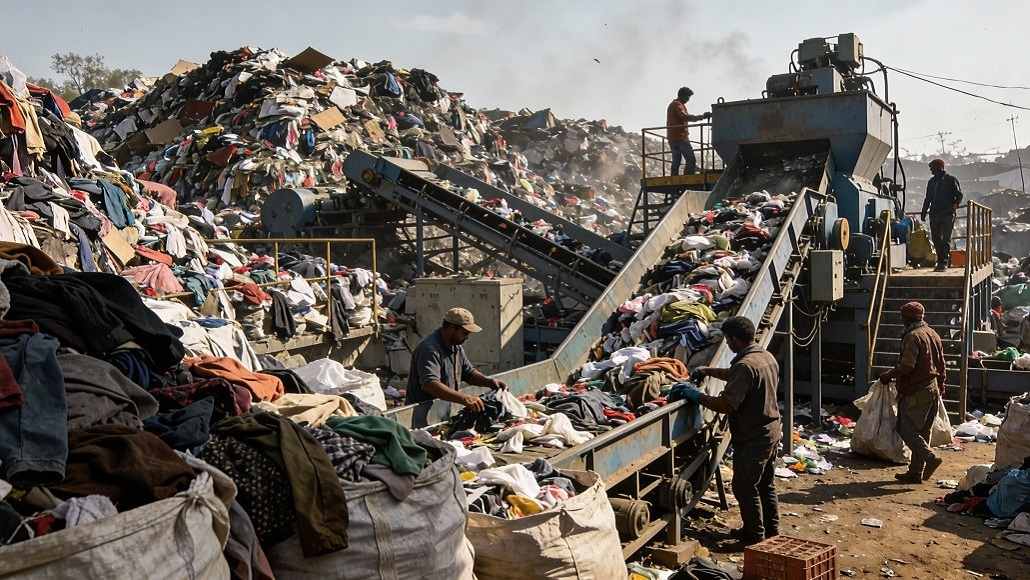
The first barrier emerges before recycling even begins: collection. The apparel industry generates 120 million metric tons of textile waste annually. Yet globally, formal collection and sorting systems have capacity to process less than 1 million tons. This infrastructure deficit is not accidental but reflects historical design assumptions: textile waste management systems were built for resale and donation, not industrial recycling.
Most developed countries lack standardized collection infrastructure. In the United States, approximately 84% of textile waste ends up in landfills or incinerators. In Europe, despite regulatory mandates for separate textile collection by 2025, implementation remains inconsistent. Collection points lack geographic coverage in rural areas. Convenience remains problematic consumers must find and access specialized textile collection rather than disposing of clothing through existing waste streams.
Furthermore, textile collection is logistically expensive. Garments are voluminous yet lightweight, requiring specialized transport logistics. Collection from dispersed household sources and consolidation to centralized processing facilities adds cost at every stage. Recyclers must manage contamination from mixed waste streams, liquids, and non-textile materials inadvertently included in collections.
The Sorting Bottleneck: Technical Challenge Meets Economic Reality
Sorting categorizing collected textiles by fiber type, color, condition, and contamination level remains the critical constraint preventing scaling. Current sorting occurs through labor-intensive manual processes. In developing regions where wage costs are lowest, manual sorting employs thousands of workers in challenging conditions. Yet even with substantial manual labor, accuracy remains problematic.
Fiber identification challenges arise from content tag degradation, deliberate mislabeling, and visual similarity among synthetic fibers. Different colored polyester looks identical to cotton blends; nylon, polyester, and acrylic cannot be reliably distinguished visually. Contemporary fast fashion employs blended fibers specifically to achieve performance characteristics impossible with single fibers. This ubiquity of blends creates sorting complexity that manual processes handle inefficiently.
Advanced sorting technologies near-infrared (NIR) spectroscopy, Raman spectroscopy, and AI-powered computer vision systems can theoretically achieve 95%+ accuracy at industrial speeds. Yet these systems require substantial capital investment. A facility capable of sorting 24,000 tons annually requires equipment investment approaching millions of dollars. Small and medium-sized recyclers cannot justify this capital expenditure; large facilities must achieve sufficient throughput to generate returns. This creates infrastructure concentration: only largest population centers justify advanced sorting facility investment.
The Blended Fabric Dilemma
Approximately 60-70% of contemporary garments comprise blended fabrics polyester-cotton, nylon-elastane, acrylic-wool combinations designed to optimize performance characteristics. These blends present particular challenge: they cannot be mechanically separated cost-effectively, and many chemical recycling processes remain economically marginal for blends. Some approaches require expensive pre-separation that negates economic advantage of recycling.
This creates perverse incentive: garments designed with recyclability concern use mono-materials, while mainstream fashion continues producing blended garments that are increasingly difficult to recycle. Design-for-recycling principles exist in concept but achieve limited market adoption because no mechanism currently compels brands to internalize end-of-life processing costs.
The Economic Paradox: Virgin Materials Remain Cheaper
Despite environmental rhetoric, the fundamental economic reality remains stark: virgin polyester costs approximately 50% less than recycled polyester. Virgin cotton, while facing mounting sustainability questions, remains competitive in price with recycled alternatives. This cost advantage derives from mature global supply chains optimized for virgin material production, external environmental cost externalization, and in some regions, government subsidies supporting virgin material extraction.
Recycled materials therefore face a structural cost disadvantage. A brand seeking to minimize production cost has clear economic incentive to use virgin materials. Regulatory intervention carbon pricing, extended producer responsibility fees, virgin material taxation remains necessary to internalize end-of-life costs into virgin material pricing. Without such intervention, market economics favor virgin materials despite technological capacity for recycled alternatives.
This economic barrier proves particularly difficult because virgin polyester producers have achieved economies of scale, supply chain integration, and operational efficiency that recyclers struggle to match. Recyclers’ feedstock post-consumer waste is inherently variable in quality, composition, and contamination level, preventing optimization that virgin material processors achieve. Cost parity between virgin and recycled polyester remains years away absent substantial technical breakthrough or regulatory reorientation.
Logistics and Infrastructure Scale Requirements
Moving material from collection points to processing facilities to end markets requires logistics infrastructure that remains fragmentary. Transportation costs for low-density textiles are substantial relative to material value. A decentralized network of regional recycling facilities could theoretically reduce transportation burden, yet such a network requires coordinated investment across many jurisdictions something market mechanisms have not generated.
Furthermore, textile recycling infrastructure buildout requires coordination across supply chains. Pre-consumer waste (manufacturing offcuts) flows differently than post-consumer waste (discarded garments). Different fiber types require different processing pathways. Geographic variation in waste composition, collection capacity, and local industry structures prevents standardized solutions. What works for polyester recycling in Europe may not translate directly to cotton-rich textile waste streams in India or South Asia.
Infrastructure investment estimates range from hundreds of billions to trillions of dollars to achieve global textile recycling at meaningful scale. This investment barrier explains why venture capital funding, while substantial, remains insufficient to drive rapid scaling. Public sector involvement through regulatory mandates, subsidies, and coordinated infrastructure investment remains necessary complement to private sector innovation.
Consumer Participation Challenges
Consumer behavior represents the ultimate bottleneck. Despite increased awareness of environmental sustainability, actual consumer participation in textile recycling programs remains limited. Less than 20% of clothing in most developed countries enters formal recycling systems. The remainder either remains in wardrobes longer than intended, is donated informally, or enters general waste streams.
Participation barriers include lack of awareness about recycling options, inconvenience of access, skepticism about recycling effectiveness, and cultural norms around clothing disposal. In many communities, donating to charitable organizations or informal resale remains preferred to formal recycling. Even where formal recycling options exist, they often feel inconvenient compared to general waste disposal.
Incentive mechanisms to encourage participation have achieved limited success. Discount offers (10% future purchase reduction) have not substantially increased return rates. Some innovative programs (Patagonia repairs, some brand take-back systems) achieve higher participation among core brand loyalists, but do not capture mainstream consumer behavior. Cultural transformation toward viewing textiles as valuable material requiring responsible end-of-life management remains incomplete.
Technological Limitations in Processing
While chemical recycling technologies have advanced dramatically, they remain not universally applicable. Some fabric finishes and treatments cannot be economically recovered. Heavy contamination or mixed waste streams can damage recycling chemistry. Certain synthetic fibers (elastane, particularly) present distinct recovery challenges. Some textile dyeing and finishing approaches create byproducts that require special handling.
Mechanical recycling, faster and less chemically intensive than chemical approaches, still produces lower-quality fibers unsuitable for premium applications. This bifurcation chemical recycling for high-value output, mechanical for commodity applications means significant textile waste streams have limited high-value recovery pathways.
The Path Forward: Acknowledging Persistent Barriers
Large-scale textile recycling scaling requires simultaneous solutions across collection, sorting, processing, and consumer participation. No single innovation resolves all barriers. Rather, coordinated policy intervention, substantial infrastructure investment, technological advancement, and consumer behavior change must progress together.
Current barriers explain why most textile recycling remains concentrated in developed regions where infrastructure investment, regulatory support, and consumer engagement have achieved greater maturity. Global textile recycling scaling remains years away, with realistic timelines suggesting 10-15% recycling by 2035 rather than 50%+ often projected in aspirational forecasts.
Acknowledging these barriers is not pessimism but rather pragmatism necessary for designing effective policy and investment strategies that address genuine constraints, not merely technical challenges.