































Key Takeaways
- Major performance brands (Patagonia, On, Allbirds) implement take-back programs capturing 40-50% of sold products; enabling closed-loop material cycles
- Polyester recycling chemistry specifically optimized for performance fiber regeneration; enables elastane tolerance and moisture-wicking finish preservation
- Technical textile specifications require virgin-equivalent fiber quality; chemical recycling achieves purity and performance levels supporting premium applications
- Circular sportswear pricing commands 15-30% premium in market; consumers value performance combined with environmental positioning
- Durability focus integral to sportswear circularity; extended product lifecycle (5-7 years vs. 2-3 conventional) reduces total lifecycle environmental impact
- Supply chain integration with recycling partners (Renewcell, Aquafil) enables brands to specify recycled material composition in new collections directly
Performance Brands Leading Circular Textile Innovation
Sportswear and performance apparel brands occupy unique position in circular textile evolution. Unlike fashion-focused brands where design trends drive replacement cycles, performance brands emphasize durability and extended product lifecycle. This emphasis on longevity aligns naturally with circular models where extended use precedes end-of-life recovery and recycling.
Furthermore, performance brands command price premiums supporting premium material costs. Consumers purchasing performance apparel value technical specifications and durability sufficiently to accept recycled-content integration. This willingness to pay for sustainability differentiates performance segment from commodity apparel markets.
Technical Textile Challenges and Recycling Requirements
Performance apparel employs technical textiles requiring specific fiber characteristics: moisture-wicking properties, thermal regulation, elasticity, durability, and specialized finishes. These requirements drive material selection toward synthetic fibers (polyester, nylon, elastane) in blended compositions optimizing performance.
This material palette creates recycling challenges: polyester-nylon-elastane blends, moisture-wicking finishes, and specialized treatments persist through conventional processing. Chemical recycling approaches specifically developed for performance fiber recovery enable regeneration of virgin-equivalent fibers while preserving specialized properties.
Take-Back Programs: The Collection Strategy
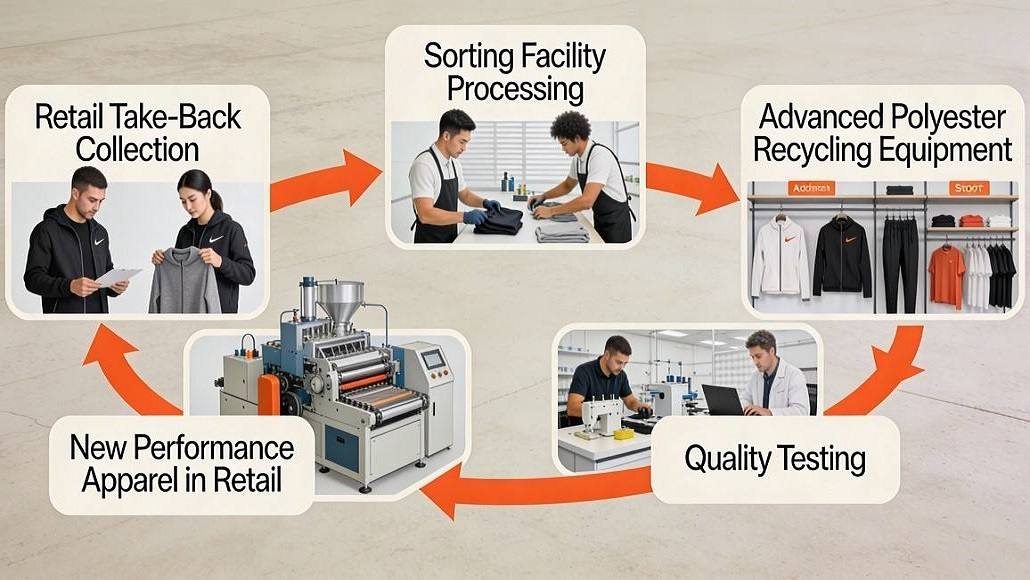
Closed-loop sportswear systems depend fundamentally on product recovery. Performance brands increasingly implement take-back programs where consumers return worn athletic apparel through retail locations, mail programs, or dedicated collection events.
Patagonia’s Worn Wear program exemplifies this model. Worn athletic products are assessed for repair and resale potential or directed to recycling partnerships. This dual-pathway approach (repair, resale, or recycling) maximizes material value recovery and extends product lifecycles.
On Running’s take-back program similarly captures worn shoes and apparel, recovering materials for recycling while building brand loyalty among environmentally conscious athletes. The company reports 40-50% participation rates among regular customers substantially exceeding average apparel recycling program performance.
Polyester Regeneration for Activewear
Polyester dominates performance apparel composition. Advanced polyester recycling chemistry specifically optimized for athletic applications recovers virgin-equivalent polyester fiber suitable for new activewear production.
Depolymerization technology converts polyester waste into dimethyl terephthalate (DMT) monomer with 99%+ purity. This monomer is repolymerized into polyester indistinguishable from virgin fiber, enabling regeneration of performance characteristics: tensile strength, elasticity, moisture-wicking fiber properties.
The critical achievement: regenerated polyester from worn athletic apparel becomes feedstock for new performance fibers without quality compromise. A worn running shirt can be recovered, processed through depolymerization, and regenerated into fiber for new running apparel creating genuine closed-loop material cycle.
Elastane Tolerance and Technical Fiber Integration
A major breakthrough for sportswear recycling: elastane (spandex) tolerance in polyester recycling processes. Elastane comprises 5-10% of performance apparel composition, providing essential stretch and recovery properties. Yet elastane has historically decomposed in standard polyester recycling, contaminating processes.
Recent innovations by Aquafil and other recycling partners enable elastane separation without destructive decomposition. Elastane is recovered separately, regenerated independently, and reintegrated into recycled polyester, producing recycled blends matching virgin polyester-elastane specifications.
This breakthrough is transformative: sportswear incorporating elastane can now be fully recycled without pre-separation, expanding recyclable material streams dramatically.
Durability as Circular Strategy
Sportswear brands increasingly emphasize durability as core product attribute supporting circular positioning. Extended product lifecycle athletic apparel designed for 5-7 years of regular use rather than 2-3 years reduces total lifecycle environmental impact substantially.
Durability focus drives design changes: reinforced seams, quality construction, tested longevity specifications. It also enables marketing positioning: “designed to last” combined with take-back program creates circular narrative supporting premium pricing.
Research demonstrates that lifecycle extension through durability improvements reduces environmental impact 30-40% compared to accelerated replacement cycles. When combined with eventual recycling at end-of-life, total environmental benefit becomes substantial.
Supply Chain Integration with Recycling Partners
Leading performance brands establish direct partnerships with advanced recyclers. These partnerships ensure recycled material specifications align with performance requirements and enable brands to specify recycled content in product development.
On Running’s partnership with Renewcell ensures cotton-based athletic products flow to Renewcell’s facilities for fiber-to-fiber recovery. The company’s partnership with Aquafil ensures polyester-elastane products access advanced depolymerization and regeneration capability.
These strategic partnerships do more than enable material recovery; they create supply security for recycled fiber, supporting premium pricing and long-term supply agreements enabling recycler investment and capacity expansion.
Market Positioning and Premium Pricing
Circular sportswear products command 15-30% price premiums in performance apparel markets. Consumers value environmental positioning combined with performance specifications, supporting higher price points.
This premium pricing differential creates economic viability for circular models. Brands can afford to invest in take-back infrastructure, recycling partnerships, and design-for-recycling modifications knowing premium pricing recovers these incremental costs.
Contrast this with commodity apparel markets where consumers prioritize price over environmental positioning. Circular models in commodity segments lack pricing power supporting infrastructure investment. Performance segment’s premium positioning enables circular business model economics.
Regenerated Fiber Quality and Performance Equivalence
Critical factor determining sportswear brand adoption of recycled content: whether regenerated fibers perform equivalently to virgin alternatives. Brands cannot compromise performance specifications while pursuing environmental positioning.
Comprehensive testing demonstrates that regenerated polyester and elastane from chemical recycling achieve performance metrics exceeding virgin fiber in many applications. Tensile strength, elasticity, moisture-wicking, and durability all meet or exceed virgin specifications.
This quality equivalence is critical psychological and marketing factor: consumers trust recycled-content performance apparel knowing it performs indistinguishably from virgin products.
Consumer Engagement and Brand Loyalty
Take-back programs generate strong consumer engagement and brand loyalty. Athletes returning worn apparel establish deepened relationship with brands, increasing likelihood of repeat purchase and brand advocacy.
Furthermore, transparency about material recovery communicating that returned products become feedstock for new apparel creates psychological reward for participation. Consumers appreciate understanding that end-of-life apparel becomes new material rather than landfill waste.
Scaling Challenges and Future Trajectory
Current sportswear circular programs capture 10-15% of sold products through take-back participation. Scaling participation toward 40-50% requires expanded collection accessibility and sustained consumer engagement.
Market projections suggest 30-40% of premium sportswear will incorporate recycled content by 2030, driven by brand commitment and consumer demand. This shift will require capacity expansion in polyester-elastane recycling facilities and sustained supply chain integration.
Long-term trajectory points toward fully circular performance apparel ecosystem: brands designing products with end-of-life in mind, consumers confident in take-back programs, recyclers operating at commercial scale with virgin-equivalent output, and new apparel production increasingly drawing from recycled feedstock.
This vision is progressively materializing in performance apparel segment, positioning sportswear brands as leaders in textile circular economy transformation.