






























Key Takeaways
- Microwave-assisted glycolysis depolymerizes polyester, nylon, elastane to monomers in 15 minutes with 99%+ purity
- Chemical recycling now produces virgin-quality fibers from mixed textile waste including polyester-cotton blends
- AI-powered sorting systems achieve 95%+ accuracy in fiber composition identification at speeds exceeding 1 piece per second
- Aquafil’s regeneration hub scales to 50,000 metric tons rBHET annual capacity (equivalent to 300M garments)
- Hydrolysis processes recover terephthalic acid (TPA) and ethylene glycol (EG) from polyester with minimal environmental impact
- Commercial-scale facilities demonstrate polyester recycling cost approaching parity with virgin production
The Technology Revolution Redefining Textile Recycling in 2026
Textile recycling technology has reached an inflection point. What began as experimental chemistry confined to university laboratories and small pilot facilities is now transitioning into commercial-scale operations demonstrating genuine technical and economic viability. The innovations transforming textile recycling in 2026 represent more than incremental improvements they constitute fundamental breakthroughs enabling the industry to process waste streams previously considered unrecyclable and to generate output materials matching virgin fiber quality specifications.
Chemical Depolymerization: Breaking Textiles Into Building Blocks
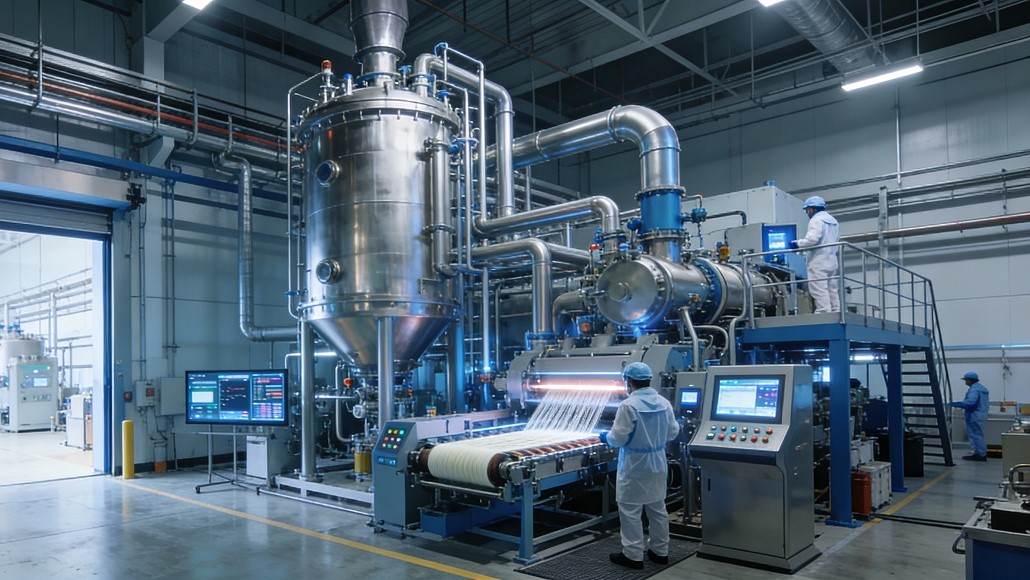
The most transformative innovation is chemical depolymerization processes that break polymer chains into constituent monomers, enabling complete material recovery and repolymerization. Unlike mechanical recycling, which degrades fiber properties with each cycle, chemical depolymerization produces monomers of sufficient purity to manufacture virgin-quality fibers repeatedly without property degradation.
Microwave-assisted glycolysis represents a breakthrough approach gaining commercial traction. Research teams have demonstrated complete depolymerization of mixed textile waste polyester, cotton, nylon, and spandex in single batch processing under relatively mild conditions: 15 minutes reaction time at 200°C using zinc oxide (ZnO) catalyst. The process achieves complete depolymerization of polyester and spandex into their monomers while cotton and nylon remain structurally intact, enabling simple solvent-based separation of fibers.
Hydrolytic depolymerization, employed by companies like DePoly and Rittec’s RevolTex® process, employs aqueous sodium hydroxide solutions to break polyester into terephthalic acid (TPA) and ethylene glycol (EG). This approach has particular advantages: water is the primary solvent, reaction temperatures are relatively moderate, and recovered monomers achieve purity levels exceeding 99%, enabling direct repolymerization into new polyester without additional purification steps.
Methanolysis and other alcoholysis pathways represent alternative approaches. Loop Industries’ process converts polyester and polyester-containing waste into dimethyl terephthalate (DMT) and has demonstrated commercial scalability with disclosed operations processing thousands of tons annually. The company reports capability to recycle polyester-containing waste streams including mixed fabrics, creating closed-loop material cycles previously impossible.
Fiber Regeneration: Transforming Cellulose and Polyester Recovery
Fiber regeneration technologies enable complete transformation of recovered cellulose and polyester into fibers matching or exceeding virgin material specifications. Renewcell’s Circulose® platform represents the most extensively commercialized technology, scaling capacity to process 1.4 billion T-shirts annually by 2030. The process dissolves cotton and cellulose-based waste textiles into pulp form, which fiber manufacturers subsequently transform into viscose, lyocell, modal, acetate, and other regenerated cellulose fibers.
Evrnu’s NuCycl technology demonstrates similar capability for cotton-rich textile waste, converting waste fibers into cellulose with purity and performance characteristics enabling indefinite recycling cycles. The technology removes contaminants, dyes, and finishes, producing regenerated lyocell fibers with performance metrics equivalent to virgin alternatives.
Aquafil’s recent announcement of “Regeneration Hub One” demonstrates polyester regeneration at scale. The facility is engineered to process waste equivalent to 300 million garments annually, producing 50,000 metric tons of regenerated BHET (bis(hydroxyethyl) terephthalate) yearly for repolymerization into virgin-equivalent polyester fiber. This operational model closed-loop polyester recovery from pre- and post-consumer waste was technically infeasible at scale five years ago.
Infinited Fiber’s Naia™ Renew technology partnership with Kering and other luxury brands demonstrates that fiber regeneration is no longer confined to commodity production but now supports premium apparel creation. Regenerated fibers can match or exceed virgin fiber specifications in tensile strength, color consistency, and performance characteristics that premium manufacturers require.
Blended Fabric Recycling: Solving the Polycotton Challenge
Historical textile recycling limitation: blended fabrics represent approximately 60-70% of modern garment composition, yet conventional recycling required mechanical separation before processing. This separation step dramatically increased process cost and complexity, limiting economic viability.
Chemical processes now enable direct processing of blended textiles without pre-separation. Recover™’s RMix technology processes polyester-cotton blends directly, converting both fiber types into high-quality recycled materials suitable for new garment production. This advancement eliminates separation as a required step, reducing process complexity and cost substantially.
Research published in Science Advances demonstrated polyester-spandex-cotton blend recycling in single processing step: polyester and spandex decompose to monomers via microwave glycolysis while cotton remains structurally intact, enabling simple downstream solvent separation of cotton from recovered polyester monomers. This approach handles real textile waste composition without requiring expensive, labor-intensive pre-sorting.
Automated Sorting Systems: AI and Spectroscopy Precision
Textile sorting distinguishing among different fiber types, identifying damage and contamination, separating materials by color has historically been labor-intensive manual work. Modern AI-powered sorting systems now achieve accuracy exceeding 95% while processing materials at industrial speeds.
Near-infrared (NIR) spectroscopy combined with convolutional neural networks (CNNs) and machine learning algorithms enable identification of 13+ textile fiber types with processing speed of less than 2 seconds per garment. The system operates by analyzing spectral reflectance patterns effectively the spectral “fingerprint” of different fibers and classifying materials based on this spectral data.
Raman spectroscopy-based sorting, developed at Taiwan’s Institute of Industrial Technology Research (ITRI), provides even more detailed molecular compositional information, enabling textile grouping into six fiber composition categories with precision exceeding 95% at process speeds of 1 piece per second. Integration of artificial intelligence technologies PCA, KNN, SVM, RF, ANN, and CNN algorithms further enhances sorting efficiency and accuracy.
RFID tagging and digital identification systems enable another layer of sorting sophistication. Brands embedding digital fiber composition data directly into garments simplify downstream recycler operations and enable precise direc handling of different material streams to appropriate recycling pathways.
Advanced Blending Solutions for Mixed-Fiber Waste
Beyond separation, advanced blending solutions address the reality that perfect material purity is often uneconomic. Processes enabling controlled blending of recovered polyester, cotton, nylon, and other fibers produce “new blends” matched to specific end-use applications. This flexibility dramatically expands the range of products that can incorporate recycled content.
Blend Re:Wind, developed through collaboration between Mistra Future Fashion and Chalmers University, employs hydrolysis with sodium hydroxide, benzyltributylammonium chloride (BTBAC), and controlled blending to process mixed fibers. This creates opportunity to engineer fiber blends from waste streams matched to specific technical and aesthetic requirements.
Environmental Performance: Life Cycle Assessment Data
Technical capability means little without economic and environmental viability. Life cycle assessment data demonstrates that chemical recycling of polyester achieves dramatic environmental advantage over virgin polyester production: 1.88 kg CO₂ equivalent savings per kilogram of recovered material compared to conventional DMT manufacturing.
Polyester regeneration via hydrolytic depolymerization eliminates 92% of water consumption compared to virgin polyester production. Recovered solvents and catalysts are recycled achieving greater than 91% recovery rates across multiple depolymerization cycles.
Scalability and Commercial Viability
The critical transition from innovation to industry transformation occurs when technologies achieve commercial scale with positive unit economics. Multiple companies have now demonstrated this transition. Renewcell, Aquafil, Loop Industries, and emerging competitors have secured funding, established commercial partnerships with major apparel brands, and are expanding capacity toward processing millions of garments annually.
Industry projections suggest that textile recycling technologies demonstrated in 2026 will process over 8 million tons of waste annually by 2030, compared to less than 1 million tons today. This eightfold capacity expansion represents the technological transformation becoming operational reality at industrial scale.
Integration With Circular Fashion Systems
These innovations increasingly integrate with broader circular fashion systems. Chemical recycling technology enables design-for-recycling principles where products are engineered specifically for efficient chemical recovery. Brands like Renewcell customers and Aquafil partners are designing collections where fiber composition is optimized for recycling chemistry, not merely for initial garment performance.
The 2026 textile recycling technology landscape represents a maturation toward true circular material cycles. Chemical depolymerization, fiber regeneration, automated sorting, and advanced blending solutions have collectively addressed the technical barriers that historically confined textile recycling to low-grade applications. Contemporary textile recycling innovation now enables closed-loop systems where fibers cycle repeatedly through production, use, and recovery with minimal property degradation transforming textile waste from disposal challenge into valuable material resource.