























Key Takeaways
- Fiber-to-fiber recycling achieves 99%+ material recovery with virgin-equivalent tensile strength and performance
- Regenerated polyester from Aquafil’s technology reaches commercial scale of 50,000 tons rBHET annually by 2026
- Renewcell’s Circulose® technology scales to process 1.4 billion T-shirts annually, enabling infinite cotton cycling
- Evrnu’s NuCycl process transforms cotton waste into lyocell fibers matching virgin specifications indefinitely
- High-purity fiber recovery enables 10+ material cycles without property degradation, compared to 2-3 for mechanical recycling
- Chemical regeneration processes reduce material loss to <1% vs. 30-40% typical in mechanical approaches
Closing the Circle: Fiber-to-Fiber Regeneration as Ultimate Sustainability
Fiber-to-fiber recycling represents the asymptotic achievement of circular economy principles applied to textiles. Where mechanical recycling downgrades material quality and limits reuse cycles, fiber-to-fiber regeneration recovers materials at molecular level and rebuilds them into virgin-equivalent fibers capable of indefinite cycling. This transformation from waste to virgin-quality material to new garment and eventual recovery again closes the loop completely.
The Distinction: Fiber-to-Fiber vs. Downcycling
Conventional textile recycling has historically meant downcycling: transforming worn clothing into lower-value products (insulation, wiping cloths, industrial applications). While valuable from waste diversion perspective, downcycling represents eventual termination of material value. The garment ultimately becomes waste unable to further regeneration.
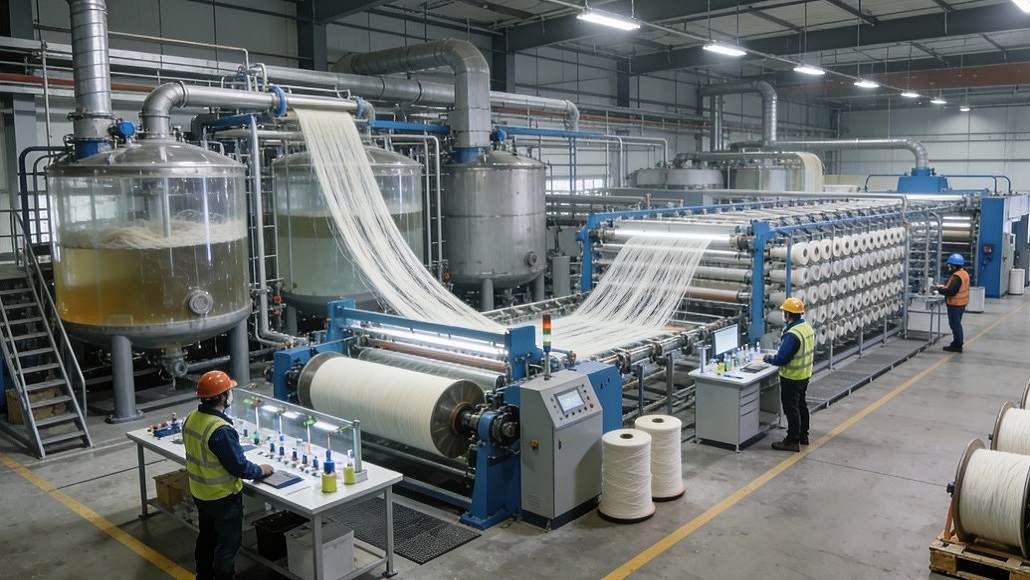
Fiber-to-fiber recycling fundamentally differs. Worn polyester clothing is chemically depolymerized into its molecular components (dimethyl terephthalate, ethylene glycol), which are purified and repolymerized into virgin polyester indistinguishable from fossil-based material. Cotton-based textiles are chemically dissolved into cellulose, filtered, processed, and re-extruded into regenerated fibers (lyocell, viscose, modal) matching virgin specifications. This approach preserves material value indefinitely.
The distinction carries profound implications. True circularity requires indefinite material cycling. Without fiber-to-fiber regeneration, circular claims remain aspirational rather than operational.
Polyester Regeneration at Scale
Commercial polyester regeneration has recently transitioned from pilot to industrial scale. Aquafil’s “Regeneration Hub One,” announced in 2024, targets 50,000 metric tons annual capacity of regenerated PET (rPET) monomer, equivalent to processing 300 million garments. This facility represents qualitative leap: polyester recycling now operates at scale previously achieved only in virgin material production.
The process employs advanced hydrolysis and depolymerization chemistry, converting post-consumer polyester textile waste blended with pre-consumer scraps and industrial waste streams into purified monomers (bis-hydroxyethyl terephthalate, BHET) suitable for direct repolymerization into virgin-equivalent polyester fiber. Tensile strength, color consistency, and performance specifications match virgin polyester across comprehensive testing protocols.
Loop Industries operates commercial methanolysis facilities processing polyester waste into dimethyl terephthalate (DMT) with comparable scale and output quality. The company has demonstrated capability to process mixed polyester feedstock including contaminated and dyed materials.
DePoly’s low-temperature chemical recycling processes polyester into terephthalic acid (TPA) and ethylene glycol (EG) through hydrolysis using undisclosed proprietary catalysts. Commercial deployment in Switzerland marks maturation from laboratory innovation to industrial operation.
The critical achievement these technologies represent: polyester can now be recycled repeatedly without material property degradation. A polyester fiber could theoretically cycle through production-wear-recovery-regeneration-production sequences indefinitely, with each cycle preserving virgin-equivalent material characteristics.
Cotton Fiber Regeneration: Scale and Quality
Natural fiber regeneration technology lags polyester in commercial scale but demonstrates equally impressive technical performance. Renewcell’s Circulose® technology dissolves cotton and cellulose-based textile waste into pulp, which fiber producers subsequently transform into regenerated cellulose fibers (viscose, lyocell, modal, acetate). Scale projections indicate capacity to process 1.4 billion T-shirts by 2030 representing meaningful fraction of global apparel production.
Circulose® fibers demonstrate virgin-equivalent performance across standard testing protocols. Fiber producers report that Circulose® can be used identically to virgin dissolving pulp in regeneration processes, requiring no modifications to existing production equipment or chemistry. This technical compatibility dramatically accelerates market adoption: mills can incorporate recycled cotton without capital expenditure or operational modification.
Evrnu’s NuCycl technology employs similar dissolution approach but uses proprietary cellulose recovery chemistry. The company demonstrates cotton waste conversion into new lyocell fibers with enhanced properties: improved strength, superior color consistency, and performance metrics exceeding virgin cotton in many applications.
Infinited Fiber’s Naia™ Renew employs closed-loop lyocell production: textile waste dissolves into cellulose pulp, which transforms into lyocell fiber through proprietary non-toxic solvent chemistry with >99% solvent recovery across multiple cycles. The company reports tensile strength, elasticity, and durability characteristics identical to virgin lyocell produced from traditional dissolving pulp.
Critical achievement: cotton waste can be transformed into regenerated cellulose fibers matching virgin specifications. This enables cotton-to-cotton recycling cycles where worn cotton garments recover into new cotton-equivalent fiber indefinitely.
Blended Material Regeneration: Addressing 70% of Apparel
Blended fabrics represent approximately 70% of contemporary apparel yet historically presented primary barrier to fiber-to-fiber recycling. Chemical regeneration now enables selective processing where polyester depolymerizes to monomers while cotton remains structurally intact, enabling downstream solvent separation.
Recover™’s RMix technology processes polyester-cotton blends directly without pre-separation. The facility in Vietnam, commissioned late 2025, operates two recycling lines and targets 10,000 tons annual capacity of recovered polyester and cotton fiber from blended waste.
This capability is transformative because it addresses real-world textile waste composition. Rather than requiring expensive pre-separation or restricting recycling to mono-material garments, contemporary blended fabric recycling expands the recyclable waste stream dramatically.
The Environmental and Economic Case
Fiber-to-fiber regeneration offers compelling environmental advantage over virgin material production. Polyester regeneration saves 87% CO₂ emissions compared to virgin production. Cotton regeneration eliminates water consumption almost entirely (99% water savings) compared to virgin cotton cultivation. Chemical usage drops dramatically because regeneration employs far fewer processing steps than virgin fiber production.
Economically, the case strengthens as scale increases. As recycling capacity expands toward millions of tons annually, unit cost of regenerated fiber converges toward virgin cost. Recent market dynamics indicate recycled polyester pricing moving closer to virgin polyester across 2025-2026, and some premium regenerated fibers now command price premiums reflecting quality advantages.
Indefinite Material Cycling: The Ultimate Achievement
The distinguishing feature of fiber-to-fiber regeneration is genuine indefinite material cycling. Mechanical recycling typically supports 2-3 product cycles before fiber degradation prevents further recycling. Chemical regeneration demonstrates no inherent cycle limit: fibers can theoretically recycle 10+, 100+, or indefinitely times without property degradation, provided collection and regeneration infrastructure exists.
This achievement represents asymptotic approach to true circular economy. Material value persists indefinitely. Economic value and environmental benefit accrue across all cycles. The fiber, rather than garment or product, becomes the persistent material asset.
Infrastructure Requirements for Scaling
Fiber-to-fiber recycling scaling requires collection systems feeding adequate feedstock to regeneration facilities, sorting infrastructure ensuring material purity, and end-market demand for regenerated materials. Currently, regeneration facility capacity still exceeds available feedstock in many regions collection and sorting infrastructure lag technology advancement.
As collection systems develop and sorting improves, regeneration capacity will expand. Feedback loop: better collection and sorting enable larger recycling facilities, generating sufficient regenerated material supply to justify brand commitment to recycled-content products.