

































Key Takeaways
- Global textile recycling market growing at 7.2% CAGR, reaching $11.88 billion by 2030
- Apparel waste segment holds 56% market share with 3.3% annual growth trajectory
- Cotton recycling accounts for 38% of market, expanding at 3.1% CAGR through 2035
- Asia Pacific leading regional growth at 8.1% CAGR, driven by manufacturing volume and policy support
- Investment in chemical recycling and AI-based sorting systems accelerating industry maturity
- Extended producer responsibility (EPR) regulations in EU, France, and California reshaping manufacturer accountability
The Transformation of Global Apparel Through Textile Recycling
The fashion and textile industries stand at an inflection point. With 120 million metric tons of textile waste generated annually across the globe, waste streams that once represented pure loss now represent unprecedented economic and environmental opportunity. The global textile recycling market, valued at approximately USD 8.41 billion in 2025, is projected to expand to USD 11.88 billion by 2030, reflecting a robust 7.2% compound annual growth rate that signals fundamental industry restructuring.
This growth trajectory is not driven by sentiment alone. Rather, it reflects a convergence of regulatory pressure, consumer demand for sustainability, material cost volatility, and technological breakthrough that has made textile recycling not merely a corporate responsibility gesture but an increasingly profitable business imperative. Apparel manufacturers, retailers, and brands are beginning to recognize that access to high-quality recycled fibers represents competitive advantage in an era where virgin material sourcing faces mounting environmental scrutiny and regulatory restrictions.
The Scale of Market Opportunity
The apparel waste segment dominates textile recycling adoption, commanding approximately 56% of the global market share in 2025 and projected to grow at a steady 3.3% annual compound rate through 2035. This dominance reflects the sheer volume of post-consumer clothing that enters waste streams annually. Fast fashion acceleration has compounded this challenge garments designed for rapid turnover, minimal durability, and short consumer engagement periods create exponentially larger waste volumes than traditional manufacturing models.
Cotton-based materials represent the second major recycling segment, representing approximately 38% of global textile recycling market share and expanding at a 3.1% CAGR. The recovery of cotton from both post-consumer garments and pre-consumer manufacturing waste cutting scraps, quality rejects, and inventory overstock provides pathways to reintegrate valuable cellulose fiber back into production cycles. Unlike virgin cotton cultivation, which demands extensive water resources and pesticide inputs, recycled cotton requires substantially fewer resources while delivering fiber with comparable performance characteristics for many applications.
Regional Growth Dynamics and Policy Catalysts
Geography matters significantly in understanding textile recycling expansion. Asia Pacific is emerging as the fastest-growing region, expanding at 8.1% CAGR, driven by the region’s position as the global manufacturing hub for apparel production. China’s textile recycling sector is growing at an impressive 3.8% CAGR, with projections of USD 1.49 billion market value by 2035. Meanwhile, India’s textile recycling market is expanding at 4.0% CAGR, reaching an estimated USD 0.53 billion by 2035.
Germany has established itself as a leading European market, benefiting from well-developed waste management infrastructure, stringent environmental regulations, and strong government support for circular economy initiatives. Germany’s textile recycling market is projected to grow at 3.5% CAGR, reaching USD 0.96 billion by 2035. The European Union’s recently finalized Extended Producer Responsibility (EPR) framework for textiles, which officially came into force in October 2025, is fundamentally reshaping how manufacturers and brands approach end-of-life product management across member states.
France, having pioneered textile EPR requirements in 2007 and subsequently strengthened them through the 2020 AGEC (Anti-Waste for a Circular Economy) Law, continues to drive European leadership. French textile recycling sales are projected to reach
The Transformation of Global Apparel Through Textile Recycling
The fashion and textile industries stand at an inflection point. With 120 million metric tons of textile waste generated annually across the globe, waste streams that once represented pure loss now represent unprecedented economic and environmental opportunity. The global textile recycling market, valued at approximately USD 8.41 billion in 2025, is projected to expand to USD 11.88 billion by 2030, reflecting a robust 7.2% compound annual growth rate that signals fundamental industry restructuring.
This growth trajectory is not driven by sentiment alone. Rather, it reflects a convergence of regulatory pressure, consumer demand for sustainability, material cost volatility, and technological breakthrough that has made textile recycling not merely a corporate responsibility gesture but an increasingly profitable business imperative. Apparel manufacturers, retailers, and brands are beginning to recognize that access to high-quality recycled fibers represents competitive advantage in an era where virgin material sourcing faces mounting environmental scrutiny and regulatory restrictions.
The Scale of Market Opportunity
The apparel waste segment dominates textile recycling adoption, commanding approximately 56% of the global market share in 2025 and projected to grow at a steady 3.3% annual compound rate through 2035. This dominance reflects the sheer volume of post-consumer clothing that enters waste streams annually. Fast fashion acceleration has compounded this challenge garments designed for rapid turnover, minimal durability, and short consumer engagement periods create exponentially larger waste volumes than traditional manufacturing models.
Cotton-based materials represent the second major recycling segment, representing approximately 38% of global textile recycling market share and expanding at a 3.1% CAGR. The recovery of cotton from both post-consumer garments and pre-consumer manufacturing waste cutting scraps, quality rejects, and inventory overstock provides pathways to reintegrate valuable cellulose fiber back into production cycles. Unlike virgin cotton cultivation, which demands extensive water resources and pesticide inputs, recycled cotton requires substantially fewer resources while delivering fiber with comparable performance characteristics for many applications.
Regional Growth Dynamics and Policy Catalysts
Geography matters significantly in understanding textile recycling expansion. Asia Pacific is emerging as the fastest-growing region, expanding at 8.1% CAGR, driven by the region’s position as the global manufacturing hub for apparel production. China’s textile recycling sector is growing at an impressive 3.8% CAGR, with projections of USD 1.49 billion market value by 2035. Meanwhile, India’s textile recycling market is expanding at 4.0% CAGR, reaching an estimated USD 0.53 billion by 2035.
Germany has established itself as a leading European market, benefiting from well-developed waste management infrastructure, stringent environmental regulations, and strong government support for circular economy initiatives. Germany’s textile recycling market is projected to grow at 3.5% CAGR, reaching USD 0.96 billion by 2035. The European Union’s recently finalized Extended Producer Responsibility (EPR) framework for textiles, which officially came into force in October 2025, is fundamentally reshaping how manufacturers and brands approach end-of-life product management across member states.
France, having pioneered textile EPR requirements in 2007 and subsequently strengthened them through the 2020 AGEC (Anti-Waste for a Circular Economy) Law, continues to drive European leadership. French textile recycling sales are projected to reach USD 0.80 billion by 2035, growing at 3.4% CAGR. This regulatory pressure has forced the creation of producer responsibility organizations (PROs) and stewardship programs that ensure brands and manufacturers bear financial and operational responsibility for their products’ end-of-life management.
How Textile Recycling Is Reshaping Manufacturing Decisions
The expansion of textile recycling capacity is directly influencing how apparel companies approach sourcing, material selection, and manufacturing process design. Brands now recognize that their competitive positioning increasingly depends on demonstrable access to certified recycled fibers, transparent supply chain documentation, and measurable progress toward circular business model targets.
This shift manifests in several operational ways. First, major fashion brands are establishing formal partnerships with recycling companies and technology providers to secure reliable, high-quality recycled fiber supplies. Vertical integration where manufacturers acquire or develop their own recycling capabilities is becoming increasingly common. The Sanko Group’s launch of RE&UP, a dedicated operation converting post-consumer waste into advanced recycled materials, exemplifies this strategic trend. Second, apparel companies are reimagining product design to facilitate recyclability, incorporating mono-material construction, reducing adhesive-based attachments, and designing for disassembly.
Third, supply chain transparency is becoming competitive necessity. Brands are investing in digital tracking systems, blockchain-enabled provenance documentation, and third-party certifications to validate that recycled content claims meet regulatory and consumer expectations. This infrastructure supports not merely environmental claims but increasingly meets mandatory disclosure requirements under emerging sustainability legislation.
Technology Advancement Supporting Scaling
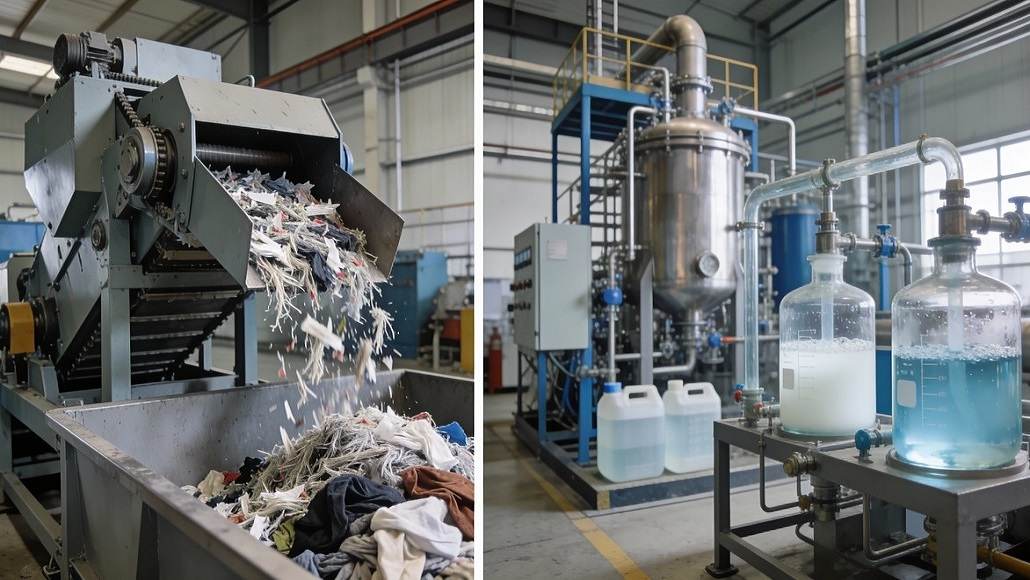
The technical feasibility of fiber-to-fiber recycling has improved dramatically. Chemical recycling methods, particularly depolymerization technologies, now enable recovery of monomers from synthetic textiles specifically polyester with sufficient purity to repolymerize into virgin-quality fibers. Recent breakthroughs by companies like Loop Industries, Aquafil, and DePoly demonstrate that closed-loop polyester recycling is transitioning from experimental to commercial scale.
Similarly, advancements in cotton and cellulose fiber recycling are expanding the range of recyclable materials. Renewcell’s Circulose® technology and Evrnu’s NuCycl process are scaling capacity to process cotton-rich textile waste into regenerated fibers indistinguishable from virgin alternatives. These innovations are critical because they address the historical limitation where mechanical recycling produces lower-quality fibers unsuitable for premium applications.
Automated sorting technology, powered by artificial intelligence, near-infrared spectroscopy, and machine learning algorithms, is progressively solving what has historically been the bottleneck in textile recycling systems: efficient, cost-effective material separation. Systems now achieving over 95% sorting accuracy and processing timelines under two seconds per item are becoming operational reality in leading recycling facilities across Europe, Asia, and North America.
Investment and Industry Consolidation
Venture capital funding, strategic corporate investments, and government subsidies are flowing toward textile recycling infrastructure at unprecedented scale. Leading players including Lenzing AG, Birla Cellulose, HYOSUNG TNC, and Renewcell are expanding capacity, acquiring complementary technologies, and establishing long-term partnerships with apparel brands seeking reliable recycled fiber sourcing.
The projected expansion to USD 11.88 billion by 2030 does not happen without substantial capital deployment. Industry analysts estimate that achieving 10% textile-to-textile recycling globally would require infrastructure investments approaching trillions of dollars. Governments, recognizing both environmental imperatives and economic opportunity, are beginning to allocate public resources toward collection infrastructure, sorting facility development, and technology advancement.
The Sustainability Imperative Meets Economic Reality
Beyond regulatory compliance and consumer preference, textile recycling increasingly addresses material security and cost volatility. Virgin polyester production depends on fossil fuel inputs subject to geopolitical risk and price volatility. Virgin cotton production faces water scarcity challenges, particularly in water-stressed regions that historically dominated global cultivation. Access to domestically sourced, processed, and recycled textile fibers reduces supply chain vulnerability and provides price stability compared to commoditized virgin material markets.
Looking Forward: Consolidation and Standardization
As the textile recycling market matures, industry consolidation is accelerating. Smaller regional recyclers are consolidating into larger operations with greater capacity, better technology, and established supply relationships. Simultaneously, standardization of quality metrics, certification frameworks, and environmental impact assessment methodologies is becoming essential infrastructure. The global textile recycling market’s trajectory to USD 11.88 billion by 2030 represents not an endpoint but rather a transition point where textile recycling transforms from niche sustainability initiative to mainstream industrial operation.
The apparel industry’s transformation toward circular models is now inevitable. The convergence of regulatory requirement, consumer expectation, technical feasibility, and economic incentive has crossed the threshold where alternatives no longer exist. Global textile recycling growth represents not optional sustainability positioning but rather the fundamental restructuring of how apparel is manufactured, sourced, and ultimately recovered.
e creation of producer responsibility organizations (PROs) and stewardship programs that ensure brands and manufacturers bear financial and operational responsibility for their products’ end-of-life management.
How Textile Recycling Is Reshaping Manufacturing Decisions
The expansion of textile recycling capacity is directly influencing how apparel companies approach sourcing, material selection, and manufacturing process design. Brands now recognize that their competitive positioning increasingly depends on demonstrable access to certified recycled fibers, transparent supply chain documentation, and measurable progress toward circular business model targets.
This shift manifests in several operational ways. First, major fashion brands are establishing formal partnerships with recycling companies and technology providers to secure reliable, high-quality recycled fiber supplies. Vertical integration where manufacturers acquire or develop their own recycling capabilities is becoming increasingly common. The Sanko Group’s launch of RE&UP, a dedicated operation converting post-consumer waste into advanced recycled materials, exemplifies this strategic trend. Second, apparel companies are reimagining product design to facilitate recyclability, incorporating mono-material construction, reducing adhesive-based attachments, and designing for disassembly.
Third, supply chain transparency is becoming competitive necessity. Brands are investing in digital tracking systems, blockchain-enabled provenance documentation, and third-party certifications to validate that recycled content claims meet regulatory and consumer expectations. This infrastructure supports not merely environmental claims but increasingly meets mandatory disclosure requirements under emerging sustainability legislation.
Technology Advancement Supporting Scaling
The technical feasibility of fiber-to-fiber recycling has improved dramatically. Chemical recycling methods, particularly depolymerization technologies, now enable recovery of monomers from synthetic textiles specifically polyester with sufficient purity to repolymerize into virgin-quality fibers. Recent breakthroughs by companies like Loop Industries, Aquafil, and DePoly demonstrate that closed-loop polyester recycling is transitioning from experimental to commercial scale.
Similarly, advancements in cotton and cellulose fiber recycling are expanding the range of recyclable materials. Renewcell’s Circulose® technology and Evrnu’s NuCycl process are scaling capacity to process cotton-rich textile waste into regenerated fibers indistinguishable from virgin alternatives. These innovations are critical because they address the historical limitation where mechanical recycling produces lower-quality fibers unsuitable for premium applications.
Automated sorting technology, powered by artificial intelligence, near-infrared spectroscopy, and machine learning algorithms, is progressively solving what has historically been the bottleneck in textile recycling systems: efficient, cost-effective material separation. Systems now achieving over 95% sorting accuracy and processing timelines under two seconds per item are becoming operational reality in leading recycling facilities across Europe, Asia, and North America.
Investment and Industry Consolidation
Venture capital funding, strategic corporate investments, and government subsidies are flowing toward textile recycling infrastructure at unprecedented scale. Leading players including Lenzing AG, Birla Cellulose, HYOSUNG TNC, and Renewcell are expanding capacity, acquiring complementary technologies, and establishing long-term partnerships with apparel brands seeking reliable recycled fiber sourcing.
The projected expansion to USD 11.88 billion by 2030 does not happen without substantial capital deployment. Industry analysts estimate that achieving 10% textile-to-textile recycling globally would require infrastructure investments approaching trillions of dollars. Governments, recognizing both environmental imperatives and economic opportunity, are beginning to allocate public resources toward collection infrastructure, sorting facility development, and technology advancement.
The Sustainability Imperative Meets Economic Reality
Beyond regulatory compliance and consumer preference, textile recycling increasingly addresses material security and cost volatility. Virgin polyester production depends on fossil fuel inputs subject to geopolitical risk and price volatility. Virgin cotton production faces water scarcity challenges, particularly in water-stressed regions that historically dominated global cultivation. Access to domestically sourced, processed, and recycled textile fibers reduces supply chain vulnerability and provides price stability compared to commoditized virgin material markets.
Looking Forward: Consolidation and Standardization
As the textile recycling market matures, industry consolidation is accelerating. Smaller regional recyclers are consolidating into larger operations with greater capacity, better technology, and established supply relationships. Simultaneously, standardization of quality metrics, certification frameworks, and environmental impact assessment methodologies is becoming essential infrastructure. The global textile recycling market’s trajectory to USD 11.88 billion by 2030 represents not an endpoint but rather a transition point where textile recycling transforms from niche sustainability initiative to mainstream industrial operation.
The apparel industry’s transformation toward circular models is now inevitable. The convergence of regulatory requirement, consumer expectation, technical feasibility, and economic incentive has crossed the threshold where alternatives no longer exist. Global textile recycling growth represents not optional sustainability positioning but rather the fundamental restructuring of how apparel is manufactured, sourced, and ultimately recovered.