

































Key Takeaways
- Pre-consumer waste represents 15-20% of total textile waste, primarily manufacturing offcuts; recycling reduces landfill costs significantly
- Post-consumer garments account for 80-85% of total textile waste; formal collection captures <20% in most markets currently
- Fashion supply chain waste reduction potential exceeds 50% through optimized design, manufacturing, and recycling integration
- Textile-to-textile recycling reduces supply chain environmental footprint by 87% compared to virgin material production
- Extended producer responsibility programs shift waste management costs to manufacturers, incentivizing waste reduction in design
- Decentralized collection systems increase participation rates 3-5x compared to centralized approaches
Understanding Waste Across the Fashion Supply Chain
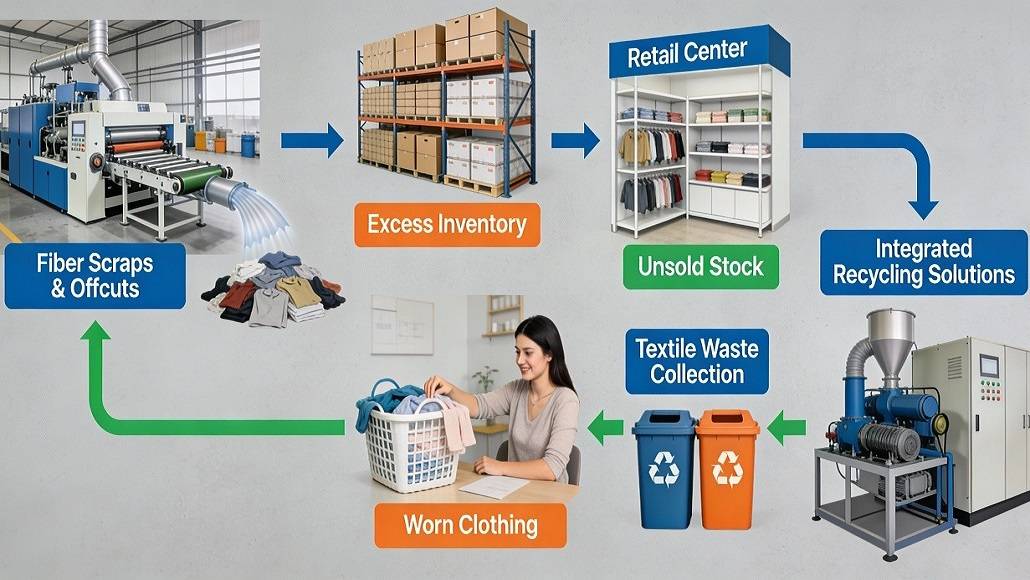
The fashion and apparel industry operates one of the most complex and geographically distributed supply chains in global commerce. Raw materials flow from agricultural regions and petrochemical facilities, through spinning and weaving mills, to manufacturing centers, then distribution networks, retail environments, consumers, and finally disposal. At every stage, waste accumulates: fiber waste in cultivation and spinning, fabric waste in cutting, garment defects in assembly, excess inventory in retail, worn clothing in households, and ultimately landfill or incineration.
Textile recycling is not peripheral to this system but rather essential infrastructure enabling the supply chain itself to function sustainably. Understanding where waste occurs throughout the value chain reveals why recycling capability is prerequisite for comprehensive waste reduction.
Pre-Consumer Waste: The Manufacturing Opportunity
Pre-consumer textile waste originates in manufacturing processes: spinning mills generate short fiber fragments; weaving and knitting facilities produce selvage and end-of-roll trim; cutting operations create inevitable waste patterns; quality control rejects garments; and warehouses manage obsolete inventory.
Global estimates suggest pre-consumer waste represents 15-20% of total textile waste by volume. In absolute terms, this translates to approximately 18-24 million metric tons annually from manufacturing alone. Unlike post-consumer waste dispersed across millions of households, pre-consumer waste concentrates at specific facilities where collection and recycling economics improve dramatically.
Textile mills increasingly implement fiber recycling strategies. Short fibers too degraded for respinning into yarn become feedstock for nonwoven fabrics, insulation materials, or chemical recycling processes. Fabric scraps from cutting operations are collected and sold to mechanical or chemical recyclers. Quality-reject garments are diverted to recycling rather than landfill.
The economic case for pre-consumer waste recycling is more compelling than post-consumer because collection costs are minimal. Material flows through existing facility infrastructure; transportation distances are short; and sorting is unnecessary because material is homogeneous at source. Textile mills implementing pre-consumer waste recycling programs report cost savings alongside environmental benefits: recovered fiber generates offsetting revenue while reducing landfill tipping fees.
However, pre-consumer waste recycling remains incomplete globally. Many developing-region facilities lack recycling infrastructure access. Smaller manufacturers cannot achieve economic scale necessary to justify investment in on-site recycling. International waste trading regulations complicate cross-border pre-consumer waste movement.
The Challenge of Post-Consumer Waste
Post-consumer textile waste discarded garments, worn textiles, obsolete clothing collections represents the larger challenge by scale and complexity. Global estimates indicate 80-85% of total textile waste originates from post-consumer sources. This waste is geographically dispersed across millions of households, heterogeneous in composition, often contaminated, and requires collection infrastructure that currently exists in only developed regions.
The volume is staggering: approximately 100-110 million metric tons of post-consumer textile waste annually worldwide. Yet the recycling capture rate is dismally low. In the United States, approximately 84% of textile waste enters landfills or incinerators. Even in Europe, where separate textile collection mandates are now in force, recycling capture remains below 30% in most countries.
This low capture rate reflects multiple barriers: insufficient collection infrastructure, consumer disposal convenience favoring trash over recycling, unclear sorting and preparation requirements, and skepticism about recycling effectiveness. Furthermore, significant portion of post-consumer textile waste exports globally for second-hand resale and eventual recycling in developing countries. This international trade, while extending garment life, complicates waste accounting and creates tracking challenges.
The Supply Chain Restructuring Enabled by Recycling
Textile recycling fundamentally enables supply chain restructuring toward circular models. When recycling infrastructure exists, manufacturers can implement take-back programs where consumers return worn clothing for recovery and remanufacturing. This closed-loop approach generates material feedstock continuously, reduces reliance on virgin material sourcing, and creates value chains where waste becomes input rather than liability.
Patagonia’s supply chain demonstrates take-back integration at scale. Worn Patagonia garments flow back to the company through retail locations and mail programs, directed toward repair or recycling based on condition. This creates material feedstock for new production while strengthening customer relationship and brand differentiation. The supply chain element that historical fashion systems treated as terminal point (consumer discard) becomes instead a materials recovery stage creating business value.
Design-for-Recycling Implications for Supply Chain
Recognition that supply chain must accommodate textile recycling changes design decisions upstream. Designers increasingly consider how garments will be recovered, sorted, processed, and regenerated into new fiber. This consideration drives material selection toward mono-material construction, elimination of non-separable trim, and specifications supporting chemical or mechanical recycling.
These design changes ripple across the supply chain. Mills receive requirements for specific fiber purity. Component suppliers (buttons, zippers, elastics) deliver detachable versus integrated trim. Manufacturing processes incorporate procedures enabling later disassembly during recycling. These upstream changes increase design complexity but ultimately enable circular supply chain closure.
Extended Producer Responsibility: Economic Restructuring
Extended producer responsibility (EPR) regulations fundamentally restructure economic incentives throughout the supply chain. By making producers financially responsible for end-of-life textile management, EPR policies create direct economic incentive to incorporate recyclability into design and manufacturing processes. A designer considering garment composition now calculates not merely production cost but also anticipated recycling processing cost incentive absent without EPR.
EU EPR regulations, now mandatory across member states, shift billions of euros of waste management cost from public sector to apparel industry. This reorientation forces supply chain recalculation: is fiber composition optimized for cost minimization or cost minimization plus end-of-life processability? Often, modest design changes reduce total supply chain cost including recycling when EPR fees are internalized.
Geographic Supply Chain Implications
Textile recycling infrastructure development carries implications for manufacturing geography. Historically, apparel production has concentrated in labor-cost-optimized locations, often distant from consumer markets and from waste disposal infrastructure. This geographic separation creates inefficiency and environmental impact: product ships globally, then at end-of-life travels again often back toward producing regions for recycling.
Development of decentralized recycling infrastructure in multiple regions enables on-shoring of secondary material production. Garments manufactured in Asia might be consumed in Europe and the Americas but increasingly would be recycled locally rather than exported. This geographic redistribution reduces transportation impact and strengthens regional circular supply chains.
Metrics and Supply Chain Accountability
Supply chain transparency increasingly includes textile waste accounting. Brands now publicly disclose waste metrics: proportion of virgin materials, quantity of recycled content, waste diversion rates, end-of-life recovery targets. These disclosures convert waste management from internal operational matter to external stakeholder accountability mechanism.
Supply chain audits increasingly include waste management capability assessment. Manufacturers demonstrate recycling partnerships, material recovery rates, and pre-consumer waste diversion. This creates competitive advantage for suppliers demonstrating recycling capability and operational risk for those lacking waste management infrastructure.
The Circular Feedback Loop
Textile recycling enables supply chain transformation through feedback loops. As recycled material supply increases, cost decreases toward parity with virgin materials. As cost parity approaches, economic incentive to use recycled content strengthens. As demand for recycled material increases, recycling infrastructure investment improves. This virtuous cycle gradually restructures supply chains toward increasingly circular models.
The fashion supply chain’s transformation from linear extraction model toward circular regeneration model depends fundamentally on textile recycling capability at every stage. Pre-consumer waste recovery improves manufacturing efficiency. Post-consumer collection and recovery extend material lifecycles. Design-for-recycling principles optimize upstream decisions. EPR policies align economic incentives. Geographic redistribution of recycling infrastructure strengthens regional circularity. Together, these supply chain elements powered by textile recycling infrastructure create pathways toward truly circular fashion systems.