


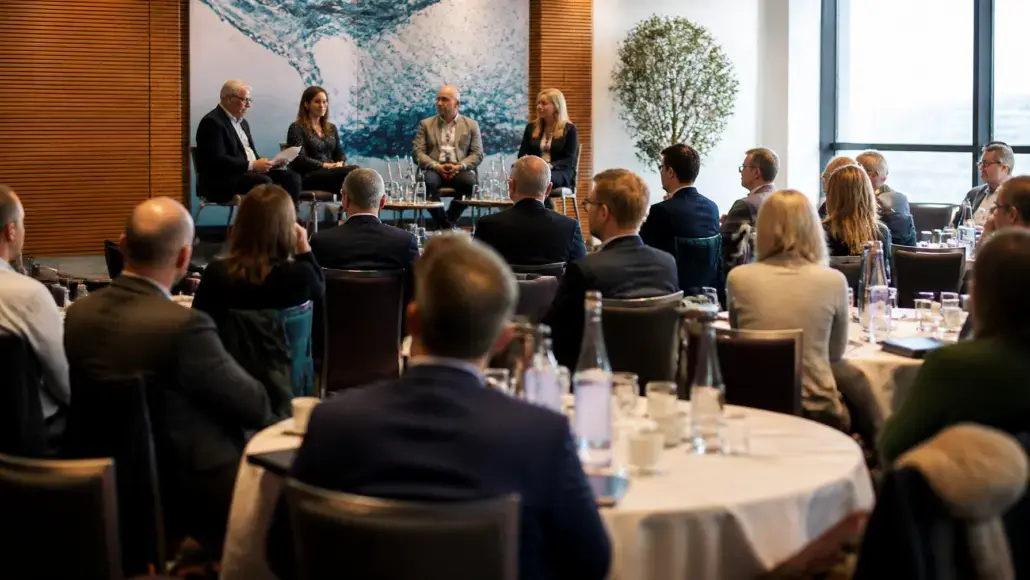
The autumn meeting of the textile service industry brought together a diverse range of voices and expertise, covering topics that extend well beyond laundry operations and into some of the most pressing issues facing modern society. From water treatment innovation to artificial intelligence in healthcare, the event demonstrated the breadth of challenges and opportunities shaping the sector today.
Water Treatment Takes Centre Stage
Michael Bo Jensen from Alumichem, drawing on more than 50 years of experience in the water industry, opened with a presentation titled “From Laundry Water to Competitive Advantage – How Industrial Laundries Can Meet the Next Wave of Water Requirements.” His session addressed the growing regulatory and operational pressures facing the textile service industry, particularly around PFAS, microplastics, and overall water consumption.
Jensen highlighted how modern water treatment, purification, and water reuse technologies present a genuine opportunity for industrial laundries to turn environmental compliance into a competitive advantage. As water-related requirements continue to tighten globally, his insights offered actionable direction for facilities navigating this evolving landscape.
Artificial Intelligence Enters the Healthcare Conversation
Farzaneh Etminani, Professor at Halmstad University and Research Leader at the Research and Innovation Centre, Region Halland, followed with a presentation on artificial intelligence in healthcare. Her session, “Artificial Intelligence in Healthcare – What, How and Why?”, drew on her research in machine learning to illustrate how AI is actively transforming diagnostics and clinical decision-making.
She outlined how the technology enables the identification of complex patterns, supports faster diagnostic processes, and contributes to more reliable outcomes. Alongside these opportunities, Etminani addressed critical questions surrounding the reliability of AI systems, the ethical considerations involved, and the importance of maintaining patient safety in AI-assisted environments.
Extended Producer Responsibility for Textiles
Nina Nagskov Jørgensen, Senior Consultant at Dansk Industri (DI), where she works with ARI – the Waste and Resource Industry, shared an overview of how Denmark is implementing extended producer responsibility for textiles. Her session provided delegates with a detailed look at the Danish regulatory framework and what it means for the textile service industry as sustainability obligations continue to evolve across the region.
Fire Safety: A Hidden Threat in Industrial Laundries
Ben Rannila-Mühlhaus from Quanturi focused his presentation on fire safety risks specific to industrial laundry environments. Titled “The Hidden Fire Risk in Industrial Laundries – From Prevention to Early Detection,” the session examined how fire hazards can develop unnoticed, particularly during periods when facilities are unattended, such as nights and weekends.
Rannila-Mühlhaus explained how wireless temperature monitoring and early warning systems are capable of detecting abnormal temperature changes before they escalate into serious incidents. For the textile service industry, where large volumes of materials are stored and processed around the clock, early detection represents a critical line of defence against fire damage.
Regional Preparedness and Crisis Response
Claes Lindgren, County Director and Deputy to the Governor at the County Administrative Board of Halland, offered a broader societal perspective. With extensive experience from the Government Offices of Sweden, including the Ministry of Finance, the Ministry of Enterprise, and the Ministry of Social Affairs, Lindgren addressed the region’s preparedness for future disruptions and crises.
His presentation provided context on society’s overall capacity to respond to emerging challenges, a theme that resonated with attendees across both industry and public sector backgrounds.
Understanding the Food Price Shock
Closing the day’s formal presentations was Ulf Mazur, founder of the price comparison service Matpriskollen. His talk, “The Food Price Shock – How the Industry Works,” explored the structural dynamics of the grocery retail sector, covering competition, consumer behaviour, and price development.
Matpriskollen collects millions of price data points daily, enabling it to track price trends at both the product and store level. Mazur explained why grocery prices fluctuate, how competition functions within the retail sector, and in what ways consumers are able to influence pricing outcomes. The session proved to be a timely and engaging discussion that resonated with delegates well beyond those directly connected to the laundry sector.
Industry Exhibition Brings Together Around 35 Exhibitors
Running alongside the meeting programme, an industry exhibition featuring approximately 35 exhibitors gave attendees the opportunity to explore products, services, and innovative solutions firsthand. Delegates were able to engage directly with suppliers, discuss current operational challenges, and build new professional contacts — reinforcing the event’s value as both an educational and networking platform for the textile service industry.