






























Key Takeaways
- Leading brands redesigning collections with 80-100% mono-material garments, reducing downstream processing complexity by 40-50%
- Detachable trim design enables post-consumer recovery of primary fibers while separating non-textile components, improving material purity
- Mono-material construction increases production efficiency 15-25% through simplified material handling and reduced waste in manufacturing
- Design-for-recycling extends product life through durability focus, reducing replacement frequency and total lifecycle environmental impact
- Circular design drives 10-20% premium pricing in sustainability-conscious segments while reducing end-of-life management costs
- Brands implementing design-for-recycling report 25-35% cost savings when including end-of-life processing costs in total cost calculation
The Strategic Imperative of Redesigning for End-of-Life
For decades, fashion design has optimized for production efficiency, aesthetic appeal, and cost minimization at point of manufacture. Circular design thinking fundamentally reorders these priorities by incorporating end-of-life requirements into design decisions from inception. Rather than designing products optimized for virgin material production then attempting to retrofit recycling compatibility, circular design integrates recyclability as primary design parameter.
This represents not minor modification to existing design processes but rather fundamental paradigm shift requiring new design tools, revised material selection criteria, modified manufacturing processes, and altered supply chain relationships. Yet leading brands increasingly recognize that circular design offers competitive advantage: market differentiation, operational efficiency, risk mitigation, and ultimately superior economic returns across product lifecycle.
Design-for-Recycling Core Principles
Design-for-recycling operates through several core principles. First, material simplification: reducing number of different materials in single garment. A conventional t-shirt might incorporate polyester body, cotton trim, elastane in cuffs, polyester thread, synthetic buttons, and plastic label. Each material component complicates end-of-life processing; recovery of high-purity polyester requires removing all non-polyester elements.
Second, mono-material specification: designing garments from single fiber type either 100% polyester, 100% cotton, 100% nylon eliminates separation requirements. A mono-material garment can be processed through appropriate recycling pathway without pre-separation, reducing processing cost 15-25% compared to blended alternatives.
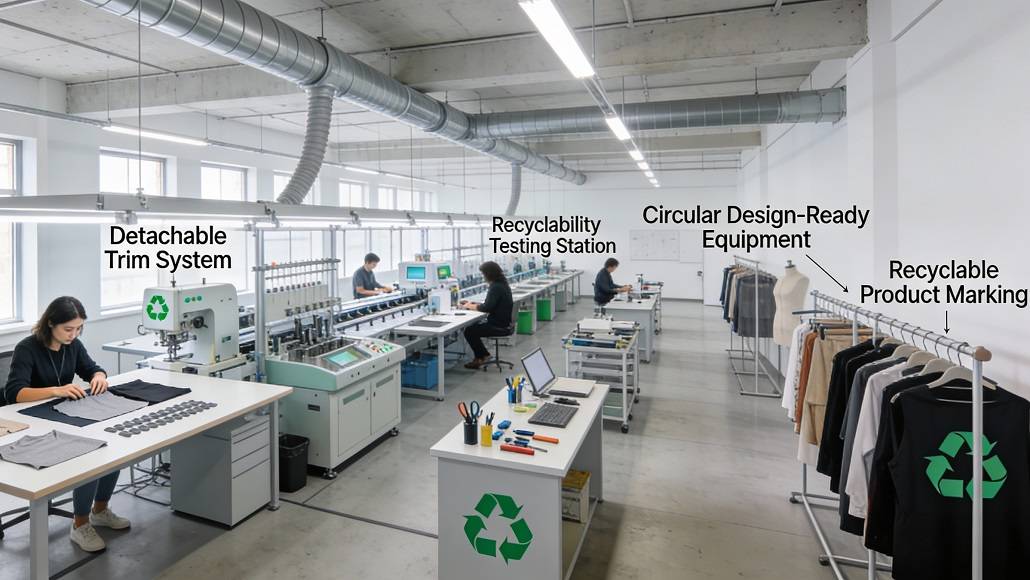
Third, detachable components: engineering buttons, zippers, labels, and elastic as removable systems rather than integrated into fabric structure. This enables recovery of primary fibers while separately processing non-textile components. A dress might be engineered with snaps enabling removal of elastic, separable zipper, and adhesive-free labeling—allowing the fabric itself to be processed without contamination from non-textile elements.
Fourth, elimination of harmful chemical finishes: many textile finishes water repellents, flame retardants, heavy metal dyes persist through recycling processes and can contaminate recycled fiber. Design-for-recycling specifies finishes compatible with downstream recycling processes.
Fifth, durability emphasis: designing garments for extended longevity reduces replacement frequency, extending product lifecycle and delaying end-of-life processing. A durable garment worn five years rather than two years represents 150% environmental impact reduction through lifecycle extension alone. Durability focus reinforced seams, quality construction, timeless design aligns with circular principles.
Implementation Challenges and Solutions
Implementing mono-material construction presents design challenges. Many apparel applications historically employed fiber blends because single fibers cannot achieve required performance characteristics. A running shirt might combine polyester for moisture-wicking properties with cotton for breathability neither alone optimally serving both functions.
Mono-material design requires engineering solutions: high-performance polyester with enhanced breathability, cotton blends with greater durability, or advanced synthetic fibers providing multiple desired properties. This creates upstream materials innovation demand, driving development of new fiber technologies specifically enabling circular design.
Removable trim systems similarly require engineering. Conventional buttons are sewn directly into fabric—removing them destroys fabric integrity. Circular design specifies snap fasteners, magnetic closures, or hook-and-loop systems enabling non-destructive removal. Zippers are specified as separate systems with removable slider mechanisms rather than sewn permanently.
These design modifications increase product development time and may increase manufacturing complexity during initial implementation. However, once processes are established, circular design frequently reduces overall cost. Simpler material handling, reduced waste, and shorter processing cycles offset design complexity.
Brand Case Studies: Circular Design Leaders
Patagonia’s circular product initiatives demonstrate scale feasibility. The company has redesigned multiple product lines toward mono-material and detachable-component specifications. Patagonia jackets now feature detachable synthetic insulation, removable synthetic shell, and washable liners enabling consumers to repair, extend use, or consciously retire products for recycling.
Reformation, a sustainability-focused brand, has designed collections with 70%+ mono-material garments. The brand transparently communicates material specifications enabling consumers to understand end-of-life recyclability. This transparency drives purchasing among environmentally conscious consumers.
Burberry’s circular design initiatives focus on luxury segment. The brand has developed mono-material collection specifications, sourced sustainable trims, and designed for disassembly. These initiatives maintain luxury positioning while achieving circular objectives.
Renewcell partnerships with multiple brands demonstrate take-back program integration with circular design. Brands design collections specifically for recycling through Renewcell’s technology, understanding exact material specifications needed for successful processing. This collaboration between brand, designer, and recycler ensures circular design is optimized for actual recycling chemistry.
Performance Implications and Consumer Acceptance
A critical question: does circular design compromise product performance or aesthetic appeal? Evidence suggests it need not. Performance requirements drive appropriate material selections and construction methods. Aesthetic appeal remains designer’s domain circular specifications constrain material palette but do not restrict creative expression.
Consumer testing reveals minimal performance perception difference between conventional and circular-designed garments. When properly communicated, consumers express preference for circular products, willing to accept minor aesthetic modifications supporting environmental positioning.
Pricing evidence suggests 10-20% premium acceptance for clearly circular-positioned garments in sustainability-conscious segments. Consumers recognize environmental benefit and willingly allocate premium purchasing power toward products supporting circular objectives.
Manufacturing Integration and Supply Chain Adaptation
Circular design requires supply chain adaptation. Textile mills must produce specified materials high-performance mono-material fibers. Component suppliers must produce removable trim systems. Manufacturers must implement processes supporting detachable design.
These adaptations increase supplier diversity requirements. Rather than sourcing from lowest-cost suppliers, brands increasingly specify suppliers capable of producing circular-design components. This requirement drives supply chain consolidation around circular-capable partners.
Interestingly, this supply chain reorientation often reduces geographic dispersion. Circular-design suppliers tend to concentrate in regions with stronger manufacturing capability and infrastructure. This consolidation may reduce logistics complexity while supporting local manufacturing ecosystems.
Regulatory Drivers and Compliance Requirements
Extended producer responsibility regulations increasingly mandate design-for-recycling considerations. EU regulations emphasize recyclability as design requirement. These regulatory drivers have accelerated circular design adoption among brands serving EU markets, with design innovations then transferring globally.
California’s emerging extended producer responsibility framework similarly emphasizes design-for-recycling, further incentivizing circular design adoption among brands seeking comprehensive market access.
Economic Analysis: Circular Design Cost Benefit
Comprehensive cost analysis including end-of-life management reveals circular design financial advantage. A conventionally designed garment might cost USD 15 to produce but USD 3 to process at end-of-life through specialized sorting and material separation. A circular-designed garment might cost USD 16 to produce but only USD 0.50 to process—net cost advantage of USD 1.50 across lifecycle.
Brands implementing circular design cost analysis across full product lifecycle frequently discover overall cost reduction despite modest production cost increase. This economic advantage increasingly motivates circular design adoption beyond sustainability commitment.
Scaling Circular Design: Market Growth Trajectory
Currently, circular-designed garments represent <5% of global apparel production. However, growth trajectory is steep. Industry projections suggest 30-40% of mainstream apparel will employ circular design principles by 2030, driven by regulatory requirements, consumer demand, and economic advantage discovery.
This growth will accelerate fiber-to-fiber recycling scaling by improving feedstock quality. Materials entering recycling systems with greater material purity, reduced contamination, and specified composition will enable higher-efficiency processing and superior output quality.
Future: Integration with Extended Producer Responsibility
As extended producer responsibility becomes global standard, brands’ financial responsibility for end-of-life management will create direct economic incentive for circular design. When brands pay proportionally higher fees for recycling complex, hard-to-process garments compared to simple mono-material designs, financial motivation for circular design becomes undeniable.
This fee structure may ultimately drive complete industry transformation toward circular design standards.