
































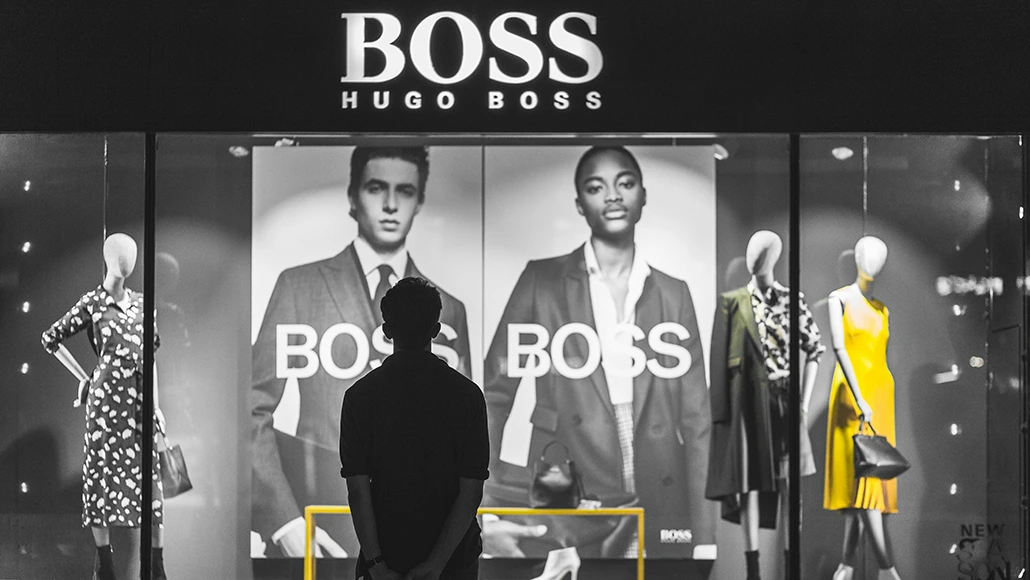

Hugo Boss has officially launched its Claim 5 Touchdown strategy, outlining plans to drive sustainable growth through to 2028. The strategy refines and builds upon the existing Claim 5 initiative, emphasizing enhanced efficiency in brand development, distribution, and operations.
Originally unveiled in August 2021, the Claim 5 strategy set an ambitious goal to double Hugo Boss’s sales to €4 billion ($4.6 billion) by 2025. Thanks to the success of this strategy and a stronger-than-anticipated market momentum, the brand surpassed the €4 billion target two years ahead of schedule, achieving this milestone in fiscal year 2023. As a result, Hugo Boss increased its 2025 sales goal to €5 billion in June 2023.
CEO Daniel Grieder stated, “Following the successes of recent years, we are now deliberately taking a step back to prepare for tomorrow’s growth. Our focus in the coming years will be on the ongoing optimisation in the areas of brand, distribution, and operations with the clear ambition to transform them from great to excellent.”
In 2026, Hugo Boss plans to enter a realignment phase to improve business processes, refine product assortments, and streamline its distribution network. This period is anticipated to accelerate the generation of free cash flow while enhancing operational and financial stability.
With a reported compound annual growth rate of 22% for both the Boss and Hugo brands from 2020 to 2024, the brand remarked that structural investments have built a robust platform for future development.
Claim 5 Touchdown Strategy Through 2028
The Claim 5 Touchdown strategy emphasizes initiatives aimed at strengthening the relevance of the Boss and Hugo brands while enhancing customer loyalty.
For the Boss Menswear line, the brand will maintain its established positioning, whereas Boss Womenswear will prioritize a core selection of products designed for women. Meanwhile, Hugo aims to refine its identity through updated brand positioning and a more accessible range of products. The company is creating a new organizational model featuring separate teams for menswear and womenswear, which will foster synergies across the two brands.
Marketing investments are expected to approach 7% of group sales, focusing on high-return initiatives, such as partnerships like Beckham x Boss and product-led campaigns.
The distribution strategy involves optimizing Hugo Boss’s store portfolio to enhance customer experience, boost sales productivity, and improve retail efficiency. In wholesale channels, the brand intends to strengthen strategic collaborations, introduce more selective assortments, and grow its franchise operations.
Moreover, the company seeks to expand its digital channels, improving brand visibility and customer engagement across various platforms. Regionally, Hugo Boss aims to solidify its market presence in the US and China while leveraging its strong European footprint to capture additional market share.
Operationally, Hugo Boss will emphasize supply chain improvements, focusing on sourcing efficiencies such as vendor optimization, sea freight preference, and shorter lead times. The company plans to upgrade its planning processes by utilizing technology and AI, enabling faster decision-making.
Financial Objectives Linked to Claim 5 Touchdown
Hugo Boss’s financial aims include achieving an earnings before interest and taxes (EBIT) margin nearing 12% over the medium to long term. The brand aspires to generate annual free cash flow of approximately €300 million by 2028, nearly three times its recent performance, supported by reduced capital expenditures and tighter management of working capital.
Inventory levels are projected to decrease to about 20% of sales by 2028. While the company expects a currency-adjusted sales decline of mid- to high-single digits in 2026, due to the planned realignment of brands and channels, it anticipates returning to growth by 2027 and further acceleration in 2028.
Gross margin improvements are expected starting in 2026, driven by sourcing efficiencies, price adjustments, and an increase in full-price sales. EBIT is projected to be between €300 million and €350 million in 2026, with further profitability improvements from 2027 onward.
Yves Müller, Chief Financial Officer and Chief Operating Officer, noted: “2026 will be a year of consolidation and realignment and an important step toward positioning Hugo Boss for long-term profitable growth. While we expect a temporary decline in sales, we will continue to drive our efficiency agenda along the value chain to safeguard margins and strongly accelerate cash flow generation.”