
































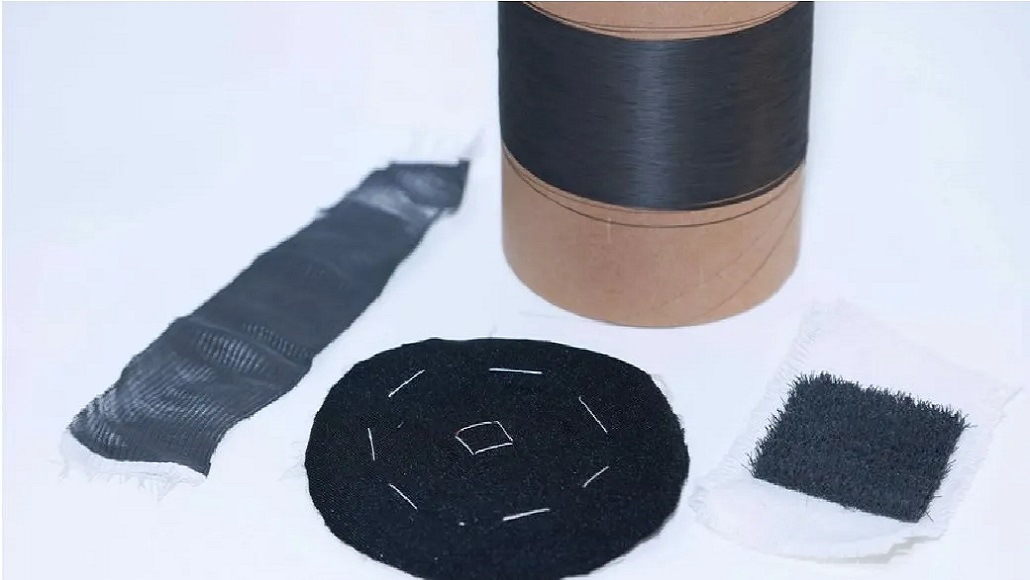

A team of researchers from The Hong Kong Polytechnic University (PolyU) has made groundbreaking strides in smart materials by developing innovative soft magnetorheological textiles. These advanced textiles can flexibly deform and adjust their mechanical properties in response to a human-safe magnetic field. Fueled by electricity and programmable control, these materials integrate lightweight, flexible, and breathable characteristics, expanding their applications in smart wearables, soft robotics, virtual reality, and haptic experiences in the metaverse.
Traditional magnetorheological materials have historically faced two significant hurdles: the weight of magnetic powders and the health risks that high-strength magnetic fields may pose. Professor Tao Xiaoming, director of the PolyU Research Institute for Intelligent Wearable Systems, alongside Vincent and Lily Woo, a professor of textiles technology and chair professor of Textile Technology at the School of Fashion and Textiles, spearheaded this pioneering research. Professor Xiaoming stated, “The core objective of our research team is to overcome the application limits of traditional magnetorheological technology, extending it to fibre form, and enabling precise intelligent modulation while remaining compatible with textile properties such as softness and breathability.”
The research team crafted soft magnetic polymer composite fibers measuring only 57 micrometers in diameter by uniformly dispersing magnetic powders in a low-density polyethylene matrix. These fibers facilitate precise control under low-strength magnetic fields and effectively solve the issue of heavy magnetic powders. Additionally, they can be spun into yarns and composite fabrics, enabling large-area, controllable deformations.
In contrast to conventional smart materials that respond to scalar stimuli—like voltage, current, or temperature—these new soft magnetorheological textiles provide unique directionally controllable responses. This unique feature has led to the development of three novel fabric materials, as highlighted in the study.
“The key breakthrough of this research lies in converting traditional rigid magnetic devices into flexible alternatives. This success can be extended to the development of hard magnetic fibre materials, laying a foundation for the next generation of soft robotics, electromagnetic devices, and wearable technologies,” explained Xiaoming.
On the subject of industrialization prospects, Dr. PU Junhong, assistant professor (research) at the School of Fashion and Textiles, remarked, “From raw material selection to processing technology, we have taken industrialization needs into consideration. We adopt commodity-grade, mass production-ready raw materials and mature processing techniques, paving the way for rapid translation in fields such as food production, medical rehabilitation, and metaverse interaction.”