





























Pakistan’s premier readymade garment industry group, representing more than 500 member companies, has joined a climate initiative led by fellow manufacturers to lower environmental impact through scalable and practical decarbonization. The Pakistan Readymade Garment Manufacturers and Exporters Association (PRGMEA) has officially joined the Apparel & Textile Transformation Initiative (ATTI), making Pakistan the third country represented after Bangladesh and Turkey. PRGMEA joins ATTI under a framework designed to support coordinated action across the global sector.
National chapter established under a new memorandum
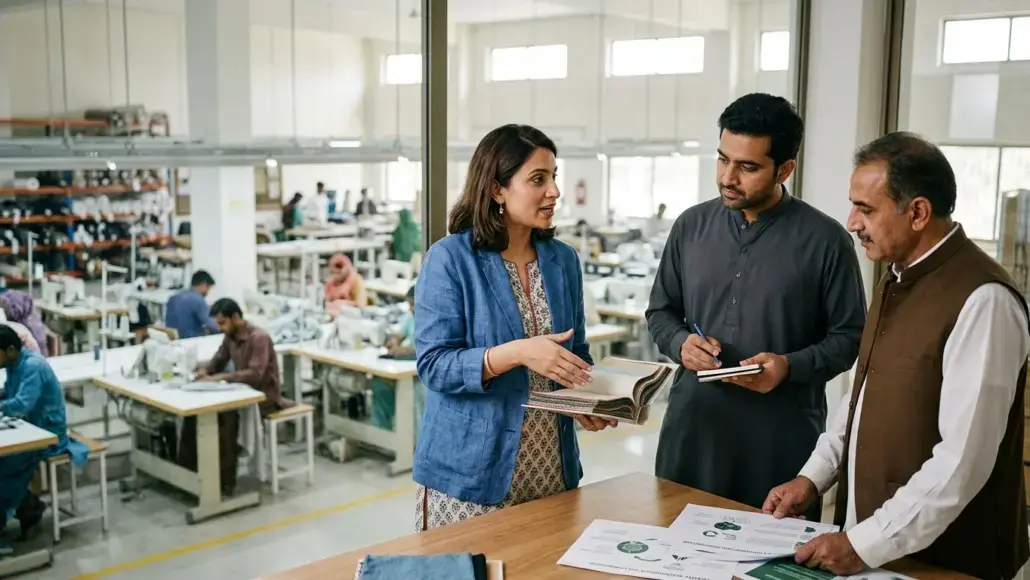
ATTI said it has signed a memorandum of understanding with PRGMEA to establish a national chapter under ATTI as manufacturers seek to accelerate practical and scalable decarbonization efforts across the industry. The agreement outlines ATTI’s support for PRGMEA across a full scope of work that includes a needs assessment, collaborative solutions design, and a contextualized plan to develop Pakistan’s garment and textile sector. PRGMEA, for its part, committed to provide the institutional resources, staff capacity, and member engagement required for effective implementation. This approach aligns with priorities in the Pakistan garment industry to advance textile sustainability and decarbonization.
Statement from ATTI on Pakistan’s inclusion
“As one of the world’s most significant garment manufacturing and exporting nations, Pakistan’s inclusion strengthens ATTI’s mission to reduce fragmentation, coordinate efforts, and accelerate the sector’s transition to lower-impact production,” ATTI said in its statement.
A manufacturer-led program with growing participation
ATTI is a relatively young program, launched in June last year during the London Climate Action Week by the International Apparel Federation and the Apparel and Textile Transformation Initiative. According to its official website, similar garment manufacturer and exporter groups in Bangladesh and Turkey countries among the world’s top exporters of textiles and apparel have signed up for the program. From its launch, the initiative was described as manufacturer-led, giving these stakeholders a voice in discussions that often leave them without one.
As Miran Ali, a former vice president of the Bangladesh Garment Manufacturers and Exporters Association, said at the launch: “You cannot turn up in a country which is the second-largest exporter of apparel in the world, and then demand radical changes without ever expecting to spend even one penny on it; it’s not possible.” He continued, “Yes, we need to make this industry more sustainable. It has to be more transformative. But you can’t destroy my country to make your clothes.”
Economic role and emissions profile of the Pakistan garment industry
What these efforts will look like in practice remains to be seen, but the plan acknowledges the large role the textile industry plays in Pakistan’s economy and its sizable carbon footprint. Textiles are the country’s largest export product, and the industry accounts for roughly 40 percent of the total labor force, according to the country’s Board of Investment. PRGMEA joins ATTI as part of broader efforts to coordinate action across the Pakistan garment industry and strengthen textile sustainability initiatives.
Globally, Pakistan ranked the ninth-largest exporter of textiles in 2024, shipping $19.5 billion worth of material, according to data from the Observatory of Economic Complexity. In emissions terms, the local textile sector is the second-largest producer of greenhouse gases after cement, with various sources estimating its contribution at 5 to nearly 9 percent of national emissions, or approximately 8.1 million tons of carbon each year. These figures underscore why decarbonization remains a central goal for ATTI, PRGMEA, and industry partners focused on textile sustainability.

