


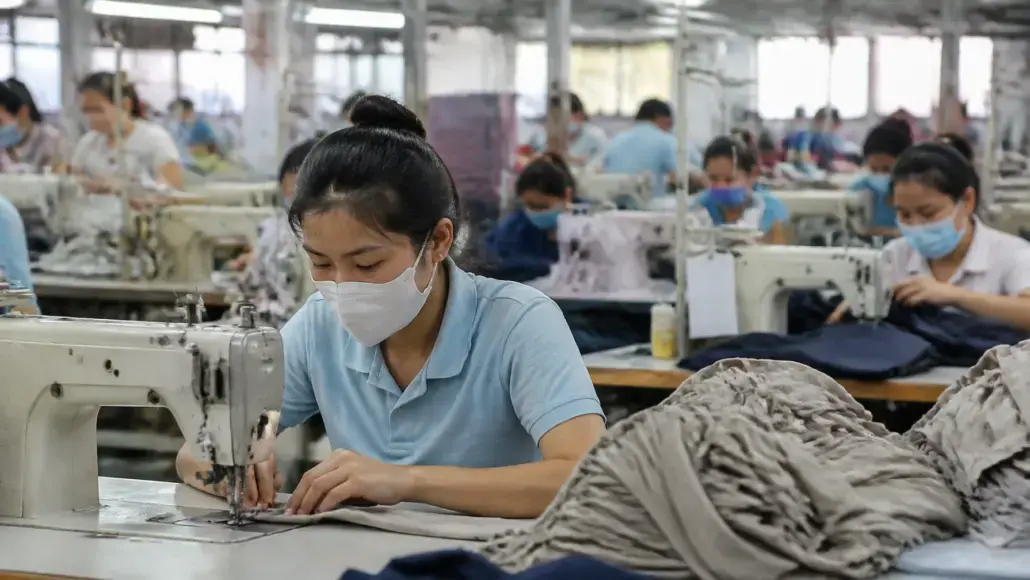
Navigating ongoing economic volatility, the sector driving Vietnam textile exports is implementing coordinated strategies to sustain production momentum. A primary focus for companies remains protecting the livelihoods and incomes of the workforce.
According to Pham Xuan Hong, Chairman of the Ho Chi Minh City Association of Garment Textile Embroidery Knitting (AGTEX), businesses in the garment industry have adopted a pragmatic operational approach this year. Rather than prioritizing maximum profit margins, manufacturers are prioritizing job retention and securing wages for their dedicated workforce. This targeted commitment has successfully maintained stable employment for more than 1.86 million industrial workers across the country.
To meet increasingly stringent partner requirements regarding custom designs and product quality, manufacturers are adapting flexibly, even seamlessly accommodating smaller production orders.
Financial Performance and Annual Projections
Recent import-export balance reports reveal that Vietnam textile exports reached 39.84 billion USD during the first ten months of 2026, marking a 3.9% increase year-on-year. In October alone, the garment industry generated 4.08 billion USD in revenue, which represents an increase of 0.9% from September and a 9.8% rise compared to October 2025.
With domestic production remaining robust and numerous factories holding full order books through the year’s end, the sector is well-positioned to achieve its annual export targets of 48 to 49 billion USD for 2026.
Strategic Measures for Market Expansion
To ensure these export targets are met efficiently, enterprises are executing several core operational initiatives:
- Diversifying international partnerships and destination markets.
- Developing supporting industries to create fully integrated raw material networks.
- Investing in artificial intelligence technology alongside high-quality workforce training.
- Advancing green transformation through functional circular economy models.
Currently, products from the sector reach 137 countries and territories. The United States remains the dominant market, absorbing approximately 40% of shipments. Other vital destinations include the European Union, the Republic of Korea, Japan, China, and ASEAN nations, alongside emerging regional opportunities in Africa and the Middle East.
Adapting to Global Trade Dynamics
Broadening market reach allows businesses to distribute operational risk and adapt to shifting demands within global supply chains. Closer collaboration among enterprises is also being prioritized to share physical resources and satisfy the rigorous standards set by international buyers.
Despite positive revenue figures, the sector faces pressing needs to elevate the quality of its growth. Tariff fluctuations, geopolitical conflicts, and potential disruptions across global supply chains present ongoing risks to operational costs and delivery timelines. As international clients increasingly scrutinize resource consumption, production conditions, and raw material origins, the sector must enhance its self-reliance in design, technology, and materials.
Long-term Industry Objectives
Under the supporting industry development program mapped for 2026 to 2035, the sector aims to achieve a 60% localization rate by 2030. This objective is designed to help enterprises comply with strict rules of origin and generate greater added value across production networks.
Achieving this benchmark requires upgrading supplier capabilities in management, technology, and delivery, while strengthening vertical connections across the spinning, weaving, dyeing, and manufacturing stages. Throughout this evolutionary process, maintaining stable employment remains central to the sector’s long-term vision. Continuous training will be essential for workers to master new technologies, ensuring that productivity improvements align directly with higher incomes and sustainable job quality.