
































Researchers at EPFL in Switzerland have redesigned how thin metal fibres are embedded into cloth, creating high-force textile actuators that remain soft enough for clothing while delivering lifting power typically associated with rigid mechanisms. The team reports that a 4.5-gram fabric sample, when contracting by 50%, can raise a 1-kilogram load more than 400 times its own weight supporting the next wave of wearable assistive devices that avoid bulky hardware.
Most wearable robotics still depend on stiff components that can restrict movement, reduce comfort and limit everyday usability. Soft robotic elements promise more discreet support, but achieving meaningful force and motion inside a flexible garment has been a persistent engineering challenge.
The breakthrough comes from EPFL’s Soft Transducers Lab (LMTS) in the School of Engineering, where PhD student Huapeng Zhang and LMTS head Herbert Shea developed an actuator textile using shape memory alloy (SMA) fibres arranged in a periodic X-crossing architecture. SMA fibres, made from nickel-titanium, shorten and stiffen when heated by an electrical current. While the material itself is powerful, its output has often been diluted in textiles because conventional knits and knotted structures make fibres pull in different directions, causing forces to counteract one another.
EPFL’s X-crossing design addresses that problem by aligning each fibre intersection with the intended direction of movement, so the forces add up constructively rather than cancelling out. The team also says the geometry improves wearability: the fabric can stretch to 160% of its original length, helping garments remain easy to put on and comfortable in motion.
“We realised that the orientation of fibre crossings plays a critical role in how forces add up inside a textile actuator,” explains PhD student Huapeng Zhang. “By aligning the crossings, we ensure that the forces generated at each intersection contribute constructively, rather than working against each other, resulting in a textile actuator that significantly outperform previous knitted or knotted designs.”
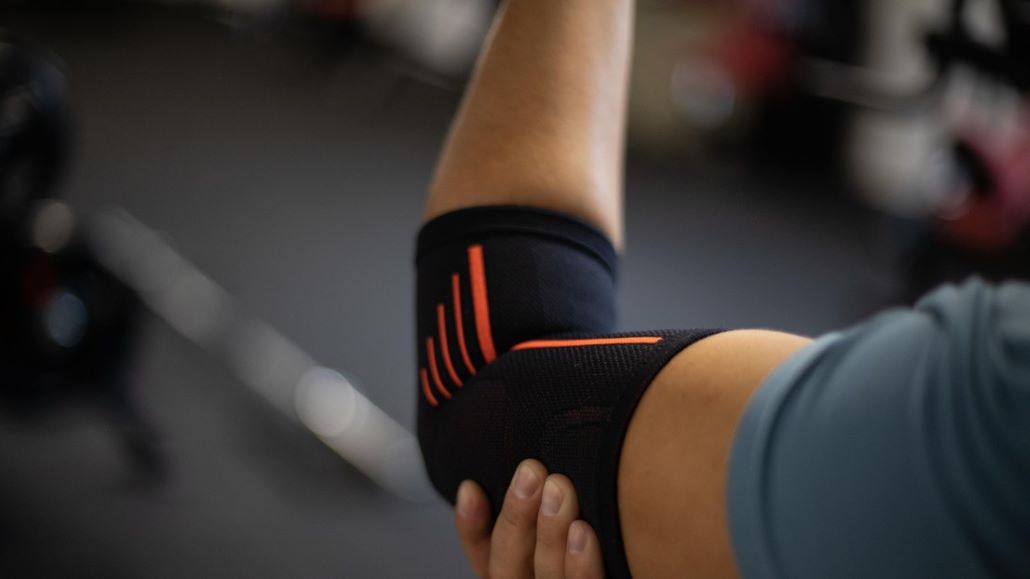
To show application potential, the researchers integrated the textile actuators into two prototypes. In one demonstration, the actuator was mounted on a mannequin’s arm as a sleeve to assist elbow flexion, lifting a 1 kg bag through a smooth 30-degree range of motion. In a second test, the actuators generated on-body compression, a key requirement for medical sleeves and performance athletic gear.
Beyond the textile architecture, the team developed a mechanics model that better predicts performance by capturing how SMA stiffness changes with temperature and stress along each fibre as phase transitions occur. The model is designed to help engineers forecast force and contraction under different loads, thermal conditions and geometric layouts, supporting more reliable design and scaling.
Shea also highlighted efficiency as a practical advantage, noting that the X-crossing configuration can maintain compression pressure with zero ongoing energy input.
“While textiles traditionally serve solely as passive apparel, the transition to fabrics that function as powerful actuators will enable a new class of comfortable, unobtrusive, practical wearable robotics that provide support for daily activities to be designed,” he says.