


























In a formal letter addressed to Bangladesh Commerce Secretary Md Ataur Rahman Khan, James Goldman, Deputy High Commissioner and Development Director at the British High Commission in Dhaka, has confirmed that Bangladesh will retain its existing market access to the United Kingdom for a period of three years following its graduation from Least Developed Country (LDC) status. The assurance, reported by local media, gives Bangladesh’s export community a defined transition window before the country moves into a new preferential arrangement.
What the Transition Means for Bangladesh’s Exporters
Bangladesh currently enjoys tariff-free access on 99.8 per cent of its goods exports to the UK under the Developing Countries Trading Scheme, widely referred to as DCTS Bangladesh. After the three-year transition period concludes, Bangladesh will move directly into the Enhanced Preferences tier of the same scheme. Under this arrangement, 92 per cent of goods will continue to qualify for duty-free access, and crucially, this shift will not require a separate bilateral trade agreement or any fresh renegotiation with the United Kingdom.
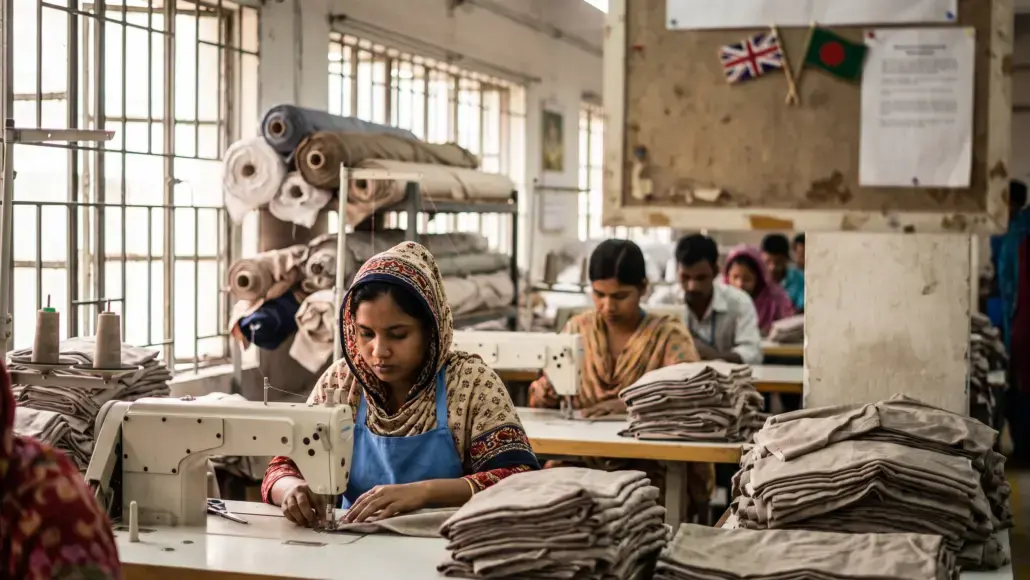
The Bangladesh LDC graduation transition is particularly consequential for the country’s readymade garment and apparel sector, which remains its single largest source of export revenue. The British High Commission has specifically confirmed that garments falling under chapters 61 and 62 — which include knitwear and woven garments — will see no change in their market access under the Enhanced Preferences arrangement. Commerce Ministry officials have further clarified that the overall reduction from 99.8 per cent to 92 per cent of goods eligible for duty-free treatment will not affect Bangladesh garment exports UK trade in any meaningful way.
Revised Rules of Origin Offer Added Flexibility
Beyond the continuity of tariff access, the UK’s revised Rules of Origin represent a further advantage for Bangladesh’s apparel exporters. Under the updated framework, exporters will no longer be required to meet the existing double-transformation requirement to qualify for preferential tariffs. This change allows manufacturers greater flexibility in sourcing fabrics and intermediate inputs from a broader range of countries while still retaining preferential access to the UK market.
This development carries significant weight for Bangladesh’s apparel industry, which has historically depended on imported fabrics and intermediate inputs for numerous product categories. The relaxed sourcing rules are expected to ease operational and cost pressures across the supply chain.
UK Remains a Critical Export Market
The UK is among Bangladesh’s most important export destinations, with ready-made garments forming the backbone of bilateral trade. Bangladesh garment exports UK registered a growth of 0.91 per cent in the last fiscal year, even as garment shipments to the broader European Union declined by 3.31 per cent over the same period.
Commerce Secretary Khan noted that the assurance from the British High Commission would provide Bangladesh with greater scope to build export capacity, diversify its range of products and explore new international markets during the transition phase.
Bangladesh Seeks Extended LDC Graduation Timeline
Bangladesh is simultaneously pursuing a three-year extension of its LDC graduation timeline, pushing the effective date to November 2029. If granted, this extension would allow the current duty benefits under the existing framework to remain unchanged throughout that period, offering exporters additional certainty.
British High Commission to Conduct Stakeholder Workshops
The British High Commission has also confirmed that it will work closely with Bangladesh’s Export Promotion Bureau, government bodies, business associations and exporters to improve awareness and utilisation of the DCTS Bangladesh framework. As part of this effort, a series of workshops targeting exporters and other trade stakeholders will be organised over the coming months. These sessions will focus on explaining the scheme’s structure, available preferential access routes and the implications of the updated Rules of Origin.
Certainty for Bangladesh’s Export Sector
By maintaining existing market access for three years after Bangladesh LDC graduation, followed by continued duty-free treatment for 92 per cent of goods under the Enhanced Preferences tier and more flexible sourcing rules for garment manufacturers, the United Kingdom has provided Bangladesh’s export community with a clear and stable pathway. The arrangement gives the country time to strengthen its competitiveness and broaden its export base ahead of the full transition.