

























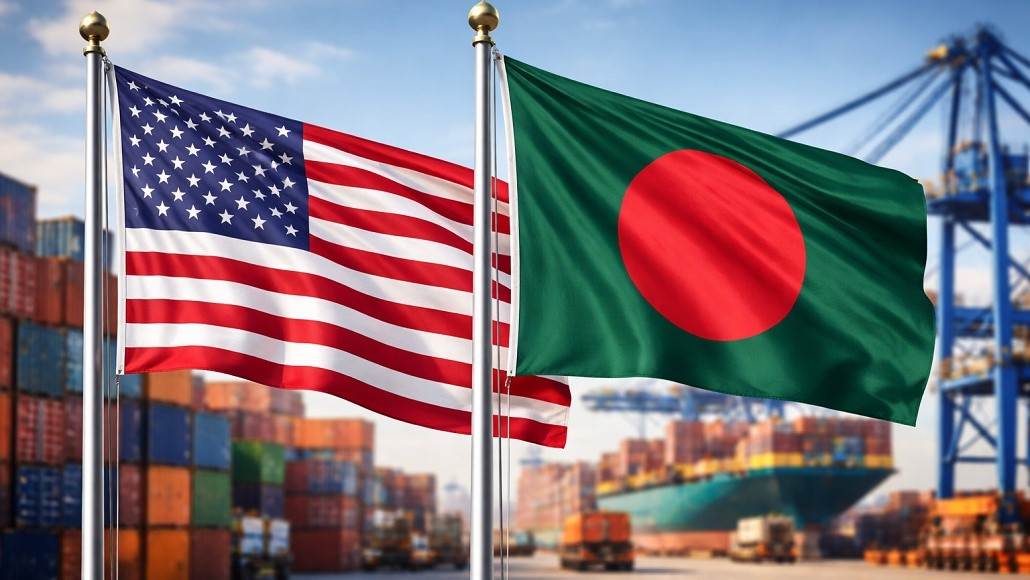
The United States and Bangladesh have signed a new US-Bangladesh trade agreement that creates a structured route to zero reciprocal tariffs on defined quantities of Bangladeshi textile and apparel exports bound for the American market.
Signed on 9 February after nine months of what was described as “intensive discussions,” the deal lowers the general US tariff cap for Bangladeshi imports from 20% to 19%. It also introduces a carve-out for items that are not produced in the United States—or are not available from US supply—allowing those products to enter at a zero tariff rate.
A central feature of the arrangement is a volume-linked incentive system. Certain Bangladesh-made textile and apparel lines can qualify for zero reciprocal tariffs, but the eligible import volume is tied to the amount of US-origin cotton and man-made fibre textile inputs shipped to Bangladesh. In effect, tariff-free access expands as more American raw materials are incorporated into Bangladesh’s export manufacturing base.
Bangladesh’s garment industry association, BGMEA, welcomed the announcement and said it could strengthen the country’s apparel shipments to the US. At the same time, the group flagged operational hurdles that could determine whether the commercial upside is fully realised, calling for stronger controls around input documentation and tracking.
“As US cotton is of superior quality and relatively higher cost, significant export opportunities can be created if local spinners are able to ensure competitive yarn pricing. It is important to note that BGMEA has not yet been formally informed of the complete terms and conditions of the agreement. Upon receiving detailed documentation from the government, BGMEA will convene an urgent meeting with its members and engage in discussions with the US Embassy in Dhaka and the USTR to determine the next course of action,” BGMEA on a LinkedIn post.
Wider market-access commitments
The US-Bangladesh trade agreement is not limited to apparel. Bangladesh has agreed to grant “significant preferential market access” for an extensive list of US industrial and agricultural exports, removing some duties immediately and cutting others by half before phasing them out completely.
Product groups covered include chemicals, medical devices, machinery, motor vehicles and parts, ICT equipment, energy products, soy products, dairy, beef, poultry, nuts, and fruit.
Customs modernisation, enforcement and standards
The pact also pushes Bangladesh toward more technology-enabled customs administration, with a commitment to full pre-arrival processing and digitisation by 2030. It includes language requiring Bangladesh to take measures consistent with its laws in support of US border actions taken for economic or national security reasons.
On trade enforcement, Bangladesh agrees to bolster export controls and compliance mechanisms, including systems designed to address export practices by entities owned or controlled by third countries that could distort trade, and to conclude a duty-evasion cooperation agreement with the US.
Further terms include removing discriminatory VAT treatment for US companies, lifting import restrictions or licensing requirements on US remanufactured goods and their parts, and adopting policies aligned with internationally recognised labour rights. Environmental provisions call for maintaining strong environmental protection and enforcement, alongside measures addressing subsidies and state-owned enterprise activity.
Both governments said domestic procedures still need to be finalised before the agreement officially enters into force.