
































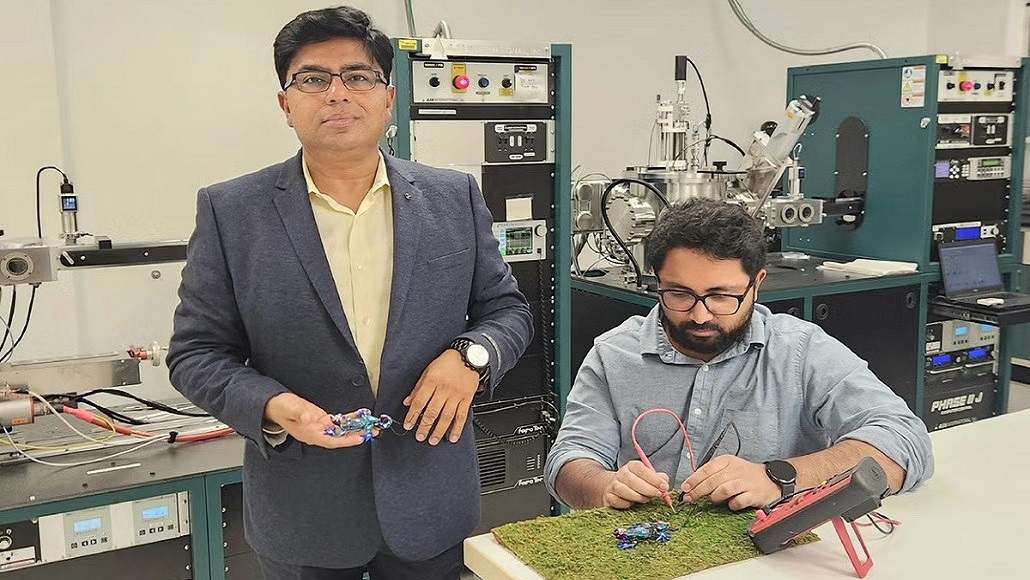

Debashis Chanda, a researcher and professor at the NanoScience Technology Centre at the University of Central Florida, has made significant strides in creating a dynamic color-changing material that responds to external stimuli, such as temperature. This breakthrough opens exciting new possibilities for materials and devices that can adapt and reconfigure in real time.
In traditional commercial and industrial products, colors are primarily derived from pigments, which absorb and reflect light but tend to fade over time. Alternatively, structural colors, like those seen in octopuses, utilize nanoscale structures to manage light reflection. Inspired by this biological efficiency, Chanda has focused on developing vibrant, angle-independent colors that do not rely on chemical pigments.
His latest work addresses the complexities of creating a dynamic color-changing material while also tackling manufacturing challenges associated with structural colors, potentially making it easier to produce these materials commercially. This innovation holds considerable promise for applications in fields such as thermal sensing, advanced textile engineering, camouflage, and reconfigurable displays.
Chanda’s approach involves phase modulation of a multilayer stack that consists of a phase-changing material and a high-index material positioned on a reflective surface. As temperature shifts, the way light traverses the material changes, leading to variations in the surface color.
This technology features several innovative aspects, including the ability to fabricate large areas without the need for complex lithography, a generally expensive process. The method allows for reversible color changes, precise control over dynamically tunable colors, and covers a broad dynamic range within the visible color spectrum.
Prior methods of developing structural color relied heavily on costly electrochromic materials, mechanical actuation, or photonic crystals. These approaches often face limitations related to tunability, complex fabrication, manufacturing steps, and angular sensitivity. Achieving dynamic color switching in the visible range has remained a substantial obstacle.
“The reliance on angle-dependent resonances or patterned nanostructures limits practical integration and scalability,” Chanda explained. “Overcoming these barriers is critical for advancing tunable structural color platforms toward real-world applications in flexible electronics, displays, and wearable systems.”
This new method of creating a dynamic color-changing material has potential applications for large-scale textiles, intricate surfaces, and temperature-sensitive labels for consumer products. Drawing inspiration from animals like octopuses, which alter their color by rearranging small structures in their skin rather than generating new pigments, Chanda’s team devised a layered design that alters color without being influenced by viewing angles or the direction of incoming light.
By utilizing a very thin layer of VO2, a material that transitions from a semiconductor to a metal as temperature changes, placed on top of a thicker aluminum layer, the design establishes a resonating cavity that effectively traps and reflects light in a controlled manner.
Unlike pigment colorants, which govern light absorption based on a material’s electronic properties and require unique molecules for each color, structural colorants operate differently. These colorants control how light is reflected, scattered, or absorbed based on the arrangement of nanostructures, allowing for sensitivity to environmental changes.
“Harnessing the reversible phase transition, the platform offers precise control over dynamically tunable color, opening avenues for applications in temperature sensing, displays, tunable colored fabrics, and many other consumer products,” Chanda described.
The bi-layer structure is fabricated using magnetron sputtering to deposit the phase-change material through a process that employs plasma. Additionally, electron-beam deposition is used to apply the metal layer, which involves focusing an electron beam to precisely melt and coat the material. This combination makes the structure suitable for flexible substrates, paving the way for large-scale production and wearable applications.