

































The Fabric of Modern Branding: Understanding Custom Textiles
In an increasingly crowded marketplace where digital noise drowns out traditional advertising messages, custom textiles have emerged as a tangible and powerful medium for brand expression. The strategic deployment of branded apparel extends far beyond mere promotional gimmicks—it represents a sophisticated approach to building brandready identity, fostering emotional connections, and driving measurable consumer engagement.
The textile industry has witnessed a profound transformation in recent years, with custom merchandise evolving from simple logo-bearing items into carefully curated experiences that communicate brand values, company culture, and corporate ethos. When consumers interact with thoughtfully designed custom textiles, they experience something visceral and personal, engaging multiple sensory dimensions that digital touchpoints cannot replicate. This tactile dimension of branding creates lasting impressions that transcend conventional marketing channels.
The Psychology Behind Personalized Textiles
Consumer behavior research reveals compelling insights into why personalized merchandise resonates so powerfully with audiences. At its core, the human psychology of personalization operates on fundamental principles of recognition and belonging. When brands invest in textile branding solutions that acknowledge individual preferences and values, they communicate a profound message: “We understand you, we value you, and we see you as more than just a transaction.”
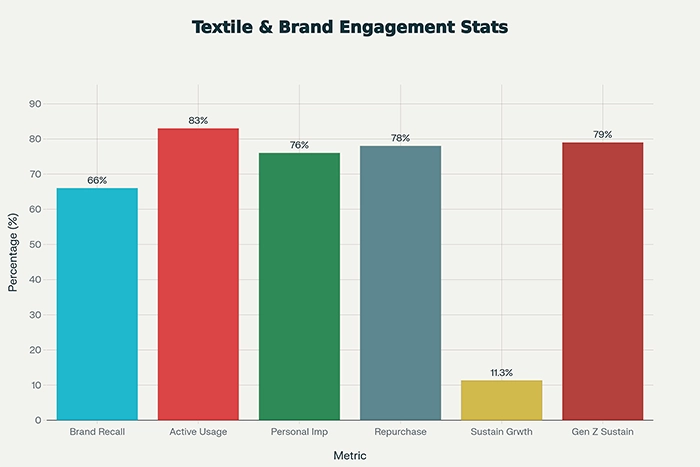
The science is compelling. Research demonstrates that 76% of consumers are more likely to consider a brand after receiving personalized communications, while 78% show significantly increased propensity to repurchase from brands that personalize their offerings. This psychological principle extends naturally to custom textiles, where each garment becomes a statement of personal identity and brand affiliation simultaneously.
The concept of self-concept theory illuminates this phenomenon further. Individuals construct their identity partly through the products they use and display. When someone wears branded apparel that aligns with their personal values and aesthetic preferences, they’re not merely advertising a company—they’re reinforcing their own identity and social positioning. This integration of brand identity with personal identity creates a powerful dual benefit: the wearer feels validated, while the brand receives authentic advocacy.
Building Lasting Emotional Connections Through Custom Merchandise
Consumer engagement through branded textiles operates on emotional levels that traditional marketing struggles to achieve. Emotional branding—the practice of establishing deep, meaningful connections between consumers and brands—has proven remarkably effective at driving loyalty and repeat engagement.
When fashion and apparel brands leverage emotional storytelling within their textile designs and messaging, they tap into fundamental human desires for connection, meaning, and self-expression. A thoughtfully designed custom polo shirt or branded jacket becomes more than functional clothing; it transforms into a wearable narrative that communicates shared values between brand and consumer.
Consider how leading brands have successfully implemented this strategy. Companies that excel at brand identity strategies recognize that emotional resonance drives approximately 40% more revenue than average competitors. The differential in performance correlates directly with the depth of emotional connection brands establish with their audiences through consistent, authentic touchpoints—including the strategic use of custom textiles.
The mere-exposure effect, a well-documented psychological principle, demonstrates that repeated exposure to stimuli increases affinity and positive associations. Custom branded apparel serves as a brilliant application of this principle. Each time an employee wears a branded jacket to a meeting, each instance a customer spots branded merchandise at an event, each photograph shared on social media featuring custom textiles—these cumulative exposures reinforce brand recognition and deepen psychological association with the company’s values and promise.
Custom Textiles as Strategic Marketing Assets
Elevating Brand Visibility and Recognition
The capacity of branded apparel to function as a mobile marketing platform represents one of its most compelling advantages in contemporary brand strategies. Unlike static advertisements that fade after fleeting exposure, custom textiles provide continuous, ambient brand presence in everyday environments.
Research indicates that promotional products, specifically branded apparel, increase brand recognition by up to 85%—a dramatic improvement over most traditional advertising channels. Moreover, 66% of consumers can recall the specific brand name from logoed products they received within the past 12 months, demonstrating remarkable retention despite the proliferation of marketing messages consumers encounter daily.
The economics of this visibility advantage prove particularly attractive to marketing decision-makers. A well-designed branded t-shirt or sustainable hoodie made from quality materials represents a one-time investment that generates ongoing brand exposure potentially spanning years. A professional employee wearing company-branded attire at industry conferences, community events, or simply throughout daily life becomes an unpaid ambassador, extending brand reach far beyond what traditional advertising budgets could achieve.
The Conversion Power of Personalized Merchandise
Organizations implementing personalised textiles strategies report significantly elevated engagement metrics compared to generic promotional approaches. The distinction between mass-produced branded items and personalized, custom merchandise correlates directly with consumer response rates and perceived value.
Personalization in the context of branded apparel extends beyond simple monogramming or name embroidery. It encompasses the entire design philosophy—selecting color palettes that reflect individual preferences, incorporating design elements aligned with recipient interests, and crafting narratives within garment aesthetics that speak to specific audience segments.
This personalization extends the psychological principle of reciprocity: when consumers perceive that a brand has invested effort in understanding and serving their individual preferences, they naturally reciprocate with increased loyalty, repeat engagement, and positive word-of-mouth advocacy. The statistics supporting this dynamic are substantial: companies excelling at personalization generate 40% more revenue than average performers, and 78% of consumers demonstrate increased likelihood of repurchasing from brands offering personalized experiences.
Textiles as Vehicles for Sustainable Brand Values
Environmental Consciousness Meets Brand Strategy
The contemporary consumer landscape reflects a fundamental shift in purchasing priorities. Approximately 79% of Generation Z consumers explicitly consider sustainability when selecting brands, while 73% of Millennials similarly prioritize environmental impact in their buying decisions. This generational realignment of values necessitates that custom textiles influence brand identity in ways that explicitly communicate environmental consciousness and corporate responsibility.
The sustainable textile movement has transformed from niche concern to mainstream expectation. By 2025, the global sustainable apparel market commands 47.4% of all apparel products by segment share, driven entirely by consumer demand for ethical and environmentally responsible options. Custom textile strategies that incorporate sustainable materials—organic cotton, recycled fibers, innovative biodegradable alternatives like Tencel—directly address this consumer expectation while simultaneously reinforcing authentic brand values.
Organizations implementing sustainable custom merchandise experience dual benefits. First, they generate positive environmental impact by reducing waste associated with mass production and selected overstock. Second, they signal to conscious consumers that their brand authentically shares environmental values rather than engaging in superficial “greenwashing.” This authenticity translates directly into consumer trust and loyalty.
The sustainability advantage extends economically beyond brand reputation. Eco-friendly merchandise receives disproportionate engagement on social media platforms, where environmentally conscious consumers frequently photograph and share items aligned with their values. This organic amplification of brand messaging through social sharing provides measurable ROI beyond traditional metrics.
Quality Over Quantity: The Custom Production Advantage
Textile branding strategies emphasizing custom production inherently promote quality over quantity—a positioning that appeals powerfully to contemporary consumers fatigued by disposable fast fashion. Custom textile production, by definition, involves creating garments specifically for identified purposes and audiences rather than speculating on market demand and producing excess inventory destined for liquidation or waste streams.
This approach aligns perfectly with the growing consumer desire for durable, meaningful possessions rather than accumulation of disposable goods. Research indicates that 23% of Americans explicitly state they would purchase more sustainable apparel if it were more readily available, suggesting significant latent demand for quality-focused custom solutions. By positioning custom textiles as premium, durable, and thoughtfully produced alternatives to mass-market merchandise, brands tap into this emerging consumer segment.
Strategic Implementation: From Concept to Consumer
Designing for Impact: The Textile Branding Process
Effective branded apparel campaigns emerge from deliberate strategic processes rather than rushed production decisions. The journey from initial brand concept to impactful consumer touchpoint encompasses several critical phases, each contributing essential elements to ultimate campaign success.
The process begins with thorough internal clarity regarding brand identity, core values, and the specific narrative the apparel should communicate. What emotional response should the custom textile evoke? What brand promise should the garment reinforce? These foundational questions guide all subsequent design and production decisions.
The design phase translates strategic intent into visual and tactile form. Color psychology plays a crucial role—different hues communicate distinct emotions and associations that influence consumer perception at both conscious and subconscious levels. A technology company might employ minimalist blues suggesting trust and innovation, while a creative agency might select vibrant, unconventional colors indicating imagination and bold thinking. The visual identity must demonstrate coherence with broader brand systems while maintaining sufficient distinctiveness to capture attention.
Equally important to the visual design phase is the material selection process. The fabric’s weight, texture, drape, and composition directly influence how consumers perceive and experience the garment. Premium materials signal that the brand invests in quality and respects recipients sufficiently to provide genuinely valuable merchandise rather than cheap promotional items. This material investment often generates disproportionate returns through increased wear frequency, social sharing, and brand perception elevation.
Measuring Return on Investment: Quantifying Brand Impact
Organizations implementing custom textile strategies require sophisticated frameworks for measuring campaign effectiveness beyond surface-level metrics. Consumer engagement measurement encompasses both quantitative indicators and qualitative dimensions that collectively demonstrate ROI.
Quantitative metrics include direct response tracking through unique QR codes or custom URLs incorporated into merchandise, sales correlation analysis examining whether branded merchandise distribution correlates with revenue increases, and brand recall surveys measuring percentage of target audiences who can identify and remember brand associations.
Qualitative assessment involves analyzing customer testimonials, social media sentiment, and unsolicited references to branded merchandise in customer communications. These qualitative indicators often prove as valuable as quantitative data in demonstrating genuine emotional connection and brand affinity development.
The PPAI’s 2023 Consumer Study provides compelling baseline data: 83% of consumers actively use branded merchandise they receive, a substantial increase from 54% the previous year. This usage rate directly translates to visibility and ambient brand presence. Additionally, 66% of consumers demonstrate accurate brand recall from merchandise received within 12 months—exceptional performance compared to most advertising channels’ decay rates.
For cost-per-impression calculations, organizations can establish baseline cost by dividing total campaign investment by estimated audience exposure. For instance, if a company distributes 1,000 branded hoodies at a cost of 25,000, the per-unit cost is 25. If each garment averages 50 daily exposures across the year (conservative estimate), the total impressions approach 18.25 million, resulting in approximately $0.0014 per impression—profoundly favorable compared to digital advertising benchmarks.
Building Community Through Shared Textile Identity
From Customers to Brand Advocates
Custom branded textiles function as powerful community-building instruments by creating visible symbols of shared identity and values. When customers wear merchandise bearing company logos, they publicly declare their affiliation with the brand and its mission. This visible declaration transforms passive customers into active community members and voluntary brand ambassadors.
This community-building capacity extends across diverse organizational contexts. Corporate teams unified in branded attire develop heightened internal cohesion and pride. Event attendees wearing custom merchandise experience increased sense of belonging and shared purpose. Customers displaying branded products signal their commitment to the brand’s values and aesthetic, attracting like-minded individuals to the brand community.
The psychological mechanism underlying this dynamic involves social identity theory—the tendency of individuals to derive significant portion of self-concept from group membership and identification. When brands provide visible symbols of group membership through custom textiles, they facilitate this natural human tendency toward social identity construction. Wearing branded apparel becomes an affiliation statement, and stronger affiliations produce stronger loyalty and advocacy.
Contemporary Trends and Future Directions
Digital Integration and Personalization at Scale
Emerging technologies are transforming textile branding capabilities, enabling personalization and customization previously impossible at commercial scale. Three-dimensional scanning technology, artificial intelligence-driven design tools, and digital printing innovations allow brands to offer unprecedented levels of customization while maintaining production efficiency and cost-effectiveness.
These technological advances make individually personalized merchandise increasingly feasible for mid-sized organizations, not merely luxury brands or massive enterprises. A company can now offer employees or customers the ability to select specific colors, incorporate personal names or initials, and customize design elements, all while maintaining reasonable production costs and acceptable delivery timelines.
Augmented reality technologies enable consumers to virtually preview how custom apparel will appear before finalizing purchases, reducing returns and increasing satisfaction. These digital integration points create friction-free pathways to personalised textiles experiences that feel natural and effortless from consumer perspective.
Sustainability as Competitive Differentiation
Forward-thinking organizations recognize that sustainable custom merchandise positioning represents increasingly important competitive differentiation. Brands explicitly communicating their sustainable textile sourcing practices, ethical labor standards, and environmental impact reduction efforts attract growing consumer segments prioritizing these values.
The market data supports this positioning clearly: 91% of American consumers indicate intention to shop eco-friendly in 2025, with sustainable apparel growth accelerating at 11.3% annually—significantly outpacing conventional fashion industry growth rates. Brands embracing sustainable custom textile strategies position themselves advantageously within this rapidly expanding market segment.
Measuring Success: Key Performance Indicators for Custom Textile Campaigns
Effective brand identity strategies utilizing custom textiles require comprehensive measurement frameworks encompassing multiple indicator categories:
Visibility and Reach Metrics: Calculate total estimated impressions, track social media mentions and shares featuring branded merchandise, measure geographic expansion of brand visibility, and monitor audience expansion beyond primary target segments.
Engagement Indicators: Track repeat interactions from merchandise recipients, measure conversion rates from branded merchandise touchpoints to purchase actions, monitor customer service interactions mentioning merchandise, and assess repeat customer percentages among recipients.
Loyalty Metrics: Measure customer retention rates among merchandise recipients versus non-recipients, calculate customer lifetime value for engaged merchandise recipients, assess Net Promoter Score among recipient populations, and track referral rates.
Internal Metrics: Evaluate employee retention and satisfaction increases following branded apparel distribution, measure team cohesion through internal surveys, assess recruitment improvements resulting from branded culture communication, and analyze internal brand perception changes.
Financial Metrics: Calculate ROI through direct revenue attribution, determine cost-per-impression relative to alternative marketing channels, assess inventory and supply chain efficiency, and analyze repeat order patterns.
Conclusion: The Strategic Imperative of Custom Textiles
Custom textiles have transcended their historical role as supplementary promotional items to become essential components of comprehensive brand identity and consumer engagement strategies. The convergence of psychological research, consumer behavior trends, technological capabilities, and environmental consciousness has elevated branded apparel to strategic importance in contemporary marketing.
Organizations recognizing that custom textiles influence brand identity and drive consumer engagement position themselves to capitalize on this powerful marketing channel. By approaching textile branding strategically—with genuine commitment to quality, authentic alignment with consumer values, thoughtful design execution, and comprehensive measurement frameworks—brands transform simple garments into meaningful brand experiences.
The textile industry continues evolving toward customization, sustainability, and personalization. Brands that master this evolution through sophisticated deployment of custom textiles will build deeper customer relationships, stronger brand recognition, more resilient communities of engaged advocates, and ultimately, more sustainable competitive advantages in an increasingly complex marketplace.