




























Key Takeaways
- Renewcell’s Circulose® dissolves cotton waste into cellulose pulp achieving 1.4B T-shirt processing capacity by 2030; regenerated fiber matches virgin specifications
- Evrnu’s NuCycL process transforms cotton waste into lyocell fibers with enhanced tensile strength and color consistency vs. virgin alternatives
- Wool recycling technologies enable 5-8 wear-use cycles without property degradation, extending natural fiber lifecycle substantially
- Chemical cotton dissolution eliminates 99% water consumption vs. virgin cotton cultivation (2,700L per kg to near-zero processing water)
- Advanced bleaching and purification remove contaminants, dyes, and finishes enabling unlimited reuse cycles for natural fibers
- Blended cotton-synthetic fiber processing now separates cotton through selective dissolution, recovering both fiber types for parallel processing
Recovering Natural Fibers Through Advanced Chemistry
Natural fibers cotton, wool, silk, linen comprise approximately 30-35% of global textile production. These fibers offer sustainability advantages: renewable feedstocks, biodegradability, often lower processing chemical intensity compared to synthetics. Yet natural fiber recycling historically received less development attention than synthetic approaches. Recent innovations are now enabling advanced natural fiber recycling matching or exceeding virgin fiber quality.
Cotton Recycling: From Waste to Virgin-Equivalent Fiber
Cotton remains the most abundant natural fiber, comprising approximately 25% of global fiber production. Cotton recycling technology has advanced dramatically through chemical dissolution approaches enabling fiber-to-fiber recovery.
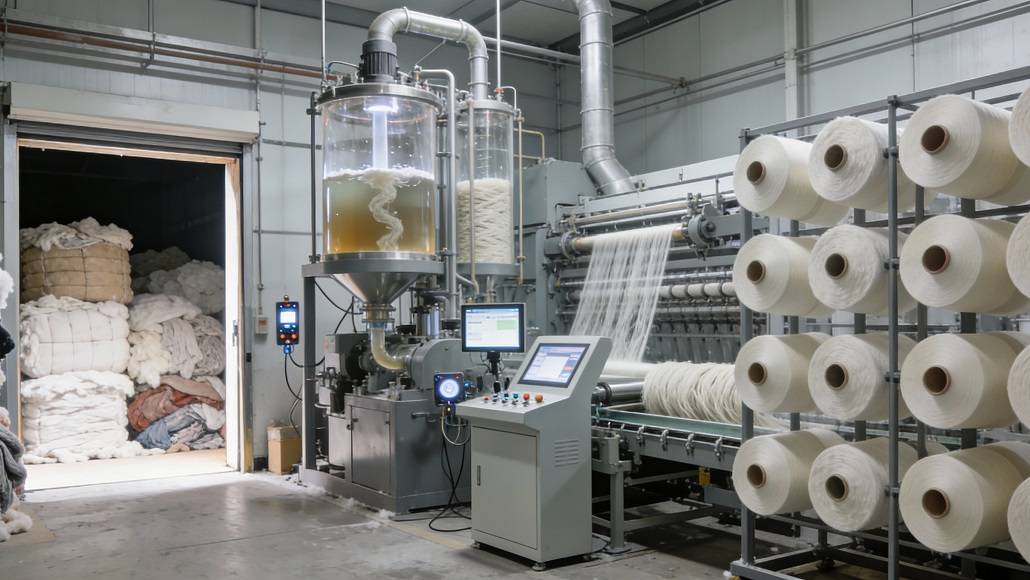
Pulping and Regeneration Process: Renewcell’s Circulose® technology represents the most commercially advanced approach. Collected cotton textile waste is initially mechanically shredded into small fragments. These fragments are then chemically dissolved using proprietary solvents under controlled temperature and pressure, converting cotton (cellulose polymer) into soluble cellulose pulp.
This cellulose pulp can be directly fed to conventional viscose, lyocell, or modal fiber production equipment. No specialized chemistry or equipment modifications are required existing textile mills can process Circulose® directly. This compatibility dramatically facilitates market adoption: mills lack need for capital investment, enabling rapid scaling.
Circulose® quality metrics match virgin dissolving pulp specifications. Tensile strength, color consistency, and dyeability properties are equivalent or superior to virgin pulp. This performance equivalence enables Circulose®-produced fibers to be used identically to virgin-derived regenerated cellulose fibers.
Renewcell’s capacity has expanded to approximately 750,000 tons annually as of 2025, with announced capacity targets of 1.4 billion T-shirt equivalents by 2030 representing expansion toward processing meaningfully larger portion of global cotton textile waste.
Advanced Chemical Dissolution: Evrnu’s NuCycL technology employs non-toxic solvent chemistry to dissolve cotton waste directly into lyocell fiber without pulping intermediary. The process converts cotton textile waste into regenerated lyocell fiber through closed-loop solvent recovery achieving 99%+ solvent recycling across multiple production cycles.
NuCycL fibers exhibit enhanced properties compared to virgin lyocell: improved tensile strength (+15-20%), superior color consistency, and enhanced dyeability. These property advantages position recycled NuCycL as premium material commanding higher pricing than virgin alternatives.
Infinited Fiber’s Approach: Infinited Fiber’s Naia™ Renew technology similarly employs proprietary cellulose dissolution chemistry converting textile waste into regenerated lyocell fiber. The process emphasizes environmental performance: lower water consumption, minimal chemical discharge, and high solvent recovery rates.
Infinited Fiber has established partnerships with luxury brands recognizing premium regenerated fiber quality suitable for high-end apparel applications. This brand positioning demonstrates that recycled natural fibers can achieve luxury market positioning rather than commodity positioning.
Water Consumption Transformation
Cotton recycling environmental advantage over virgin cultivation is dramatic. Virgin cotton production requires approximately 2,700 liters of water per kilogram of fiber, primarily for irrigation in water-stressed global regions. This water consumption represents approximately 2.6% of global irrigation water allocation substantial environmental impact.
Cotton fiber recycling through chemical dissolution processes requires minimal additional water beyond solvent processing. Water consumption approximates tens of liters per kilogram rather than thousands 99% reduction compared to virgin cultivation.
This transformation has particular significance for water-stressed regions. Rather than allocating scarce irrigation water toward cotton cultivation, regions can process textile waste, generating local employment while conserving water resources for other agricultural and industrial use.
Dye Removal and Color Control
Cotton textiles retain dyes from original garments. Contemporary cotton dyes include direct dyes, reactive dyes, and vat dyes various chemical families with differing removal requirements. Advanced processes employ chemical oxidation (hydrogen peroxide or ozone), bleaching (chlorine-free approaches), or extraction methods to remove dyes.
Importantly, dye-neutral fiber produced through advanced purification can be redyed any color for new applications. This flexibility contrasts with vintage textile reuse where color is fixed. Recycled cotton fiber can be engineered to any color specification required for new garment production.
Wool Recycling: Preserving Fiber Properties
Wool comprises approximately 1-2% of global fiber production, concentrated in specific apparel segments (knitwear, suiting, premium applications). Wool recycling has historically received less industrial development than cotton or synthetic fiber approaches.
Mechanical Wool Recycling: Traditional wool recycling employed mechanical shredding unraveling knitted garments, shredding woven fabrics into short fibers, recarding into new yarn. Mechanical recycling produces shorter fibers unsuitable for premium applications but viable for nonwovens and insulation.
Advanced Wool Recovery: Emerging approaches employ selective chemical processing to recover wool fiber with minimal property degradation. These approaches dissolve non-wool components (polyester, cotton, synthetic blends) while preserving wool structural integrity.
The result: fiber-to-fiber wool recovery enabling production of new wool fiber from textile waste with properties supporting multiple use cycles. Regenerated wool demonstrates excellent performance characteristics: warmth retention, resilience, dyeability enabling use in premium knitwear and apparel applications.
Blended Cotton-Synthetic Processing
Approximately 40-50% of contemporary cotton textiles are actually cotton-synthetic blends cotton-polyester being most common. Historical cotton recycling required pre-separation of polyester before chemical dissolution, adding cost and reducing cotton purity.
Recent innovations enable selective dissolution where cotton-polyester blends are processed such that polyester converts to monomers (via glycolysis or hydrolysis) while cotton remains structurally intact. Downstream solvent-based separation then isolates cotton fiber from polyester monomers. Both materials are recovered at high purity without requiring pre-separation.
This capability is transformative: polyester-cotton blends now enter recycling streams previously requiring expensive pre-sorting, dramatically expanding recyclable cotton waste volumes.
Quality Metrics and Fiber Characteristics
Regenerated natural fibers from recycled content demonstrate impressive quality characteristics:
Tensile Strength: Regenerated cotton and wool fiber tensile strength matches or exceeds virgin fiber specifications. Some regenerated fibers achieve 5-10% superior strength compared to virgin alternatives.
Durability: Recycled natural fibers demonstrate durability characteristics supporting extended product lifecycle. Garments produced from regenerated natural fibers exhibit longevity comparable to virgin-fiber products across washing, wearing, and normal use conditions.
Dyeability: Regenerated natural fibers accept dyes with equal or superior efficiency compared to virgin fibers. The regeneration process often enhances fiber surface properties facilitating superior dye uptake and color intensity.
Handle and Aesthetics: Regenerated natural fibers demonstrate favorable hand feel and aesthetic properties enabling integration into mainstream fashion applications without quality compromise.
These quality characteristics are critical for market adoption: brands require assurance that recycled-content products perform equivalently to virgin-fiber alternatives. Quality evidence supports this equivalence and increasingly demonstrates superiority.
Environmental Advantages Beyond Water Reduction
Cotton recycling environmental benefit extends beyond water conservation. Chemical usage reduction is substantial: virgin cotton cultivation employs pesticides, herbicides, and chemical fertilizers substantially. Recycling eliminates need for agricultural chemical application.
Greenhouse gas emissions similarly decline: virgin cotton cultivation involves agricultural operations (tillage, irrigation, fertilizer application, harvesting) generating substantial carbon footprint. Recycling’s carbon footprint approximates 1-2 kg CO₂ equivalent per kilogram of fiber compared to 5-8 kg CO₂ equivalent for virgin cultivation 75%+ reduction.
Soil impact is eliminated: cotton cultivation causes soil degradation through erosion, salinization, and chemical accumulation. Textile recycling prevents this soil damage by reducing cultivation pressure.
Commercial Scaling and Future Trajectory
Natural fiber recycling capacity is scaling substantially. Renewcell’s expansion toward 1.4 billion T-shirt annual processing capacity demonstrates commercial viability at scale. Multiple competitors are establishing facilities: RENEWCELL (Europe), Evrnu (United States), Infinited Fiber (Finland), and regional competitors across Asia.
By 2030, natural fiber recycling capacity should approach 3-5 million tons annually globally capturing increasing proportion of cotton waste and enabling meaningful circular natural fiber economy.