






























Key Takeaways
- AI-powered sorting systems achieve 95-98% accuracy identifying 13+ fiber types in <2 seconds per garment, eliminating labor-intensive manual sorting
- Convolutional neural networks (CNN) process near-infrared spectral data to classify fibers by composition, color, and contamination level
- Robotic systems handle sorted materials with precision, reducing manual labor requirements by 70-80% while improving worker safety
- Machine learning models continuously improve through training datasets, achieving incremental accuracy gains of 1-2% quarterly
- Integrated AI systems reduce overall textile recycling cost by 25-35% through efficiency gains offsetting automation capital investment
- By 2030, 60%+ of commercial textile recycling facilities will employ AI-driven sorting, up from <5% in 2023
Intelligence Transforming Physical Recycling Operations
The textile recycling industry has historically been labor-intensive. Sorting collected garments by fiber type, color, contamination level, and condition has required thousands of workers manually evaluating each item. This labor intensity has constrained scaling, increased cost, and created geographic limitations based on wage dynamics.
Artificial intelligence and automation are fundamentally reordering this value chain. Rather than human workers manually evaluating fibers through visual inspection and rudimentary testing, intelligent systems now perform this evaluation automatically with accuracy exceeding human capability. This transformation from manual labor-dependent processes to AI-driven automation represents critical infrastructure advancement enabling textile recycling scaling.
The Manual Sorting Limitation
Traditional textile sorting employs workers manually examining each garment. Assessment includes visually identifying fiber type (though synthetic fibers are visually indistinguishable), detecting contamination, classifying colors, and grading condition. Accuracy depends on worker training, attention, and consistency variability inherent in human evaluation.
Worker throughput in manual sorting facilities averages 50-80 garments per hour per worker, meaning a facility processing 1,000 garments daily requires 15-20 dedicated sorters. In developing regions where labor costs are lowest, this represents viable economics; in developed regions, economics become challenging. Geographic limitations on facility location based on labor cost availability have constrained recycling infrastructure development.
Furthermore, manual sorting accuracy limitations create downstream processing problems. Incorrectly identified fibers directed to inappropriate recycling pathways produce contaminated feedstock reducing output quality and complicating processing. Contamination rates in manually sorted material frequently exceed 15-20%, requiring additional cleaning steps.
Near-Infrared Spectroscopy: The Sensing Foundation
The technological foundation enabling AI textile sorting is near-infrared (NIR) spectroscopy. Every material possesses characteristic spectral signature the pattern of light reflection and absorption across the infrared spectrum. Different fibers (polyester, cotton, nylon, acrylic, wool) each possess distinct spectral signatures enabling identification.
NIR spectroscopy systems direct infrared light at textile samples and measure reflected light intensity across wavelength ranges 700-2,500 nanometers. Modern systems provide high spectral resolution, capturing detailed reflection patterns. These spectral data form input for machine learning classification algorithms.
The advantage of NIR-based sorting: it requires no chemical analysis, works rapidly, and provides quantitative rather than subjective data. A garment passes under NIR scanner in approximately 1-2 seconds, and spectral data is transmitted to classification algorithm. Speed and objectivity enable automation impossible with manual visual inspection.
Machine Learning Classification Algorithms
Raw spectral data arrays of light intensity measurements across hundreds of wavelength channels must be classified into textile type categories. This classification is the domain of machine learning algorithms trained on datasets containing thousands of known spectral samples with confirmed fiber compositions.
Convolutional neural networks (CNNs) represent the most successful approach. CNNs employ multiple processing layers that progressively extract features from spectral data, progressively refining pattern recognition. Early layers identify broad patterns; intermediate layers recognize more subtle spectral characteristics; final layers classify into specific fiber categories.
Training process requires preparing datasets of spectral measurements paired with confirmed fiber identifications. A comprehensive training dataset might include 10,000-50,000 individual spectral samples representing different fiber types, colors, blends, and contamination conditions. The neural network learns to recognize patterns in spectral data correlating to specific fiber types.
Modern systems achieve classification accuracy exceeding 95% across 13+ fiber types including polyester, cotton, nylon, acrylic, wool, silk, linen, elastane, polypropylene, polyamide, and others. This accuracy level exceeds manual human sorting consistently.
Computer Vision for Additional Classification
While NIR spectroscopy provides fiber composition information, computer vision systems capture additional classification parameters. High-resolution cameras document garment condition, structural integrity, staining, and contamination visible to light microscopy.
Computer vision algorithms, also employing CNNs, classify condition levels (unwearable, lightly soiled, heavily contaminated), identify damage patterns, and detect non-textile contaminants (plastic buttons, metal zippers, synthetic labels). This multisensory approach provides comprehensive garment assessment.
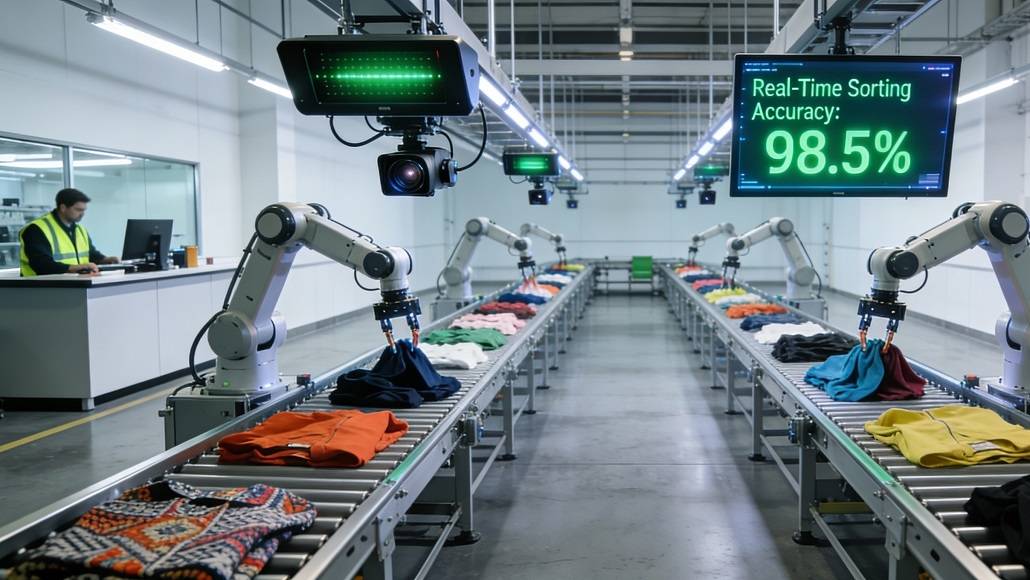
Integrated NIR-plus-vision systems achieve classification accuracy approaching 98%, far exceeding manual sorting capability. This accuracy translates directly to improved downstream processing outcomes and higher-quality recycled fiber output.
Robotic Material Handling
Once sorted into categories, textile materials must be physically moved transferred to appropriate processing lines, loaded into chemical reactors, staged for further processing. Robotic systems increasingly handle this material movement.
Robotic arms equipped with textile-gripping end-effectors can handle garments and fabric pieces with sufficient gentleness to avoid damage while providing speed and consistency exceeding manual handling. Modern textile-handling robots achieve speeds of 50-100 items per minute with positioning accuracy enabling precise placement.
Key advantage: robots operate 24/7 without fatigue, maintaining constant efficiency. Unlike human workers with fatigue, attention fluctuation, and shift-work limitations, robotic systems provide consistent throughput across full operating hours.
Sorting System Architecture and Integration
Contemporary textile recycling facilities integrate multiple technologies into coherent systems. Materials arriving at facility enter initial visual inspection where gross contamination is removed. Materials then proceed through NIR sorting systems where spectral data is captured and classified.
Classified materials drop into appropriately-labeled bins or conveyor lines directed toward specific processing pathways. Computer vision systems document condition and contamination. Materials requiring additional processing steps (stain removal, decontamination) are directed to appropriate stations; materials ready for direct recycling proceed to processing.
Throughout the facility, robotic systems handle material movement, reducing manual labor requirement significantly. A facility that historically required 20-30 manual sorters plus additional material handlers can now operate with 4-6 workers overseeing AI systems and handling exceptions.
Economic Impact and Cost Structure
Automation investment is substantial. A complete NIR + computer vision + robotic system for a facility processing 100 tons daily requires capital investment of approximately USD 5-8 million. This represents significant expense, historically limiting adoption to largest recycling facilities.
However, return on investment timeline is increasingly attractive. Through labor cost reduction alone, facilities achieve payback in 3-5 years. As automation capability improves and equipment cost declines (reflecting manufacturing scale), investment hurdle continues to lower. By 2027-2028, automation investments may achieve payback in 2-3 years.
Operational cost reduction from automation is substantial: 25-35% overall cost reduction compared to manual facilities. Labor cost reduction provides primary benefit; improved sorting accuracy reducing downstream processing problems provides secondary benefit.
Continuous Learning and Improvement
A critical advantage of AI-based systems: they improve continuously through machine learning. As systems process millions of textile items, classification algorithms are exposed to growing diversity of fiber types, colors, conditions, and blends. This exposure enables algorithm training and performance improvement.
Modern systems employ continuous learning protocols where operators can provide feedback when misclassifications occur. This feedback retrains algorithms improving future classification. Over time, system accuracy naturally improves approaching 97-99% as data accumulates.
This continuous improvement contrasts with manual sorting: human sorters’ performance plateaus after initial training; additional experience provides minimal accuracy improvement beyond proficiency threshold. AI systems demonstrate opposite trajectory: accuracy steadily improves throughout operational lifetime.
Emerging Capabilities: Advanced Contamination Detection
Beyond fiber identification, advanced AI systems now detect subtle contamination requiring post-consumer textile disposal. Oils, heavy metals, persistent organic pollutants, and microbial contamination can be detected through spectroscopic analysis combined with chemical sensor data.
Facilities employing advanced contamination detection prevent contaminated materials from entering recycling streams protecting downstream chemical processing from contamination complications and ensuring output material quality.
Workforce Transition and Skills Evolution
The automation trajectory necessarily implies reduction in manual sorting jobs a workforce challenge requiring policy attention and retraining programs. However, automation simultaneously creates new roles: system operators, technicians maintaining equipment, data scientists improving algorithms, and supervisory personnel overseeing automated processes.
Forward-looking facilities are implementing worker transition programs where manual sorters receive training in system operation and maintenance. Rather than job elimination, the transition is toward higher-skilled positions.
Geographic Implications and Infrastructure Development
AI automation’s capital requirement has traditionally concentrated textile recycling infrastructure in wealthy developed regions. As automation equipment cost declines and financing mechanisms improve, distribution should broaden geographically. Developing regions will progressively establish automated facilities even in secondary cities where labor cost advantage has historically been primary motivation.
This geographic diversification will shorten textile collection and processing logistics, reducing transportation impact and improving economic returns to regional communities.
Integration with Broader Industry 4.0 Evolution
Textile recycling automation is component of broader Industry 4.0 transformation affecting manufacturing globally. Internet-of-Things (IoT) sensors track material flow throughout facilities. Blockchain systems document material provenance and processing history. Digital twins of recycling facilities enable simulation and optimization.
These broader digital infrastructure elements increasingly integrate with textile sorting and processing automation, creating fully intelligent, transparent, data-driven recycling systems.
The Path to Unmanned Recycling Facilities
The ultimate trajectory of automation in textile recycling points toward largely unmanned facilities: materials enter, AI systems identify and sort, robotic systems handle material movement, chemical or mechanical processing proceeds, finished recycled fiber exits. Human supervision and maintenance occur, but direct labor requirement approaches near-zero.
This vision remains years away but is technically feasible. As automation technology matures and costs decline, unmanned textile recycling facilities will become operational reality, fundamentally restructuring recycling economics and geographic distribution.