
































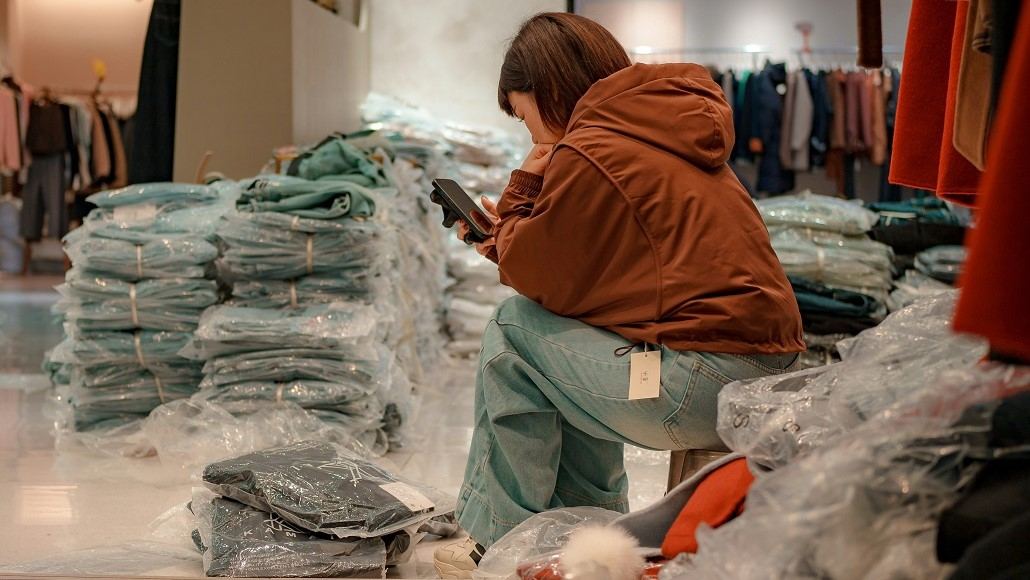

Wholesale distribution in fashion is experiencing a significant revival, underscored by new insights that reveal it has become the “most profitable” and “largest channel” for many brands.
Recent data from Joor, a fashion wholesale management platform, indicates that this resurgence is set to reshape the industry as we move into 2026. The platform analyzes exclusive transaction information from over 14,000 brands and more than 675,000 retail buyers across 150 countries. Their findings show that wholesale distribution in fashion has constituted 57% of total business for the brands surveyed.
Moreover, 52% of brand respondents identified wholesale as their most lucrative sales channel.
The report also highlights four additional trends anticipated to influence wholesale distribution in fashion over the next year:
Increased Focus on In-Season Buying
Retailers are prioritizing brands that can deliver products quickly, as data indicates a significant reduction in the average time from order placement to shipping—decreasing from 263 days in 2019 just 102 days in 2024. This trend toward shorter lead times is likely to continue as buyers increasingly favor in-season purchases.
Shift Toward Tighter Collections
The survey indicates a gradual decline in the proportion of brands releasing comprehensive new collections. Instead, those focusing on smaller capsule collections have surged from 19% to 37% over the last two years. Concurrently, evergreen and bestselling styles are becoming more significant, now representing 49% of gross merchandise value (GMV), up from 37% in 2019.
Growth of Independent Retail
Recent data shows that specialty shops and boutiques have increased their share of total wholesale transactions, rising from 49% in 2020 to 62% in 2025. Their impact is particularly strong in Europe, the Middle East, and Africa (EMEA), as well as the Asia Pacific (APAC) regions, where they account for 74% and 78% of total sales, respectively.
Expansion Driven by AI
Artificial intelligence is beginning to make waves in wholesale distribution. This momentum is expected to grow further in 2026 as AI evolves from a tool for operational efficiency to a driver of innovation and growth. The wholesale management ecosystem has integrated AI across several facets of its platform, enabling features like custom virtual modeling that reflect diverse body types, ages, and styles.
A Senior Vice President of Marketing stated: “2025 was a turbulent year with many economic factors and market conditions increasing the need for information and adaptability. Heading into 2026, the overarching theme for brands and retailers is to focus on agility and informed decision-making.
“The trends we’re seeing—from the resurgence of wholesale as a key driver of profitable growth to the dramatic shift toward in-season buying—demand that brands and retailers have a strategy built on real-time insights.”
With the anticipated transformations in wholesale distribution in fashion, brands are poised to explore avenues for engagement and success in a rapidly evolving marketplace.