
























India could build a multi‑billion‑dollar recycling economy around discarded textiles by the end of the decade, according to a new government-backed assessment that maps how waste moves through the country’s apparel and textile value chain and where investment could unlock higher circularity.
Released in New Delhi on 10 March 2026 by Union Minister of Textiles Giriraj Singh, the report Mapping of Textile Waste Value Chain in India estimates the India textile recycling market could be worth about $3.5bn by 2030. It also projects the sector has the capacity to generate around 100,000 new green jobs as collection systems, processing capacity and end markets for recycled fibres expand.
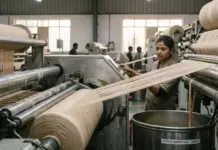
The document sets out the scale of India’s textile waste challenge, detailing how waste is generated, which recovery pathways currently dominate, and what technologies could raise the share of fibre-to-fibre recycling. Mechanical recycling still accounts for most textile waste processing today, but the report highlights chemical recycling as an emerging route that can recover fibres at the molecular level, potentially enabling true textile-to-textile loops for a wider range of materials.
How much textile waste India generates and where it comes from
According to the report, India produces roughly 7.07m tonnes of textile waste each year. It splits that figure into 42% pre-consumer waste generated before products reach consumers and 58% post-consumer waste from disposal after use.
Despite the large volumes, the report suggests recovery is already substantial. It says more than 70% of total textile waste is currently diverted through recycling, upcycling, downcycling and reuse.
Pre-consumer waste shows especially high recovery rates. The report estimates around 95% of pre-consumer textile waste is recovered, pointing to established networks and commercial incentives that keep factory offcuts and production scraps in circulation. It highlights the spinning sector as an illustration of what high recovery can look like at scale, stating that “nearly 100% of spinning waste” is reused directly in production, supported by consistent material quality and well-defined standards that make immediate reuse easier.
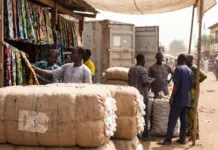
Post-consumer recovery is more uneven, but still meaningful. The report estimates about 55% of post-consumer textile waste is diverted from landfill, largely because of informal systems that collect, sort and redistribute used clothing and household textiles. It notes that this informal ecosystem supports between 4m and 4.5m livelihoods, with many roles held by women from marginalised backgrounds working in handling, sorting and resale.
Clusters, infrastructure and the role of Panipat
The report identifies Panipat, in Haryana, as a key hub for mechanical recycling activity, reflecting the concentration of skills and industrial capability in certain regions. It argues that expanding recycling infrastructure at a cluster level in major textile hubs could “significantly improve” overall efficiency by processing waste closer to where it is produced, reducing logistics costs and building stronger local supply chains for recycled inputs.
At the launch event, Singh described India’s textile sector as “one of the largest in the world,” adding that it has “significant potential” to help lead the global transition to more circular, sustainable production.
He said the report serves as a “data-driven blueprint” for turning textile waste into an economic resource positioning the India textile recycling market not only as an environmental necessity, but as a strategic industrial opportunity as the country scales circular manufacturing.