




























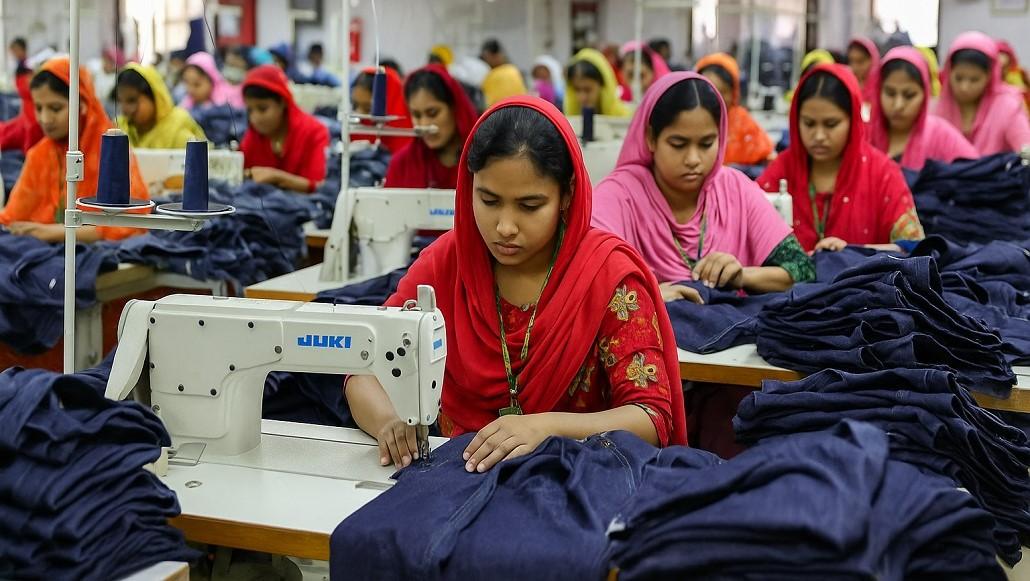
Bangladesh’s garment industry is asking the government to step in urgently to stabilise gas and electricity supply, warning that ongoing outages are already cutting factory output and threatening shipment reliability. The Bangladesh Garment Manufacturers and Exporters Association (BGMEA) said the Bangladesh garment energy crisis is forcing manufacturers to operate well below capacity and pushing up costs across the supply chain.
BGMEA president Mahmud Hasan Khan raised the issue in a meeting on 13 April 2026 with the Minister for Power, Energy and Mineral Resources, Iqbal Hasan Mahmud, and State Minister Anindya Islam Amit. The talks focused on energy disruptions that are interrupting production lines across the ready-made garment (RMG) sector.
Khan said factories are seeing production capacity reduced by roughly 25% to 30% because gas and power supplies are insufficient. He also urged policymakers to accelerate a shift toward renewable energy to reduce vulnerability to future shocks.
According to BGMEA, the impact is particularly acute in large industrial clusters such as Gazipur and Ashulia. During load shedding, many factories rely on generators, but the association said limited diesel availability is creating additional bottlenecks—compounding delays and disrupting production planning as well as shipment timelines.
The association also warned that the energy crunch is feeding directly into inflationary pressure for manufacturers. BGMEA said the crisis has contributed to rising raw material prices and higher transportation expenses, increasing overall production costs at a time when suppliers are under tight margin pressure.
BGMEA’s proposals for immediate relief
To address the short-term fuel bottleneck, BGMEA called for emergency arrangements to ensure faster diesel distribution via nearby filling stations. The association also requested additional gas connections and a more equitable distribution model, with an emphasis on supporting small and medium-sized factories particularly those with boiler capacity between 300 and 500 kilograms in industrial zones around Dhaka.
Among its infrastructure recommendations, BGMEA urged the rapid deployment of at least two additional floating storage and regasification units (FSRUs) to strengthen gas import capacity. It also asked the government to simplify installation procedures for electronic volume correctors (EVC), which are used to improve measurement and management of gas consumption in industrial operations.
On the cost side, BGMEA proposed removing import and consumer-level taxes and VAT on imported fuel, arguing that lowering the tax burden would reduce production costs while easing the need for government subsidies.
The association also pushed for policy support to help factories adopt cleaner power sources, proposing steep reductions to duties—currently ranging from 28.73% to 61.80%—on solar panels, inverters, DC cables and battery energy storage systems (BESS). BGMEA suggested lowering these duties to 1% to improve the economics of on-site renewable generation and storage.
Government response and Huawei visit
BGMEA said the two ministers reviewed its recommendations and indicated that “necessary measures” would be taken to respond to the disruption. The ministers also approved the association’s proposed framework to speed up diesel supply from filling stations one of the immediate operational constraints in the current Bangladesh garment energy crisis.
Separately, BGMEA said a delegation from Huawei Digital Power, led by Will Yu, managing director for South Asia Digital Power Business, met Mahmud Hasan Khan on 13 April. Huawei reportedly expressed interest in supporting the association through knowledge sharing and potential collaboration aimed at improving efficiency and sustainability across garment manufacturing.