


















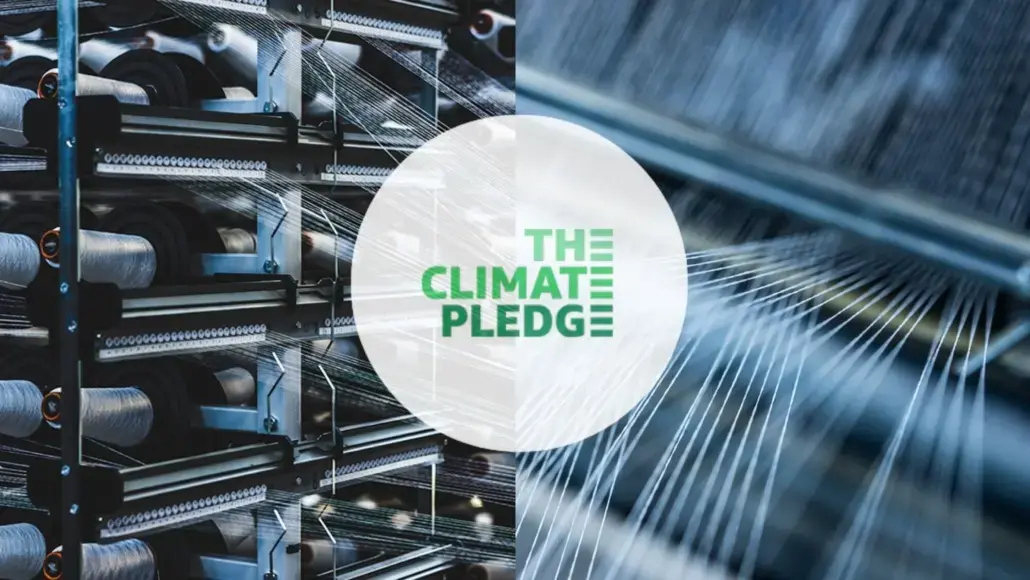
Amazon, Stella McCartney and Canopy have launched The Climate Pledge Fashion Coalition, bringing together fashion companies, retailers, manufacturers and material innovators to accelerate the adoption of lower-impact materials and production methods.
Supported by the World Economic Forum, the initiative brings together more than 60 Climate Pledge signatories from across the fashion value chain. Its objective is to build stronger demand for sustainable materials while helping companies work towards the wider Climate Pledge target of achieving net-zero carbon emissions by 2040.
The coalition will focus on addressing one of fashion’s key challenges: many lower-impact materials and production technologies are available but remain costly, limited in supply or difficult to scale commercially.
“Fashion has no shortage of ambition on sustainability. People are already looking for more sustainable options when they shop, and now the industry needs to deliver at scale,” said Kara Hurst, chief sustainability officer at Amazon. “Through The Climate Pledge, we’re bringing together more than 60 fashion and retail brands, manufacturers, and innovators to help make that happen.”
Scaling materials and manufacturing solutions
The initiative will concentrate on interventions earlier in the fashion supply chain rather than focusing only on waste and end-of-life management. Areas include recycled and next-generation fibres derived from waste feedstocks, alongside technologies designed to reduce water consumption, chemical use and emissions during manufacturing.
A central tool is the Fashion Coalition Lever Library, developed with input from more than 30 brands and suppliers. It provides access to more than 100 established and emerging solutions, fibre-specific guidance and information on companies developing next-generation materials.
The coalition is also working with the World Economic Forum on financing models that combine development finance with private investment. By aggregating demand from participating companies, the initiative aims to give material innovators and manufacturers greater certainty around future volumes and support the transition from pilot production to commercial scale.
“For over two decades, I’ve worked alongside innovators proving that fashion can be made differently,” said Stella McCartney, founder and creative director of Stella McCartney. “The solutions already exist. What’s been missing is the industry-wide commitment to help them scale. The Climate Pledge Fashion Coalition is about turning innovation into infrastructure, creating real demand for the next generation of materials, and giving the pioneers a pathway from breakthrough to industry standard.”
Building collective industry action
Fashion-focused participants include Anna Sui, Another Tomorrow, Bananatex, BioFluff, Brooks Running, Circ, DL1961, E.L.V Denim, Selfridges, unspun and Vestiaire Collective, among others.
“Making sustainable materials the default rather than the premium choice requires entire value chains to move together,“ said Clemence Schmid, head of Circular Economy Transformation and director of Global Plastic Action Partnership at World Economic Forum. “The Climate Pledge Fashion Coalition is designed to enable that alignment to ultimately increase the confidence that can unlock investment to scale. This is how we can accelerate adoption today, not a decade from now.”
The initiative builds on The Climate Pledge, co-founded by Amazon and Global Optimism in 2019. The wider pledge now has more than 700 signatories across more than 60 industries.
“Transitions of this scale don’t happen brand by brand—they happen when an industry moves together,” said Nicole Rycroft, founder and executive director of Canopy. “By diversifying fashion’s fiber basket with emerging next-generation materials, this coalition builds more resilient supply chains, reduces sourcing risk, and keeps vital forests standing.”
The coalition ultimately aims to help sustainable materials and processes reach greater commercial scale, which could gradually reduce their cost and expand their availability across fashion markets.