


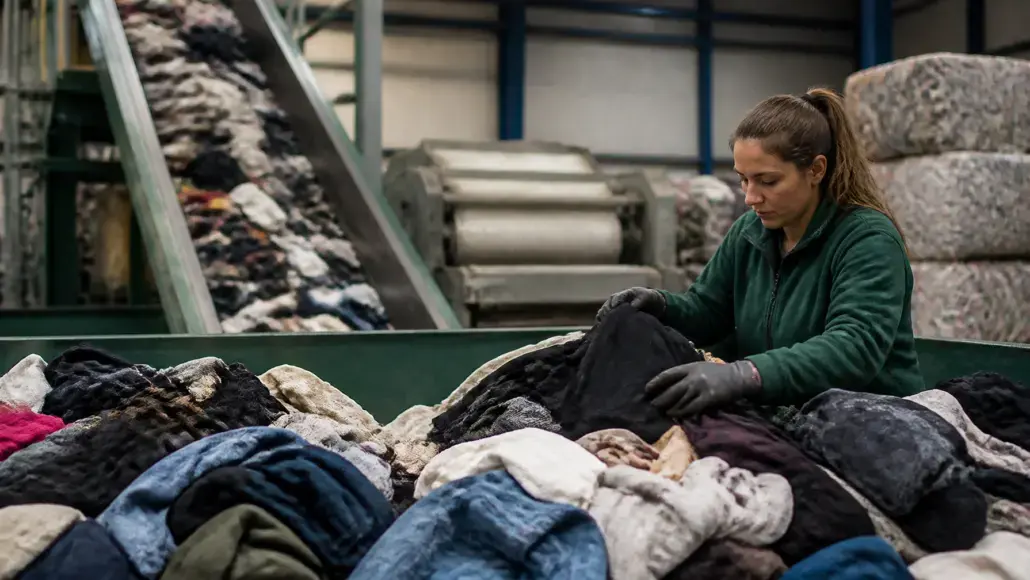
The United Kingdom discards approximately 711,000 tonnes of textiles every single year — a figure roughly equivalent to the combined weight of seven US aircraft carriers. While second-hand resale platforms are growing in popularity, the sheer volume of fabric ending up in landfill or incineration plants remains staggering. Now, two companies operating out of Peterborough and Northamptonshire are using advanced technology to redirect that waste back into the fashion supply chain — and they are drawing the attention of some of the world’s biggest brands.
Both firms are vocal about one thing: technology alone is not enough. Without stronger legislation and a shift in consumer behaviour, the pace of change will remain frustratingly slow.
Turning Old Clothes Into New Polyester in Kettering
Inside a warehouse near the A14 in Kettering, a steady stream of discarded fabric — dressing gowns, duvets, branded banners, and lanyards from events including the Commonwealth Games — is fed into industrial machinery. Every item is made from polyester, the world’s most widely used textile fibre, and every item has been thrown away.
Project Re:Claim, a partnership between The Salvation Army’s trading arm (SATCoL) and Plan B Circular, operates what it describes as the first commercial-scale polyester textile-to-textile recycling facility in Europe. The technology itself was adapted from bottle recycling processes.
Once collected by The Salvation Army, items that cannot be reused in their existing condition are shredded and melted down. Impurities, including dead skin cells and hair, are removed before the material is processed into recycled polyester pellets, known as rPET. These pellets can then be used to manufacture new garments.
“It’s the future: using the clothing we have today to make the clothing that we need tomorrow,” said Plan B Circular founder Tim Cross. “We process 500kg of fabric an hour but we could easily scale up if there was demand.”
The core challenge, Cross explains, is persuading clothing manufacturers to shift away from virgin polyester and instead incorporate recycled polyester sourced from old textiles — and to design new garments with end-of-life recyclability in mind. “A polyester blazer doesn’t need nylon buttons and labels. A sports top doesn’t need metal zips. It can all be polyester,” he said.
That point is not incidental. The facility can only process items that are entirely polyester. Mixed-fibre garments — polyester-cotton blends or items incorporating three or four different materials — remain a significant barrier.
The Mixed-Fibre Problem
“Most clothing is a fibre mix like polyester-cotton, or often three or four different materials,” said Majonne Frost, Head of Sustainability at SATCoL. Researchers are currently trialling fibre-separation techniques, but achieving this at commercial scale remains both technically difficult and costly. As a result, the majority of mixed-fibre textiles are ultimately destroyed.
Project Re:Claim states that its rPET requires 89% less carbon to produce compared to virgin polyester. The pellets are sent back to China in otherwise empty return shipping containers, where they are spun back into yarn. Pellets that do not meet the quality threshold for new garments are redirected into other products, such as car mats.
“We have the technology but we’re way behind with legislation. It absolutely should be driving the way we design and make clothing,” Cross said.
Peterborough’s Gen Phoenix: Reclaiming Leather Waste for Fashion and Aviation
While Project Re:Claim focuses on synthetic textiles, Peterborough-based Gen Phoenix has built its circular textile economy model around leather — specifically the offcuts and imperfect sections of animal hides that are discarded during conventional leather production.
The company recycles thousands of tonnes of leather waste annually into a new lower-carbon fabric. Its material has found its way into products from major brands including Dr Martens, Nike and Coach, as well as into the seating of trains, buses and commercial aircraft.
“Jet2 was our first commercial customer, and now we’re on one in every five commercial aircraft flying today,” said Chief Executive John Kennedy. “Our material has similar properties to traditional leather but with an 80% lower carbon footprint and it’s lighter. Weight is important for airlines. We’ve saved more than 18,000 tonnes of material from landfill.”
From Wet Blue to High-Performance Fabric
Leather itself is a by-product of the food industry, yet substantial quantities of it are still wasted. Gen Phoenix targets the sections of animal hides that do not produce high-quality finished leather — the neck, shoulders, belly and similar areas.
The company imports this waste material in its partially processed state, known in the industry as “wet blue,” from tanneries around the world. Senior Director of Research and Technology Richard Peace explains the manufacturing process: the leather is broken down into a fibre fluff, which is then sprayed onto thin sheets of tissue paper. These sheets are layered around a core fabric — typically recycled polyester — before high-powered water jets bind all the components together.
This technique, called hydro-entanglement, creates the new fabric without the use of resin binders, which makes the resulting product more amenable to recycling at the end of its life. The leather recycling process, the company says, reduces carbon output by 80% compared to conventional leather production, while keeping thousands of tonnes of waste out of landfill each year.
Consumer Attitudes and Legislation Are Shifting
Kennedy acknowledges that the conditions driving demand for sustainable materials are gradually improving. “The importance of sustainability is seeing a groundswell, both in terms of legislation and consumer attitude — especially with Gen Z coming through,” he said. “Brands are definitely more invested and are being fairly quiet about the great work they’re doing.”
He added that Gen Phoenix is continuing to develop its processes, including exploring the recycling of end-process leather, and that all manufacturing and research and development activity takes place at its Peterborough facility.
The Legislative Gap
Both firms point to legislation as a critical missing piece. New European Union rules are already forcing manufacturers to reduce waste, lower their environmental impact and move toward a circular model — requiring that products are not only made from recycled content but are also themselves recyclable at the end of their lives.
In the United Kingdom, the picture is less prescriptive. The Department for Environment, Food and Rural Affairs (Defra) states it is funding the UK Textiles Pact, which sets targets to cut waste and extend the lifecycle of materials. However, participation in the scheme remains voluntary. Defra has also indicated that a taskforce of experts and businesses is examining options for reducing textile waste in homes and businesses, with a report on next steps expected later in the year.
For companies like Project Re:Claim and Gen Phoenix, voluntary targets and future taskforce reports fall short of what is needed. The technology for textile waste recycling exists and is operating at scale. What is lagging, they argue, is the regulatory framework that would compel the fashion and manufacturing industries to use it.

